• Produktbild: Policy and Gay, Lesbian, Bisexual, Transgender and Intersex Students
  • Produktbild: Policy and Gay, Lesbian, Bisexual, Transgender and Intersex Students
Band 6

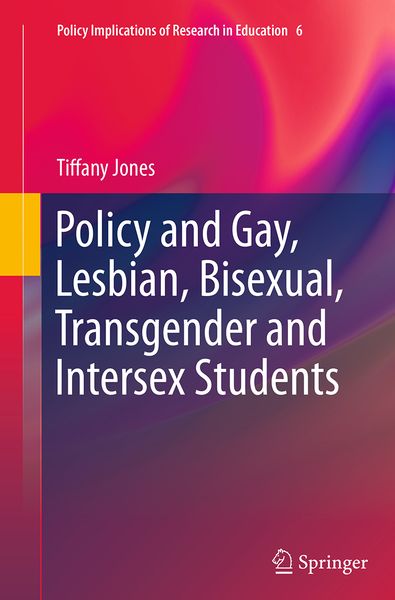
Policy and Gay, Lesbian, Bisexual, Transgender and Intersex Students

Fr. 73.90

inkl. gesetzl. MwSt., Versandkostenfrei


Beschreibung

Produktdetails

Einband

Taschenbuch

Erscheinungsdatum

23.08.2016

Abbildungen

XV, 19 illus., 18 illus. in color., schwarz-weiss Illustrationen, farbige Illustrationen

Verlag

Springer

Seitenzahl

158

Maße (L/B/H)

23.5/15.5/1 cm

Gewicht

277 g

Auflage

Softcover reprint of the original 1st edition 2015

Sprache

Englisch

ISBN

978-3-319-38141-1

Beschreibung

Rezension

"From her work with UNESCO, Dr Tiffany Jones is qualified to write with authority about GLBTIQ policy. The book's promise to problematize the power of policy provides a much needed perspective on international and Australian GLBTIQ policy, interrogating the assumption that GLBTIQ policy is an unquestioned good. The topic is clearly timely and the international focus is important given the contemporary and widely varying discourses and actions surrounding the rights of GLBTIQ individuals and groups across the globe. The use of Australian as a particular case study is also wise as moving between the general to the particular can be daunting without some sort of specific grounding in geographical context. Australia provides that grounding so that Dr. Jones can move her examination of policy across the international through Australia to particular schools and individuals. In contested social issues and conditions, such as those surrounding issues of GLBTIQ rights and sexuality education, the chance to hear the voices of those for whom policy is intended is the most powerful. This book will appeal to both policymakers and academics."

Professor Kathleen M. Brown
Professor of Educational Leadership, UNC School of Education

"This book is a very exciting and important project that examines extensively the policy issues surrounding GLBTIQ policy issues, and a very thorough study of policy efficacy. It will appeal to university professors, researchers who study policy or GLBTIQ issues, policy analysts, international scholars, law-makers. I'm very impressed. I look forward to buying thebook!"

Professor Charol Shakeshaft
Professor and Chair of the Department of Education Leadership, Virginia Commonwealth University

Produktdetails

Einband

Taschenbuch

Erscheinungsdatum

23.08.2016

Abbildungen

XV, 19 illus., 18 illus. in color., schwarz-weiss Illustrationen, farbige Illustrationen

Verlag

Springer

Seitenzahl

158

Maße (L/B/H)

23.5/15.5/1 cm

Gewicht

277 g

Auflage

Softcover reprint of the original 1st edition 2015

Sprache

Englisch

ISBN

978-3-319-38141-1

Herstelleradresse

Springer-Verlag GmbH
Tiergartenstr. 17
69121 Heidelberg
DE

Email: ProductSafety@springernature.com

Kundinnen und Kunden meinen

0 Bewertungen

Informationen zu Bewertungen

Zur Abgabe einer Bewertung ist eine Anmeldung im Konto notwendig. Die Authentizität der Bewertungen wird von uns nicht überprüft. Wir behalten uns vor, Bewertungstexte, die unseren Richtlinien widersprechen, entsprechend zu kürzen oder zu löschen.

Die Bewertungen sind nach Format, Anzahl Sterne und Datum sortiert.

Verfassen Sie die erste Bewertung zu diesem Artikel

Helfen Sie anderen Kund*innen durch Ihre Meinung

Kundinnen und Kunden meinen

0 Bewertungen filtern

  • Produktbild: Policy and Gay, Lesbian, Bisexual, Transgender and Intersex Students
  • Produktbild: Policy and Gay, Lesbian, Bisexual, Transgender and Intersex Students
  • Acknowledgements.- Glossary.- Symbols & Abbreviations.- Chapter One: Why is Policy Presumed Powerful?- 1.1 Introduction.- 1.2 Why a Policy Book?- 1.2.1 A policy push.-1.2.2 Presuppositions around policy’s power.- 1.3 What this Book Covers.- 1.3.1 How the ‘GLBTIQ’ acronym is used.- 1.3.2 How ‘sexuality’ and ‘sexuality education’ are used.- 1.3.3 Why secondary schooling?- 1.4 What is Policy, Anyway?- 1.4.1 Policy and power.- 1.4.2 Policy as discursive.- 1.4.3 Discourse and power.- 1.5 Conclusion.- Chapter Two: GLBTIQ Students; What’s the Problem?- 2.1 Introduction.- 2.11 Research on GLBTIQ students.- 2.12 Research gaps.- 2.2 ‘GLBTIQ Student’ Constructions are Discursive.- 2.3 Discourse Exemplars.- 2.4 Orientation-based Sexuality Education Discourse Exemplar.- 2.4.1 Conservative.- 2.4.2 Liberal.- 2.4.3 Critical.- 2.4.4 Post-modern.- 2.5 Conclusion.- Chapter Three: Studying Policy Impacts.- 3.1 Introduction.- 3.2 Methodology: Critical Discourse Analysis.- 3.1.1 Adaptation of CDA.- 3.1.2 Post-modern approach to description stage.- 3.1.3 Both core and innovative techniques.- 3.3 Research procedures.- 3.3.1 Data sources and collection methods.- 3.3.2 Source One: policies – textual analysis.- 3.3.3 Source Two: key informant interviews.- 3.3.4 Source Three: survey data – quantitative and qualitative analysis.- 3.4 Data analysis.- 3.4.1 Leximancer analysis of policy documents.- 3.4.2 Fairclough’s 10 CDA questions.- 3.4.3 Visual CDA techniques.- 3.4.4 Fairclough’s analysis of discursive practices.- 3.5 Ethical considerations.- 3.6 Conclusion.- Chapter Four:  How do Australian Policies Treat GLBTIQ Students?- 4.1 Introduction.- 4.2 Mapping the policy terrain – overview of the corpus.- 4.2.1 National policies: inclusion in principle.- 4.2.2 The policy states of the nation.- 4.2.3 Conclusions about policydiscourses.- 4.3 Constructions of GLBTIQ students in key policies.- 4.3.1 National: part of the general diversity.- 4.3.2 NSW: Protected victims, potential complainants.- 4.3.3 QLD: Interpretively included, or not needy enough.- 4.3.4 Victoria: DEECD: Protected needy ‘at risk’ victims.- 4.3.5 Conclusions about how constructions function.- 4.4 Conclusion.- Chapter Five: Which Policies Are Useful?- 5.1 Introduction.- 5.2 Australian GLBTIQ students.- 5.3 Usefulness of policies in enhancing school level policy protection.- 5.3.1 National.- 5.3.2 State level.- 5.4 Usefulness of policies in increasing the purchase of affirming discourses.- 5.4.1 National.- 5.4.2 State level.- 5.4.3 School level.- 5.5 Usefulness of policies in encouraging support features.- 5.5.1 National.- 5.5.2 State level.- 5.5.3 School level.- 5.6 Usefulness of policies in encouraging supportive school climates.- 5.6.1 National.- 5.6.2 State level.- 5.6.3 School level.- 5.7 Conclusion.- Chapter Six: Conclusions & Outcomes.- 6.1 Discussion of findings.- 6.1.1 Policy positions: paucity AND polyvalence.- 6.1.2 Policy’s uses and usefulness.- 6.1.3 Policy’s presumed powers.- 6.2 Conclusions.- 6.2.1 Preferable policy positions.- 6.2.2 Useful policies.- 6.2.3 Policies with enhanced powers.- 6.2.4 Limitations.- 6.3 Implications.- 6.3.1 For education bodies and policy makers.- 6.3.2 For policy advocates and activists.- 6.3.3 For school staff.- 6.3.4 For teacher educators.- 6.3.5 For students.- 6.3.6 For academics.- 6.4 Outcomes.- 6.4.1 Brief overview of dissemination.- 6.4.2 International and national outcomes.- 6.4.3 State-specific outcomes.- 6.5 Conclusion.