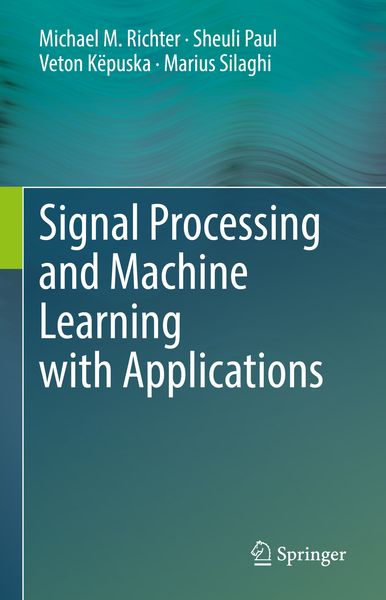
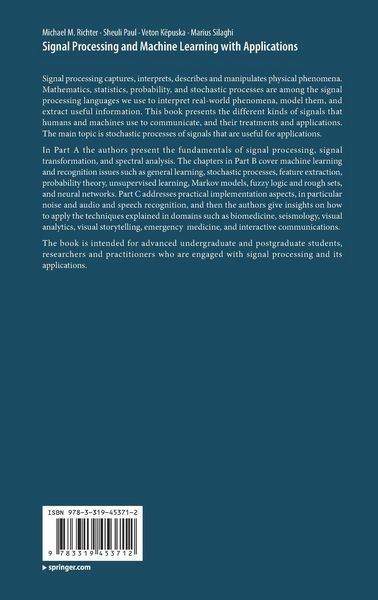
• Produktbild: Signal Processing and Machine Learning with Applications
  • Produktbild: Signal Processing and Machine Learning with Applications

Signal Processing and Machine Learning with Applications

Fr. 81.90

inkl. gesetzl. MwSt., Versandkostenfrei


Beschreibung

Produktdetails

Einband

Gebundene Ausgabe

Erscheinungsdatum

01.10.2022

Abbildungen

XLI, 300 illus., 237 illus. in color., schwarz-weiss Illustrationen, farbige Illustrationen

Verlag

Springer

Seitenzahl

607

Maße (L/B/H)

24.1/16/4.1 cm

Gewicht

1084 g

Auflage

1st ed. 2022

Sprache

Englisch

ISBN

978-3-319-45371-2

Beschreibung

Produktdetails

Einband

Gebundene Ausgabe

Erscheinungsdatum

01.10.2022

Abbildungen

XLI, 300 illus., 237 illus. in color., schwarz-weiss Illustrationen, farbige Illustrationen

Verlag

Springer

Seitenzahl

607

Maße (L/B/H)

24.1/16/4.1 cm

Gewicht

1084 g

Auflage

1st ed. 2022

Sprache

Englisch

ISBN

978-3-319-45371-2

Herstelleradresse

Springer-Verlag GmbH
Tiergartenstr. 17
69121 Heidelberg
DE

Email: ProductSafety@springernature.com

Kundinnen und Kunden meinen

0 Bewertungen

Informationen zu Bewertungen

Zur Abgabe einer Bewertung ist eine Anmeldung im Konto notwendig. Die Authentizität der Bewertungen wird von uns nicht überprüft. Wir behalten uns vor, Bewertungstexte, die unseren Richtlinien widersprechen, entsprechend zu kürzen oder zu löschen.

Die Bewertungen sind nach Format, Anzahl Sterne und Datum sortiert.

Verfassen Sie die erste Bewertung zu diesem Artikel

Helfen Sie anderen Kund*innen durch Ihre Meinung

Kundinnen und Kunden meinen

0 Bewertungen filtern

  • Produktbild: Signal Processing and Machine Learning with Applications
  • Produktbild: Signal Processing and Machine Learning with Applications
  • Part I Realms of Signal Processing

    1 Digital Signal Representation

    1.1 Introduction

    1.2 Numbers

    1.2.1 Numbers and Numerals

    1.2.2 Types of Numbers

    1.2.3 Positional Number Systems

    1.3 Sampling and Reconstruction of Signals

    1.3.1 Scalar Quantization

    1.3.2 Quantization Noise

    1.3.3 Signal-To-Noise Ratio

    1.3.4 Transmission Rate

    1.3.5 Nonuniform Quantizer

    1.3.6 Companding

    1.4 Data Representations

    1.4.1 Fixed-Point Number Representations

    1.4.2 Sign-Magnitude Format

    1.4.3 One’s-Complement Format

    1.4.4 Two’s-Complement Format

    1.5 Fix-Point DSP’s

    1.6 Fixed-Point Representations Based on Radix-Point

    1.7 Dynamic Range

    1.8 Precision

    1.9 Background Information

    1.10 Exercises

    2 Signal Processing Background

    2.1 Basic Concepts

    2.2 Signals and Information

    2.3 Signal Processing

    ix

    x Contents

    2.4 Discrete Signal Representations

    2.5 Delta and Impulse Function

    2.6 Parseval’s Theorem

    2.7 Gibbs Phenomenon

    2.8 Wold Decomposition

    2.9 State Space Signal Processing

    2.10 Common Measurements

    2.10.1 Convolution

    2.10.2 Correlation

    2.10.3 Auto Covariance

    2.10.4 Coherence

    2.10.5 Power Spectral Density (PSD)

    2.10.6 Estimation and Detection

    2.10.7 Central Limit Theorem

    2.10.8 Signal Information Processing Types

    2.10.9 Machine Learning

    2.10.10Exercises

    3 Fundamentals of Signal Transformations

    3.1 Transformation Methods

    3.1.1 Laplace Transform

    3.1.2 Z-Transform

    3.1.3 Fourier Series

    3.1.4 Fourier Transform

    3.1.5 Discrete Fourier Transform and Fast Fourier Transform

    3.1.6 Zero Padding

    3.1.7 Overlap-Add and Overlap-Save Convolution

    Algorithms

    3.1.8 Short Time Fourier Transform (STFT)

    3.1.9 Wavelet Transform

    3.1.10 Windowing Signal and the DCT Transforms

    3.2 Analysis and Comparison of Transformations

    3.3 Background Information

    3.4 Exercises

    3.5 References

    4 Digital Filters

    4.1 Introduction

    4.1.1 FIR and IIR Filters

    4.1.2 Bilinear Transform

    4.2 Windowing for Filtering

    4.3 Allpass Filters

    4.4 Lattice Filters

    4.5 All-Zero Lattice Filter

    4.6 Lattice Ladder Filters

    Contents xi

    4.7 Comb Filter

    4.8 Notch Filter

    4.9 Background Information

    4.10 Exercises

    5 Estimation and Detection

    5.1 Introduction

    5.2 Hypothesis Testing

    5.2.1 Bayesian Hypothesis Testing

    5.2.2 MAP Hypothesis Testing

    5.3 Maximum Likelihood (ML) Hypothesis Testing

    5.4 Standard Analysis Techniques

    5.4.1 Best Linear Unbiased Estimator (BLUE)

    5.4.2 Maximum Likelihood Estimator (MLE)

    5.4.3 Least Squares Estimator (LSE)

    5.4.4 Linear Minimum Mean Square Error Estimator

    (LMMSE)

    5.5 Exercises

    6 Adaptive Signal Processing

    6.1 Introduction

    6.2 Parametric Signal Modeling

    6.2.1 Parametric Estimation

    6.3 Wiener Filtering

    6.4 Kalman Filter

    6.4.1 Smoothing

    6.5 Particle Filter

    6.6 Fundamentals of Monte Carl

    6.6.1 Importance Sampling (IS)

    6.7 Non-Parametric Signal Modeling

    6.8 Non-Parametric Estimation

    6.8.1 Correlogram

    6.8.2 Periodogram

    6.9 Filter Bank Method

    6.10 Quadrature Mirror Filter Bank (QMF)

    6.11 Background Information

    6.12 Exercises

    7 Spectral Analysis

    7.1 Introduction

    7.2 Adaptive Spectral Analysis

    7.3 Multivariate Signal Processing

    7.3.1 Sub-band Coding and Subspace Analysis

    7.4 Wavelet Analysis

    7.5 Adaptive Beam Forming

    xii Contents

    7.6 Independent Component Analysis (ICA)

    7.7 Principal Component Analysis (PCA)

    7.8 Best Basis Algorithms

    7.9 Background Information

    7.10 Exercises

    Part II Machine Learning and Recognition

    8 General Learning

    8.1 Introduction to Learning

    8.2 The Learning Phases

    8.2.1 Search and Utility

    8.3 Search

    8.3.1 General Search Model

    8.3.2 Preference relations

    8.3.3 Different learning methods

    8.3.4 Similarities

    8.3.5 Learning to Recognize

    8.3.6 Learning again

    8.4 Background Information

    8.5 Exercises

    9 Signal Processes, Learning, and Recognition

    9.1 Learning

    9.2 Bayesian Formalism

    9.2.1 Dynamic Bayesian Theory

    9.2.2 Recognition and Search

    9.2.3 Influences

    9.3 Subjectivity

    9.4 Background Information

    9.5 Exercises

    10 Stochastic Processes

    10.1 Preliminaries on Probabilities

    10.2 Basic Concepts of Stochastic Processes

    10.2.1 Markov Processes

    10.2.2 Hidden Stochastic Models (HSM)

    10.2.3 HSM Topology

    10.2.4 Learning Probabilities

    10.2.5 Re-estimation

    10.2.6 Redundancy

    10.2.7 Data Preparation

    10.2.8 Proper Redundancy Removal

    10.3 Envelope Detection

    10.3.1 Silence Threshold Selection

    10.3.2 Pre-emphasis

    Contents xiii

    10.4 Several Processes

    10.4.1 Similarity

    10.4.2 The Local-Global Principle

    10.4.3 HSM Similarities

    10.5 Conflict and Support

    10.6 Examples and Applications

    10.7 Predictions

    10.8 Background Information

    10.9 Exercises

    11 Feature Extraction

    11.1 Feature Extractions

    11.2 Basic Techniques

    11.2.1 Spectral Shaping

    11.3 Spectral Analysis and Feature Transformation

    11.3.1 Parametric Feature Transformations and Cepstrum

    11.3.2 Standard Feature Extraction Techniques

    11.3.3 Frame Energy

    11.4 Linear Prediction Coe_cients (LPC)

    11.5 Linear Prediction Cepstral Coe_cients (LPCC)

    11.6 Adaptive Perceptual Local Trigonometric Transformation

    (APLTT)

    11.7 Search

    11.7.1 General Search Model

    11.8 Predictions

    11.8.1 Purpose

    11.8.2 Linear Prediction

    11.8.3 Mean Squared Error Minimization

    11.8.4 Computation of Probability of an Observation Sequence

    11.8.5 Forward and Backward Prediction

    11.8.6 Forward-Backward Prediction

    11.9 Background Information

    11.10Exercises

    12 Unsupervised Learning

    12.1 Generalities

    12.2 Clustering Principles

    12.3 Cluster Analysis Methods

    12.4 Special Methods

    12.4.1 K-means

    12.4.2 Vector Quantization (VQ)

    12.4.3 Expectation Maximization (EM)

    12.4.4 GMM Clustering

    12.5 Background Information

    12.6 Exercises

    xiv Contents

    13 Markov Model and Hidden Stochastic Model

    13.1 Markov Process

    13.2 Gaussian Mixture Model (GMM)

    13.3 Advantages of using GMM

    13.4 Linear Prediction Analysis

    13.4.1 Autocorrelation Method

    13.4.2 Yule-Walker Approach

    13.4.3 Covariance Method

    13.4.4 Comparison of Correlation and Covariance methods

    13.5 The ULS Approach

    13.6 Comparison of ULS and Covariance Methods

    13.7 Forward Prediction

    13.8 Backward Prediction

    13.9 Forward-Backward Prediction

    13.10Baum-Welch Algorithm

    13.11Viterbi Algorithm

    13.12Background Information

    13.13Exercises

    14 Fuzzy Logic and Rough Sets

    14.1 Rough Sets

    14.2 Fuzzy Sets

    14.2.1 Basis Elements

    14.2.2 Possibility and Necessity

    14.3 Fuzzy Clustering

    14.4 Fuzzy Probabilities

    14.5 Background Information

    14.6 Exercises

    15 Neural Networks

    15.1 Neural Network Types

    15.1.1 Neural Network Training

    15.1.2 Neural Network Topology

    15.2 Parallel Distributed Processing

    15.2.1 Forward and Backward Uses

    15.2.2 Learning

    15.3 Applications to Signal Processing

    15.4 Background Information

    15.5 Exercises

    Part III Real Aspects and Applications

    Contents xv

    16 Noisy Signals

    16.1 Introduction

    16.2 Noise Questions

    16.3 Sources of Noise

    16.4 Noise Measurement

    16.5 Weights and A-Weights

    16.6 Signal to Noise Ratio (SNR)

    16.7 Noise Measuring Filters and Evaluation

    16.8 Types of noise

    16.9 Origin of noises

    16.10Box Plot Evaluation

    16.11Individual noise types

    16.11.1Residual

    16.11.2Mild

    16.11.3Steady-unsteady Time varying Noise

    16.11.4Strong Noise

    16.12Solution to Strong Noise: Matched Filter

    16.13Background Information

    16.14Exercises

    17 Reasoning Methods and Noise Removal

    17.1 Generalities

    17.2 Special Noise Removal Methods

    17.2.1 Residual Noise

    17.2.2 Mild Noise

    17.2.3 Steady-Unsteady Noise

    17.2.4 Strong Noise

    17.3 Poisson Distribution

    17.3.1 Outliers and Shots

    17.3.2 Underlying probability of Shots

    17.4 Kalman Filter

    17.4.1 Prediction Estimates

    17.4.2 White noise Kalman filtering

    17.4.3 Application of Kalman filter

    17.5 Classification, Recognition and Learning

    17.5.1 Summary of the used concepts

    17.6 Principle Component Analysis (PCA)

    17.7 Reasoning Methods

    17.7.1 Case-Based Reasoning (CBR)

    17.8 Background Information

    17.9 Exercises

    xvi Contents

    18 Audio Signals and Speech Recognition

    18.1 Generalities of Speech

    18.2 Categories of Speech Recognition

    18.3 Automatic Speech Recognition

    18.3.1 System Structure

    18.4 Speech Production Model

    18.5 Acoustics

    18.6 Human Speech Production

    18.6.1 The Human Speech Generation

    18.6.2 Excitation

    18.6.3 Voiced Speech

    18.6.4 Unvoiced Speech

    18.7 Silence Regions

    18.8 Glottis

    18.9 Lips

    18.10Plosive Speech Source

    18.11Vocal-Tract

    18.12Parametric and Non-Parametric Models

    18.13Formants

    18.14Strong Noise

    18.15Background Information

    18.16Exercises

    19 Noisy Speech

    19.1 Introduction

    19.2 Colored Noise

    19.2.1 Additional types of Colored Noise

    19.3 Poisson Processes and Shots

    19.4 Matched Filters

    19.5 Shot Noise

    19.6 Background Information

    19.7 Exercises

    20 Aspects Of Human Hearing

    20.1 Human Ear

    20.2 Human Auditory System

    20.3 Critical Bands and Scales

    20.3.1 Mel Scale

    20.3.2 Bark Scale

    20.3.3 Erb Scale

    20.3.4 Greenwood Scale

    20.4 Filter Banks

    20.4.1 ICA Network

    20.4.2 Auditory Filter Banks

    20.4.3 Filter Banks

    Contents xvii

    20.4.4 Mel Critical Filter Bank

    20.5 Psycho-acoustic Phenomena

    20.5.1 Perceptual Measurement

    20.5.2 Human Hearing and Perception

    20.5.3 Sound Pressure Level (SPL)

    20.5.4 Absolute Threshold of Hearing (ATH)

    20.6 Perceptual Adaptation

    20.7 Auditory System and Hearing Model

    20.8 Auditory Masking and Masking Frequency

    20.9 Perceptual Spectral Features

    20.10Critical Band Analysis

    20.11Equal Loudness Pre-emphasis

    20.12Perceptual Transformation

    20.13Feature Transformation

    20.14Filters and Human Ear

    20.15Temporal Aspects

    20.16Background Information

    20.17Exercises

    21 Speech Features

    21.1 Generalities

    21.2 Cost Functions

    21.3 Special Feature Extractions

    21.3.1 MFCC Features

    21.3.2 Feature Transformation applying DCT

    21.4 Background Information

    21.5 Exercises

    22 Hidden Stochastic Model for Speech

    22.1 General

    22.2 Hidden Stochastic Model

    22.3 Forward and Backward Predictions

    22.3.1 Forward Algorithm

    22.3.2 Backward Algorithm

    22.4 Forward-Backward Prediction

    22.5 Burg Approach

    22.6 Graph Search

    22.6.1 Recognition Model with Search

    22.7 Semantic Issues and Industrial Applications

    22.8 Problems with Noise

    22.9 Aspects of Music

    22.10Music reception

    22.11Background Information

    22.12Exercises

    xviii Contents

    23 Different Speech Applications – Part A

    23.1 Generalities

    23.2 Example Applications

    23.2.1 Experimental laboratory

    23.2.2 Health care support (everyday actions)

    23.2.3 Diagnostic support for persons with possible dementia

    23.2.4 Noise

    23.3 Background Information

    23.4 Exercises

    24 Different Speech Applications – Part B

    24.1 Introduction

    24.2 Discrete-Time Signals

    24.3 Speech Processing

    24.3.1 Framing

    24.3.2 Pre-emphasis

    24.3.3 Windowing

    24.3.4 Fourier Transform

    24.3.5 Mel-Filtering

    24.3.6 Mel-Frequency Cepstral Coeffcients

    24.4 Speech Analysis and Sound Effects Laboratory (SASE_Lab)

    24.5 Wake-Up-Word Speech Recognition

    24.5.1 Introduction

    24.5.2 Wake-up-Word Paradigm

    24.5.3 Wake-Up-Word: Definition

    24.5.4 Wake-Up-Word System

    24.5.5 Front-End of the Wake-Up-Word System

    24.6 Conclusion

    24.6.1 Wake-Up-Word: Tool Demo

    24.6.2 Elevator Simulator

    24.7 Background Information

    24.8 Exercises

    24.9 Speech Analysis and Sound E_ects Laboratory (SASE_Lab)"

    25 Biomedical Signals: ECG, EEG

    25.1 ECG signals

    25.1.1 Bioelectric Signals

    25.1.2 Noise

    25.2 EEG Signals

    25.2.1 General properties

    25.2.2 Signal types and properties

    25.2.3 Disadvantages

    25.3 Neural Network use

    25.4 Major Research Questions

    25.5 Background Information

    Contents xix

    25.6 Exercises

    26 Seismic Signals

    26.1 Generalities

    26.2 Sources of seismic signals

    26.3 Intermediate elements

    26.4 Practical Data Sources

    26.5 Major seismic problems

    26.6 Noise

    26.7 Background Information

    26.8 Exercises

    27 Radar Signals

    27.1 Introduction

    27.2 Radar Types and Applications

    27.3 Doppler Equations, Ambiguity Function(AF) and Matched

    Filter

    27.4 Moving Target Detection

    27.5 Applications and Discussions

    27.6 Examples

    27.7 Background Information

    27.8 Exercises

    28 Visual Story Telling

    28.1 Introduction

    28.1.1 Common Visualization Approaches

    28.2 Analytics and Visualization

    28.2.1 Visualization

    28.2.2 Visual Data Minin

    28.3 Communication and Visualization

    28.4 Background Information

    28.5 Exercises

    29 Digital Processes and Multimedia

    29.1 Images

    29.1.1 Digital Image Processing

    29.1.2 Images as Matrices

    29.1.3 Gray Scale Images

    29.2 Spatial Filtering

    29.2.1 Linear Filtering of Images

    29.2.2 Separable Filters

    29.2.3 Mechanics of Linear Spatial Filtering Operation

    29.3 Median Filtering

    29.4 Color Equalization

    29.4.1 Image Transformations

    29.4.2 Examples of Image Transformation Matrixes

    xx Contents

    29.5 Basic Image Statistics

    29.6 Abstraction Levels of Images and its Representations

    29.6.1 Lowest Level

    29.6.2 Geometric Level

    29.6.3 Domain Level

    29.6.4 Segmentation

    29.7 Background Information

    29.8 Exercises

    30 Visualizations of Emergency Operation Centre

    30.1 Introduction

    30.2 Communications in Emergency Situations

    30.3 Emergency Scenario

    30.3.1 Classification and EOC Scenario

    30.4 Technical Aspects and Techniques

    30.4.1 Classification

    30.4.2 Clustering

    30.5 Background Information

    30.6 Exercises

    31 Intelligent Interactive Communications

    31.1 Introduction

    31.2 Spoken Dialogue System

    31.3 Gesture based Interaction

    31.4 Object Recognition and Identification

    31.5 Visual Story Telling

    31.6 Virtual Environment for Personal Assistance

    31.7 Sensor Fusion

    31.8 Intelligent Human Machine for Communication

    Application Scenario

    31.9 Background Information

    31.10Exercises

    32 Comparisons

    32.1 Generalities

    32.1.1 EEG and ECG

    32.1.2 Speech and biomedical applications

    32.1.3 Seismic and biomedical signals

    32.1.4 Speech and Images

    32.2 Overall

    32.3 Background Information

    32.3.1 General

    32.4 Exercises

    Glossary