KI-Beratung Beta

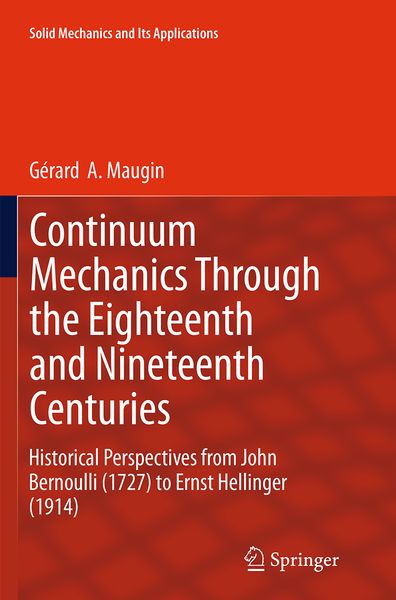
  • Produktbild: Continuum Mechanics Through the Eighteenth and Nineteenth Centuries
  • Produktbild: Continuum Mechanics Through the Eighteenth and Nineteenth Centuries
Band 214

Continuum Mechanics Through the Eighteenth and Nineteenth Centuries Historical Perspectives from John Bernoulli (1727) to Ernst Hellinger (1914)

Fr. 138.00

inkl. gesetzl. MwSt., Versandkostenfrei


Beschreibung

Conceived as a series of more or less autonomous essays, the present book critically exposes the initial developments of continuum thermo-mechanics in a post Newtonian period extending from the creative works of the Bernoullis to the First World war, i.e., roughly during first the “Age of reason” and...

Beschreibung

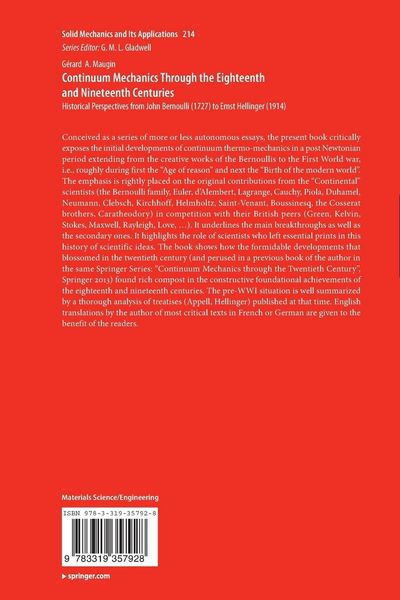
Conceived as a series of more or less autonomous essays, the present book critically exposes the initial developments of continuum thermo-mechanics in a post Newtonian period extending from the creative works of the Bernoullis to the First World war, i.e., roughly during first the “Age of reason” and next the “Birth of the modern world”. The emphasis is rightly placed on the original contributions from the “Continental” scientists (the Bernoulli family, Euler, d’Alembert, Lagrange, Cauchy, Piola, Duhamel, Neumann, Clebsch, Kirchhoff, Helmholtz, Saint-Venant, Boussinesq, the Cosserat brothers, Caratheodory) in competition with their British peers (Green, Kelvin, Stokes, Maxwell, Rayleigh, Love,..). It underlines the main breakthroughs as well as the secondary ones. It highlights the role of scientists who left essential prints in this history of scientific ideas. The book shows how the formidable developments that blossomed in the twentieth century (and perused in a previous book of the author in the same Springer Series: “Continuum Mechanics through the Twentieth Century”, Springer 2013) found rich compost in the constructive foundational achievements of the eighteenth and nineteenth centuries. The pre-WWI situation is well summarized by a thorough analysis of treatises (Appell, Hellinger) published at that time. English translations by the author of most critical texts in French or German are given to the benefit of the readers.

Rezension

From the book reviews:

“In this very interesting book, the author analyzes the significant contributions of different European scientists to the field of continuum mechanics, starting from John Bernoulli in the 18th century to Hellinger at the beginning of the 20th century. … the author ensures the possibility to different possible readers, specialists or non-specialists of this field, to be acquainted with the progress of scientific ideas along the past centuries.” (Alain Brillard, zbMATH, Vol. 1303, 2015)

Produktdetails

Einband

Taschenbuch

Erscheinungsdatum

03.09.2016

Abbildungen

XI, 269 p. 27 illus., 5 illus. in color.

Verlag Springer

Produktdetails

Einband

Taschenbuch

Erscheinungsdatum

03.09.2016

Abbildungen

XI, 269 p. 27 illus., 5 illus. in color.

Verlag Springer
Seitenzahl

269

Maße (L/B/H)

23.5/15.5/1.6 cm

Gewicht

435 g

Auflage

Softcover reprint of the original 1st ed. 2014

Sprache

Englisch

ISBN

978-3-319-35792-8

Herstelleradresse

Springer-Verlag KG
Sachsenplatz 4-6
1201 Wien
AT

Email: ProductSafety@springernature.com

Noch keine Bewertungen vorhanden

Verfassen Sie die erste Bewertung zu diesem Artikel

Helfen Sie anderen Kundinnen und Kunden durch Ihre Meinung.

Kundinnen und Kunden meinen

Bewertungen (0)

  • Produktbild: Continuum Mechanics Through the Eighteenth and Nineteenth Centuries
  • Produktbild: Continuum Mechanics Through the Eighteenth and Nineteenth Centuries

  • 1 General Introduction: About the Contents and Form of this Book.- 2 A Glimpse at the Eighteenth Century: From John Bernoulli to Lagrange.- 3 What Happened on September 30, 1822, and What Were its Implications for the Future of Continuum Mechanics?.- 4 Piola and Kirchhoff: On Changes of Configurations.- 5 Duhamel’s Pioneering Work in Thermo-elasticity and Its Legacy.- 6 From Cauchy to Boussinesq via Barré de Saint-Venant.- 7 Helmholtz Interpreted and Applied by Duhem.- 8 About the Cosserats’ Book of 1909.- 9 Caratheodory: Thermodynamics and Topology.- 10 On Duhem’s Energetics or General Thermodynamics.- 11 A Course of Continuum Mechanics at the Dawn of the Twentieth Century (Volume III of Appell’s Treatise on Rational Mechanics).- 12 A Successful Attempt at a Synthetic View of Continuum Mechanics on the Eve of WWI: Hellinger’s Article in the German Encyclopaedia of Mathematics.- 13 Epilogue.- Retrospective: A Gallery of Portraits of the Main Actors.