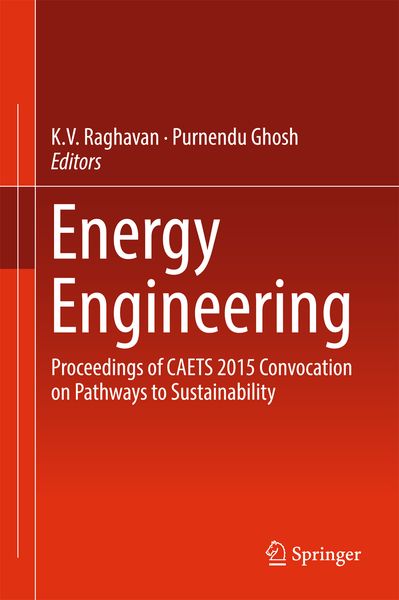
Produktbild: Energy Engineering

Energy Engineering Proceedings of CAETS 2015 Convocation on Pathways to Sustainability

Fr. 192.00

inkl. gesetzl. MwSt., Versandkostenfrei


Beschreibung

Produktdetails

Einband

Gebundene Ausgabe

Erscheinungsdatum

06.12.2016

Abbildungen

XIV, 65 illus., 49 illus. in color., schwarz-weiss Illustrationen, farbige Illustrationen

Herausgeber

K.V. Raghavan + weitere

Verlag

Springer Singapore

Seitenzahl

187

Maße (L/B/H)

24.1/16/1.6 cm

Gewicht

514 g

Auflage

1st edition 2017

Sprache

Englisch

ISBN

978-981-10-3101-4

Beschreibung

Portrait

K.V. Raghavan  received his B.Tech from Osmania University in 1964 and a MS and PhD from the Indian Institute of Technology (IIT), Madras, India. He is a Fellow of the Indian National Academy of Engineering (INAE), the Indian Institute of Chemical Engineers (IIChE), and the A. P. Akademi of Sciences (APAS), and is a Distinguished Fellow of the University of Grants Commission (UGC). Dr. Raghavan took up the distinguished Professorship of the INAE at the Indian Institute of Chemical Technology, Hyderabad, in 2008. He became the Vice President (International Cooperation) of the INAE in 2011.

He has held various levels of scientific positions in three national laboratories of the Council of Scientific and Industrial Research (CSIR) of India. He was appointed as the Director of Central Leather Research Institute, Chennai in 1994, and in 1996 he took over the Directorship of the Indian Institute of Chemical Technology, Hyderabad. On successful completion of this tenure, he was appointed as the Chairman of Recruitment and Assessment Centre of DRDO, Ministry of Defence, Government of India in May 2004. In addition, Dr. Raghavan chairs scientific committees of public and private sector bodies on clean technologies, catalytic ethanol reforming, biorefining and allied areas. The recipient of six national awards, Dr. Raghavan has published more than 150 papers, filed 45 patents and edited five books. Chemical process development and design, reaction engineering, simulation and modeling, and chemical hazard analysis are his areas of specialization. His basic research contributions cover the simulation of complex reactions in fixed bed reactors, hydrodynamics of multiphase reaction systems, envirocatalysis for clean processing, zeolite catalysis for macromolecules, thermochemistry, and kinetics of charge transfer polymerization and modeling of chemical accidents. His current research activities are in process intensification of water gas shift reaction, catalyticCO 2  decomposition, analysis of CO 2  capture technologies and characterization of the reactivity of ionic liquids.

Purnendu Ghosh  is the Executive Director, Birla Institute of Scientific Research, Jaipur. Prior to this he was Professor at Indian Institute of Technology, Delhi. He worked at the Swiss Federal Institute of Technology (ETH), Zurich, Switzerland; University of Melbourne, Australia; National Research Centre for Biotechnology (GBF), Braunschweig, Germany. He has taken a lead role in augmenting bioprocess engineering and biotechnology activities in the country as a member of several Task Forces of the Department of Biotechnology, Government of India. He is currently the Chief Editor of Publications of Indian National Academy of Engineering. He is a columnist of a leading newspaper group. Besides technical publications, he has written books of different genre.


Produktdetails

Einband

Gebundene Ausgabe

Erscheinungsdatum

06.12.2016

Abbildungen

XIV, 65 illus., 49 illus. in color., schwarz-weiss Illustrationen, farbige Illustrationen

Herausgeber

Verlag

Springer Singapore

Seitenzahl

187

Maße (L/B/H)

24.1/16/1.6 cm

Gewicht

514 g

Auflage

1st edition 2017

Sprache

Englisch

ISBN

978-981-10-3101-4

Herstelleradresse

Springer-Verlag GmbH
Tiergartenstr. 17
69121 Heidelberg
DE

Email: ProductSafety@springernature.com

Kundinnen und Kunden meinen

0 Bewertungen

Informationen zu Bewertungen

Zur Abgabe einer Bewertung ist eine Anmeldung im Konto notwendig. Die Authentizität der Bewertungen wird von uns nicht überprüft. Wir behalten uns vor, Bewertungstexte, die unseren Richtlinien widersprechen, entsprechend zu kürzen oder zu löschen.

Die Bewertungen sind nach Format, Anzahl Sterne und Datum sortiert.

Verfassen Sie die erste Bewertung zu diesem Artikel

Helfen Sie anderen Kund*innen durch Ihre Meinung

Kundinnen und Kunden meinen

0 Bewertungen filtern

  • Produktbild: Energy Engineering
  • Chapter 1. Low Carbon Pathways for India and the World.- Chapter 2. Fuel Cell Technologies for Defence Applications.- Chapter 3. Wind Energy for Buildings and Transport Sectors.- Chapter 4. Waste to Biohydrogen: Addressing Sustainability with Environmental Biorefinery.- Chapter 5. Indian Advances in Fast Breeder Nuclear Reactor Engineering.- Chapter 6. China’s long road to the high-efficiency, clean, and low-carbon energy transition.- Chapter 7. The Possible Rate of Transition to Lower-carbon Housing.- Chapter 8. Solar Cells: Materials beyond Silicon.- Chapter 9. Nano-Bio-Photonics: Integrating Technologies to Meet Challenges in Energy, Mobility and Healthcare.- Chapter 10. Carbon Dioxide to Energy: Killing Two Birds with One Stone.- Chapter 11. Multi Scale Optimization of Building Energy.- Chapter 12. Emerging Construction Materials for Energy Infrastructure.- Chapter 13. Energy Efficient Power Generation and Water Management through Membrane Technology.- Chapter 14. Transition to Lower Carbon Energy Regime: Engineering Challenges in Building and Transportation Sectors.- Chapter 15. Energy Options and Scenarios for Transitioning to a Lower Carbon Economy: An Indian Perspective.- Chapter 16. Mixed Culture Chain Elongation (MCCE) – A Novel Biotechnology for Renewable Biochemical Production from Organic Residual Streams.- Chapter 17. Bio-Energy and Bio-Refinery: Advances and Applications.- Chapter 18. Sulfonated Polyethersulfone/Torlon Blend Membrane Incorporated with Multi-walled Carbon Nanotubes for Energy Production Using Microbial Fuel Cell.- Chapter 19. Development of Sulfonated Polyethersulfone/Matrimid Acid-Base Blend Membrane for Energy Production through Fuel Cells.- Chapter 20. Adaption of a Green Technology (Friction Stir Welding) to Join Fusion Energy Materials.- Chapter 21. Advanced Materials for Indian Future Nuclear Energy Systems.- Chapter 22. Mitigating Embrittlement in Structural Steels of Power Plants by Grain Boundary Engineering.