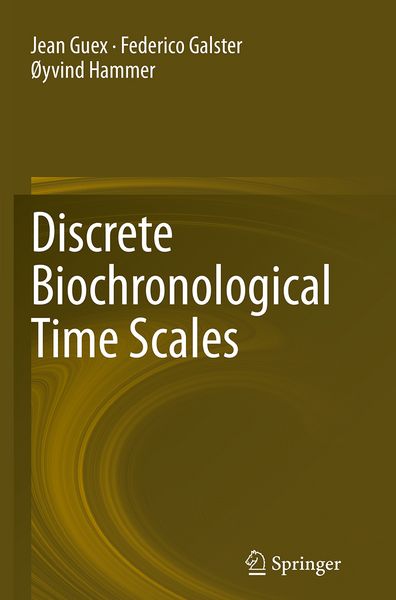
Discrete Biochronological Time Scales
-
- Hardcover
- Taschenbuch ausgewählt
- eBook
-
Sprache:Englisch
Fr. 72.90
inkl. gesetzl. MwSt.,
Beschreibung
Produktdetails
Einband
Taschenbuch
Erscheinungsdatum
01.11.2016
Abbildungen
XVIII, 160 p. 41 illus., 9 illus. in color.
Verlag
SpringerSeitenzahl
160
Maße (L/B/H)
23.5/15.5/1.1 cm
Gewicht
283 g
Auflage
Softcover reprint of the original 1st ed. 2015
Sprache
Englisch
ISBN
978-3-319-37272-3
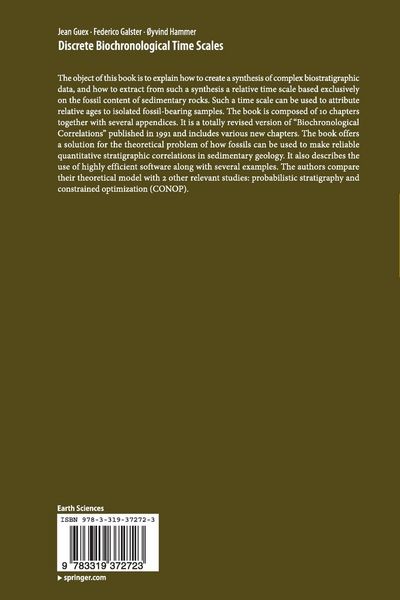
The object of this book is to explain how to create a synthesis of complex biostratigraphic data, and how to extract from such a synthesis a relative time scale based exclusively on the fossil content of sedimentary rocks. Such a time scale can be used to attribute relative ages to isolated fossil-bearing samples. The book is composed of 10 chapters together with several appendices. It is a totally revised version of “Biochronological Correlations” published in 1991 and includes various new chapters. The book offers a solution for the theoretical problem of how fossils can be used to make reliable quantitative stratigraphic correlations in sedimentary geology. It also describes the use of highly efficient software along with several examples. The authors compare their theoretical model with 2 other relevant studies: probabilistic stratigraphy and constrained optimization (CONOP).
Noch keine Bewertungen vorhanden
Verfassen Sie die erste Bewertung zu diesem Artikel
Helfen Sie anderen Kundinnen und Kunden durch Ihre Meinung.