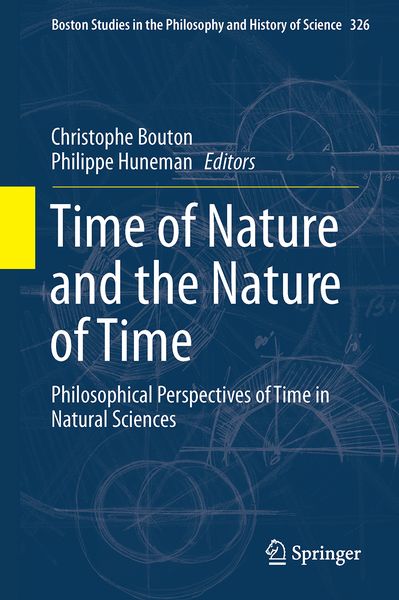
Time of Nature and the Nature of Time Philosophical Perspectives of Time in Natural Sciences
-
- Hardcover ausgewählt
- Taschenbuch
- eBook
-
Sprache:Englisch
Fr. 182.00
inkl. gesetzl. MwSt.,
Beschreibung
Produktdetails
Einband
Gebundene Ausgabe
Erscheinungsdatum
08.06.2017
Abbildungen
XIII, 82 illus., 29 illus. in color., farbige Illustrationen, schwarz-weiss Illustrationen
Herausgeber
Christophe Bouton + weitereVerlag
SpringerSeitenzahl
403
Maße (L/B/H)
24.1/16/2.7 cm
Gewicht
822 g
Auflage
1st ed. 2017
Sprache
Englisch
ISBN
978-3-319-53723-8
This volume addresses the question of time from the perspective of the time of nature. Its aim is to provide some insights about the nature of time on the basis of the different uses of the concept of time in natural sciences. Presenting a dialogue between philosophy and science, it features a collection of papers that investigate the representation, modeling and understanding of time as they appear in physics, biology, geology and paleontology. It asks questions such as: whether or not the notions of time in the various sciences are reducible to the same physical time, what status should be given to timescale differences, or what are the specific epistemic issues raised by past facts in natural sciences.
The book first explores the experience of time and its relation to time in nature in a set of chapters that bring together what human experience and physics enable metaphysicians, logicians and scientists to say about time. Next, it studies time in physics, including some puzzling paradoxes about time raised by the theory of relativity and quantum mechanics. The volume then goes on to examine the distinctive problems and conceptions of time in the life sciences. It explores the concept of deep time in paleontology and geology, time in the epistemology of evolutionary biology, and time in developmental biology. Each scientific discipline features a specific approach to time and uses distinctive methodologies for implementing time in its models. This volume seeks to define a common language to conceive of the distinct ways different scientific disciplines view time. In the process, it offers a new approach to the issue of time that will appeal to a wide range of readers: philosophers and historians of science, metaphysicians and natural scientists - be they scholars, advanced students or readers from an educated general audience.Noch keine Bewertungen vorhanden
Verfassen Sie die erste Bewertung zu diesem Artikel
Helfen Sie anderen Kundinnen und Kunden durch Ihre Meinung.