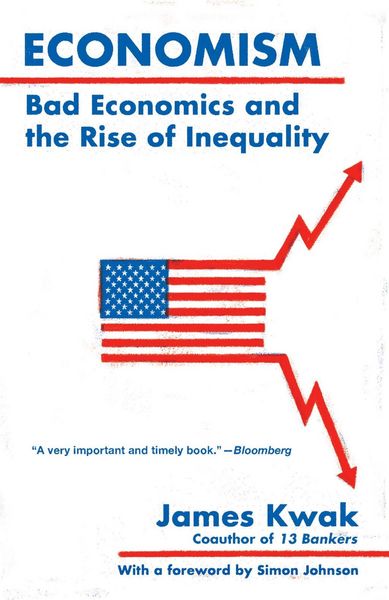
Economism Bad Economics and the Rise of Inequality
-
- Hardcover
- Taschenbuch
- eBook ausgewählt
-
Form:Einzelkauf Download
-
Sprache:Englisch
Fr. 6.40
inkl. gesetzl. MwSt.Beschreibung
Produktdetails
Format
ePUB 3
Kopierschutz
Ja
Family Sharing
Ja
Text-to-Speech
Ja
Erscheinungsdatum
10.01.2017
Verlag
Knopf Doubleday Publishing GroupSeitenzahl
256 (Printausgabe)
Dateigröße
3886 KB
Sprache
Englisch
EAN
9781101871201
Here is a bracing deconstruction of the framework for understanding the world that is learned as gospel in Economics 101, regardless of its imaginary assumptions and misleading half-truths.
Economism: an ideology that distorts the valid principles and tools of introductory college economics, propagated by self-styled experts, zealous lobbyists, clueless politicians, and ignorant pundits.
In order to illuminate the fallacies of economism, James Kwak first offers a primer on supply and demand, market equilibrium, and social welfare: the underpinnings of most popular economic arguments. Then he provides a historical account of how economism became a prevalent mode of thought in the United States-focusing on the people who packaged Econ 101 into sound bites that were then repeated until they took on the aura of truth. He shows us how issues of moment in contemporary American society-labor markets, taxes, finance, health care, and international trade, among others-are shaped by economism, demonstrating in each case with clarity and élan how, because of its failure to reflect the complexities of our world, economism has had a deleterious influence on policies that affect hundreds of millions of Americans.
Economism: an ideology that distorts the valid principles and tools of introductory college economics, propagated by self-styled experts, zealous lobbyists, clueless politicians, and ignorant pundits.
In order to illuminate the fallacies of economism, James Kwak first offers a primer on supply and demand, market equilibrium, and social welfare: the underpinnings of most popular economic arguments. Then he provides a historical account of how economism became a prevalent mode of thought in the United States-focusing on the people who packaged Econ 101 into sound bites that were then repeated until they took on the aura of truth. He shows us how issues of moment in contemporary American society-labor markets, taxes, finance, health care, and international trade, among others-are shaped by economism, demonstrating in each case with clarity and élan how, because of its failure to reflect the complexities of our world, economism has had a deleterious influence on policies that affect hundreds of millions of Americans.
Kundinnen und Kunden meinen
Verfassen Sie die erste Bewertung zu diesem Artikel
Helfen Sie anderen Kund*innen durch Ihre Meinung