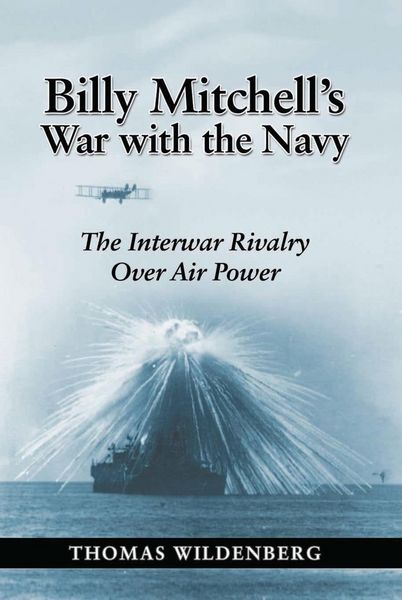
Billy Mitchell's War with the Navy The Interwar Rivalry Over Air Power
-
- Taschenbuch
- eBook ausgewählt
-
Form:Einzelkauf Download
-
Sprache:Englisch
Fr. 37.90
inkl. gesetzl. MwSt.Beschreibung
Produktdetails
Format
ePUB
Kopierschutz
Nein
Family Sharing
Nein
Text-to-Speech
Ja
Erscheinungsdatum
15.02.2014
Verlag
Kensington BooksSeitenzahl
304 (Printausgabe)
Dateigröße
10891 KB
Sprache
Englisch
EAN
9781612513324
When Billy Mitchell returned from WWI, he brought with him the deep-seated belief that air power had made navies obsolete. However, in the years following WWI, the U.S. Congress was far more interested in disarmament and isolationist policies than in funding national defense. For the military services this meant lean budgets and skeleton operating forces. Billy Mitchell's War with the Navy recounts the intense political struggle between the Army and Navy air arms for the limited resources needed to define and establish the role of aviation within their respective services in the period between the two world wars. After Congress rejected the concept of a unified air service in 1920, Mitchell and his supporters turned on the Navy, seeking to substitute the Air Service as the nation's first line of defense. While Mitchell proved that aircraft could sink a battleship with the bombing of the Ostfriesland in 1921, he was unable to convince the General Staff of the Army, the General Board of the Navy, the Secretary of War, the Secretary of the Navy, or Congress of the need for an independent air force. When Mitchell turned to the pen to discredit the Navy, he was convicted by his own words and actions in a court-martial that captivated the nation, and was forced to resign in 1925. Rather than ending the rivalry for air power, Mitchell's resignation set the stage for the ongoing dispute between the two services in the years immediately before WWII. After Mitchell's resignation, the rivalry for air power between the two services resurfaced when the Navy's plans to procure torpedo planes for the defense of Pearl Harbor and Coco Solo were brought to the attention of the Army. The book concludes with a description of the events surrounding the Air Corps' abysmal performance at Pearl Harbor and Midway followed by a critical assessment of how the development of aviation was pursued by the Army and the Navy after WWII.
Kundinnen und Kunden meinen
Verfassen Sie die erste Bewertung zu diesem Artikel
Helfen Sie anderen Kund*innen durch Ihre Meinung