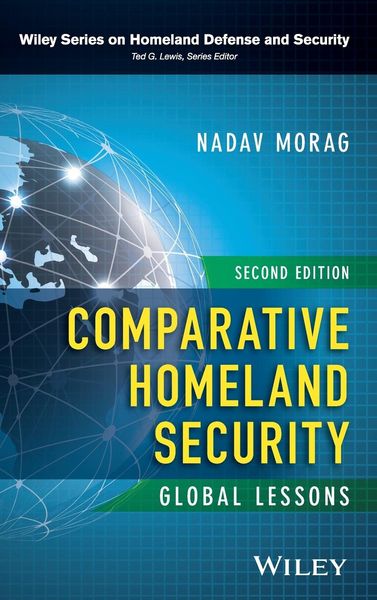
Comparative Homeland Security Global Lessons
Aus der Reihe
Wiley Series on Homeland Defense and Security)
-
Sprache:Englisch
-
Verlag:John Wiley & Sons Inc
Fr. 189.00
inkl. gesetzl. MwSt.,
Beschreibung
Produktdetails
Einband
Gebundene Ausgabe
Erscheinungsdatum
24.07.2018
Verlag
John Wiley & Sons IncSeitenzahl
512
Maße (L/B/H)
23.5/15.7/3.2 cm
Gewicht
887 g
Auflage
2nd edition
Sprache
Englisch
ISBN
978-1-119-41240-3
Introduces the reader to a variety of overseas Homeland Security strategies, policies, and practices in order to present approaches to addressing homeland security challenges and inform students and practitioners
This book educates those studying or involved in American Homeland Security on the policies and procedures set by other countries so that they can learn from foreign experiences and determine which overseas approaches may be applicable to improving US Homeland Security policy. The book is broken down into topical categories reflecting some of the major areas within the field of Homeland Security. Each chapter comprises a discussion of strategic policies followed by a set of countries in the context of the subset of Homeland Security addressed in that particular chapter. The book also delves into cybersecurity policy issues, an area that has been growing exponentially but was not touched on in the first edition.
The new edition of Comparative Homeland Security: Global Lessons updates foreign laws, strategies, and policies while expanding the depth and range of the discussion to include additional overseas policies. Based on eleven countries procedures and nine homeland security dimensions, it covers: Counterterrorism Strategies, Laws and Institutions; Law Enforcement Institutions and Strategies; Immigration and Counter-Radicalization; The Role of the Military in Security and Support for Civil Authorities; Border Security, Naturalization, and Asylum Policies; Security Facilities, Cyber Networks, and Transportation; Emergency Preparedness, Emergency Response and Management and Crisis Communications; and Public Health Strategies and Institutions.
* New edition updates foreign strategies and policies and extends the scope of discussion of these topics
* Expanded approach for a wider range of students and practitioners exploring the homeland security policies of other countries
* Covers strategies and tactics to combat terrorism from a number of the world's democracies including: Great Britain, Israel, France, Germany, Canada, and Australia
* Chapters are organized topically rather than by country, thus allowing students and practitioners to easily compare policies and integrate the concepts presented into practice
Comparative Homeland Security: Global Lessons, Second Edition is an excellent book for all scholars, students, and practitioners interested or involved in homeland security, emergency management, law enforcement, criminal justice, counter-terrorism, public health, transportation security, border security, and cybersecurity.
This book educates those studying or involved in American Homeland Security on the policies and procedures set by other countries so that they can learn from foreign experiences and determine which overseas approaches may be applicable to improving US Homeland Security policy. The book is broken down into topical categories reflecting some of the major areas within the field of Homeland Security. Each chapter comprises a discussion of strategic policies followed by a set of countries in the context of the subset of Homeland Security addressed in that particular chapter. The book also delves into cybersecurity policy issues, an area that has been growing exponentially but was not touched on in the first edition.
The new edition of Comparative Homeland Security: Global Lessons updates foreign laws, strategies, and policies while expanding the depth and range of the discussion to include additional overseas policies. Based on eleven countries procedures and nine homeland security dimensions, it covers: Counterterrorism Strategies, Laws and Institutions; Law Enforcement Institutions and Strategies; Immigration and Counter-Radicalization; The Role of the Military in Security and Support for Civil Authorities; Border Security, Naturalization, and Asylum Policies; Security Facilities, Cyber Networks, and Transportation; Emergency Preparedness, Emergency Response and Management and Crisis Communications; and Public Health Strategies and Institutions.
* New edition updates foreign strategies and policies and extends the scope of discussion of these topics
* Expanded approach for a wider range of students and practitioners exploring the homeland security policies of other countries
* Covers strategies and tactics to combat terrorism from a number of the world's democracies including: Great Britain, Israel, France, Germany, Canada, and Australia
* Chapters are organized topically rather than by country, thus allowing students and practitioners to easily compare policies and integrate the concepts presented into practice
Comparative Homeland Security: Global Lessons, Second Edition is an excellent book for all scholars, students, and practitioners interested or involved in homeland security, emergency management, law enforcement, criminal justice, counter-terrorism, public health, transportation security, border security, and cybersecurity.
Noch keine Bewertungen vorhanden
Verfassen Sie die erste Bewertung zu diesem Artikel
Helfen Sie anderen Kundinnen und Kunden durch Ihre Meinung.