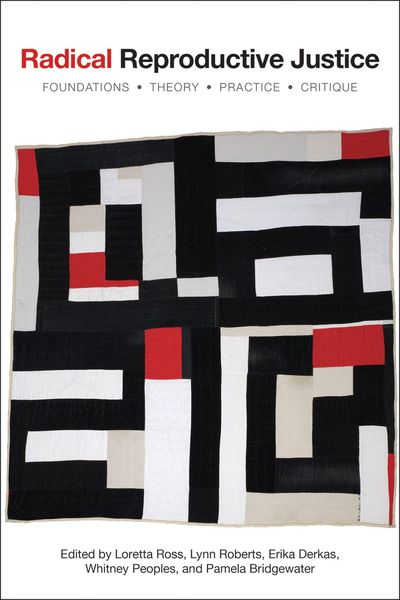
Produktbild: Radical Reproductive Justice

Radical Reproductive Justice Foundation, Theory, Practice, Critique

Fr. 41.90

inkl. gesetzl. MwSt., Versandkostenfrei


Beschreibung

Produktdetails

Einband

Taschenbuch

Erscheinungsdatum

14.11.2017

Herausgeber

Loretta Ross + weitere

Verlag

Feminist Press

Maße (L/B/H)

23.1/15.7/3.5 cm

Gewicht

555 g

Sprache

Englisch

ISBN

978-1-55861-437-6

Beschreibung

Portrait

Human and women's rights activist Loretta Ross co-founded and served as National Coordinator of the SisterSong Women of Color Reproductive Justice Collective, a network that organizes women of color in the reproductive justice movement. In fact, Ross is one of the creators of the term "Reproductive Justice," which envelops human rights and social justice into one movement. In 2004, Ross served as National Co-Director of the March for Women’s Lives in Washington DC. It became the largest protest march in US history with more than one million participants. Ross is the co-author of Undivided Rights: Women of Color Organize for Reproductive Justice and author of “The Color of Choice” chapter in Incite! Women of Color Against Violence published in 2006. She has also written extensively on the history of African American women and reproductive justice activism.

Lynn Roberts has a BS in human development from Howard University and a PhD in Human Services Studies from Cornell University. The City University of New York has been her academic home since 1995, and she is currently assistant professor in the department of Community Health and Social Sciences at the Graduate School of Public Health & Health Policy. Prior to joining CUNY, she oversaw the development, implementation and evaluation of several prevention programs for women and youth in NYC. She has also served on the board of SisterSong Women of Color Reproductive Justice Collective. Her current activism and scholarship examine the intersections of race, class and gender in adolescent dating relationships, juvenile justice and reproductive health policies; as well as the impact of models of collaborative inquiry and teaching on civic and political engagement.

Erika Derkas is a professor of Sociology and Women’s Studies at New Mexico Highlands University and is an active researcher in the area of reproductive justice, particularly, international sex worker organizing, population control, and sterilization abuse among poor women and women of color. She is currently the co-director of the Women’s Studies program and the Women’s Center at Highlands University and has been involved in feminist organizing for numerous years. Her research has taken her from New Zealand to study organizing efforts to decriminalize sex work to Palestine where she is exploring ethnic identity formation among youth, African Palestinians, and women in higher education.

Whitney Peoples is currently visiting assistant professor in the department of Multicultural Women’s and Gender Studies at Texas Woman’s University. She received her BA from Agnes Scott College, her MA from the University of Cincinnati, and her PhD from Emory University in Women’s, Gender & Sexuality Studies. Her work has been published in books such as What’s the Big Idea? Feminist Perspectives on Advertising (Lexington Books 2017); A History of African American Autobiography (Cambridge University Press 2017); and Womanist and Black Feminist Responses to Tyler Perry’s Productions (Palgrave MacMillan 2014). She has also published articles in the Journal of College Science Teaching and Meridians.

Pamela Bridgewater was an activist lawyer and legal scholar specializing in issues related to reproduction, sexuality, identity, poverty and women's health. She received her JD from Florida State University, and participated in the US Supreme Court case Judy Madsen et al. v. Women's Health Center Inc. Aware Woman Center for Choice, Inc. She went on to obtain an LL.M from the University of Wisconsin Law School, and while in Wisconsin, she developed a lifelong scholarly interest in the relationship between reproductive freedom and black emancipation. As a lawyer, Pamela provided legal defense of reproductive health care clinics, service providers and activists, and also provided pro bono legal service and consultation on matters such as estate planning for poor people and people living with HIV/AIDS, as well as legal services for peace activists and activists within the fair trade and globalization movements. She taught as professor at Northeastern University’s School of Law and at American University's Washington College of Law. She passed away in 2014.
Produktdetails

Einband

Taschenbuch

Erscheinungsdatum

14.11.2017

Herausgeber

Verlag

Feminist Press

Maße (L/B/H)

23.1/15.7/3.5 cm

Gewicht

555 g

Sprache

Englisch

ISBN

978-1-55861-437-6

Herstelleradresse

Libri GmbH
Europaallee 1
36244 Bad Hersfeld
DE

Email: gpsr@libri.de

Kundinnen und Kunden meinen

0 Bewertungen

Informationen zu Bewertungen

Zur Abgabe einer Bewertung ist eine Anmeldung im Konto notwendig. Die Authentizität der Bewertungen wird von uns nicht überprüft. Wir behalten uns vor, Bewertungstexte, die unseren Richtlinien widersprechen, entsprechend zu kürzen oder zu löschen.

Die Bewertungen sind nach Format, Anzahl Sterne und Datum sortiert.

Verfassen Sie die erste Bewertung zu diesem Artikel

Helfen Sie anderen Kund*innen durch Ihre Meinung

Kundinnen und Kunden meinen

0 Bewertungen filtern

Die Leseprobe wird geladen.
  • Produktbild: Radical Reproductive Justice
  • INTRODUCTION

    Overview of Reproductive Justice

    Origin and Definition of Reproductive Justice

    Impact of Reproductive Justice

    HISTORICAL CONTEXT

    Toni Bond Leonard/Loretta Ross, Laying the Foundation for the Reproductive Justice Movement

    Kalpana Krishnamurthy/Rachael Strickler, An RJ Timeline: Handouts and/or Pull-out chart

    Rachael Strickler/Monica Simpson, A SisterSong History (Herstory)

    Lynn Roberts, On Becoming a Mother in Four Movements: An Intergenerational View through a Reproductive Justice Lens

    Stephanie Sellers, Iroquoian Women and Reproductive Justice: Historic Empowerment

    Judy A. M. Scully, Eugenics, Women of Color and Reproductive Health: The Saga Continues

    Deleso Alford Washington, Framing Her-story: Black Women and the Development of the Medical Specialty of Gynecology in the United States

    THEORY

    Marlene Gerber Fried, 10 Reasons to Rethink Reproductive “Choice”

    Loretta Ross, Conceptualizing Reproductive Justice Theory: A Manifesto for Activism

    Andrea Smith, Beyond Pro-Choice Versus Pro-Life: Women of Color and Reproductive Justice

    Rickie Solinger, Picturing Reproductive Justice: The “Beggars and Choosers” Exhibition Challenges the Welfare Queen and other 20th Century Ideas about Maternal Legitimacy and Illegitimacy

    Beverly Juan Thompson, “Centering” Reproductive Justice: Transitioning from Abortion Rights to Social Justice

    Erika Derkas/Rachael Strickler, “Retrofitting Choice: White Women and Reproductive Justice

    POLICY, PRACTICE & ACTIVISM

    Jill Adams, Reproductive Justice Revolution for Law Students

    Pamela Bridgewater - Transforming Silence: The Personal, Political and Pedagogical Prism of
    Abortion Narrative

    Erika Derkas - Embracing Sex Work’s Complexity: The Anatomy of Global Organizing

    Dazon Dixon Diallo, HIV Prevention and Reproductive Justice: A Framework for Saving Women’s Lives

    Melissa L. Gilliam, Amy Neustadt, and Rivka Gordon, Reproductive Justice and Clinical Practice

    Julie Grigsby, We Were All Slaves Once: Post-Traumatic Slave Syndrome and Reproductive Justice Organizing in Los Angeles

    La’Tasha Mayes, Our Civic Engagement Agenda for Reproductive Justice

    Benita Miller, Mothering While Poor: Utilizing the Reproductive Justice Framework to Build the Capacities of Young Mothers

    Anna Ochoa O’Leary/William Paul Simmons, Reproductive Justice and Resistance at U.S.-Mexico Borderlands

    Joshua Price, Incarceration and Natal Alienation

    Diana Romero and Angenor Medina, The Welfare Family Cap: Reproductive Rights, Control and Poverty Prevention

    Loretta Ross: Trust Black Women: Eugenics Through Billboards

    Rachel Roth, “She Doesn’t Deserve to be Treated Like This”: Reproductive Injustice in the U.S. Prison System

    Seema Sandamana, Mandating Gardasil for Young Girls in the D.C. Public School System

    Judith A.M. Scully, Quinacrine Sterilizations: The “Choice” that Isn’t

    Alice Skenadore/Erika Derkas, Wise Women’s Gathering Place: Indigenous/Abstinence Model of Teen Pregnancy Prevention

    FRESH VOICES, NEW DIRECTIONS

    Jamarah Amani, Birth Justice: These Are Our Rights as Mothers

    Sophia Arrendondo, Jessica Far, Irene Lara, & Enrique Rodriguez – Entering Panocha~ A Borderlands Passageway

    Mary Krane Derr, Card-Carrying Marchers and Sister Travelers: Pro-life Feminists and the Reproductive Justice Movement (deceased)

    Lucia Leandro Gimeno, The Reluctant RJ Organizers: Trans Issues and Reproductive Justice

    Dheeshana S. Jayasundara, Reproductive Rights or Reproductive Justice for Reproductive Well-being

    Sujatha Jesudason and Emily Galpern, Fresh Voices, Different Perspectives: Ensuring Just Uses of Human Genetic Technologies

    Laura Jimenez, Kierra Johnson and Cara Page, Beyond the Trees: Stories and Strategies of Environmental and Reproductive Justice

    Katie O’Connell, Disability Rights and Reproductive Justice

    Cara Page, Lisa Lusero and Mia Mingus, Love Letters to the Queer Liberation and Reproductive Justice Movement(s)

    Amanda Persad, Mothers and Martyrs: Mothers and Sacrifice

    Jeanine Kamilah Valrie, Punishment in Reproductive Autonomy: U.S. Drug Policies and their Effects on Black Women

    Aaronette White, Childless by Choice: Tubes Tied Truly Child-Free At Last!