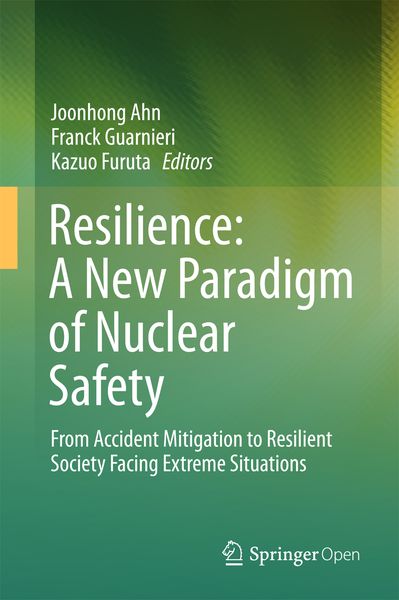
Produktbild: Resilience: A New Paradigm of Nuclear Safety

Resilience: A New Paradigm of Nuclear Safety From Accident Mitigation to Resilient Society Facing Extreme Situations

Fr. 73.90

inkl. gesetzl. MwSt., Versandkostenfrei


Beschreibung

Produktdetails

Einband

Gebundene Ausgabe

Erscheinungsdatum

23.08.2017

Abbildungen

XVII, 62 illus., 48 illus. in color., farbige Illustrationen, schwarz-weiss Illustrationen

Herausgeber

Joonhong Ahn + weitere

Verlag

Springer

Seitenzahl

356

Maße (L/B/H)

24.1/16/2.6 cm

Gewicht

729 g

Auflage

1st edition 2017

Sprache

Englisch

ISBN

978-3-319-58767-7

Beschreibung

Produktdetails

Einband

Gebundene Ausgabe

Erscheinungsdatum

23.08.2017

Abbildungen

XVII, 62 illus., 48 illus. in color., farbige Illustrationen, schwarz-weiss Illustrationen

Herausgeber

Verlag

Springer

Seitenzahl

356

Maße (L/B/H)

24.1/16/2.6 cm

Gewicht

729 g

Auflage

1st edition 2017

Sprache

Englisch

ISBN

978-3-319-58767-7

Herstelleradresse

Springer-Verlag KG
Sachsenplatz 4-6
1201 Wien
AT

Email: GPSR Kontakt

Noch keine Bewertungen vorhanden

Verfassen Sie die erste Bewertung zu diesem Artikel

Helfen Sie anderen Kundinnen und Kunden durch Ihre Meinung.

Kundinnen und Kunden meinen

Bewertungen (0)

  • Produktbild: Resilience: A New Paradigm of Nuclear Safety
  • Introduction.- Part I: What are damages in Nuclear Accidents?- Does the concept of loss orient risk prevention policy?- How the Fukushima Daiichi accident changed (or not) the nuclear safety fundamentals?- Low-dose radiation effects on human health.- Consequences of severe nuclear accidents on social regulations in socio-technical organizations.- Philosophical problems, old and new, posed by the possibility of major nuclear disasters.- Part II: Measurement of Damages.- A Multiscale Bayesian Data Integration Approach for Mapping Radionuclide Contamination.- Challenges for Nuclear Safety from Viewpoint of Natural Hazard Risk Management.- Evaluation of the expected costs of nuclear accident.- Considering nuclear accident in energy modeling analysis.- Measurements of risk perception and social acceptability.- Development of a knowledge management system for energy driven by public feedback.- Part III: Barriers against Transition into Resilience.- What cultural objects say about nuclear accidents and their way of depicting a controversial industry.- Why is it so difficult to learn from accidents?- Decision making in extreme situations following the Fukushima Dai Ichi accident.- Japan’s Nuclear Imaginaries before and after Fukushima: Visions of Science, Technology, and Society.- Institute for Resilient Community.- Part IV: Research questions for developing knowledge toward transition into resilience.- Approach to Reaching decisions on risk.- Democracy in nuclear system.- Effects of an Extreme Situation on engineers.- Epilogue.