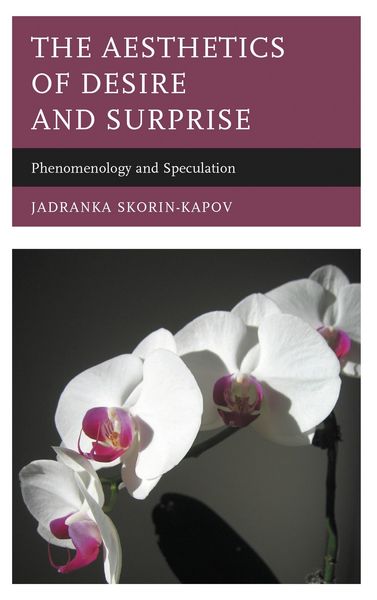
The Aesthetics of Desire and Surprise Phenomenology and Speculation
-
- Hardcover
- Taschenbuch
- eBook ausgewählt
-
Form:Einzelkauf Download
-
Sprache:Englisch
-
eBook Format:ePUB
- PDF Fr. 47.90
- ePUB Fr. 47.90 ausgewählt
Fr. 47.90
inkl. gesetzl. MwSt.Beschreibung
Produktdetails
Format
ePUB
Kopierschutz
Ja
Family Sharing
Nein
Text-to-Speech
Ja
Erscheinungsdatum
08.10.2015
Verlag
Bloomsbury eBooks USSeitenzahl
220 (Printausgabe)
Auflage
1. Auflage
Sprache
Englisch
EAN
9781498518475
The Aesthetics of Desire and Surprise: Phenomenology and Speculation covers issues central to contemporary continental philosophy (desire, expectations, excess, rupture, transcendence, immanence, surprise). The proposed term desire||surprise captures the phenomenological-speculative character of the pair not yet and no longer. Non-obvious parallels between different thinkers are drawn, and the argumentation is organized around philosophical figures relevant in the sequence desire - excess -pause (rupture, break) - recuperation (surprise). The works of Levinas, Zizek, Bataille, Blanchot, Foucault, and Ricoeur are interpreted and positioned according to the proposed template of desire - excess - pause. The consideration of limit experiences involves authors fascinated by transgression, and the question of whether excess is immanent or transcendent. This discussion considers works by Nietzsche, Deleuze, Zizek, and Foucault. The analysis of surprise and the beginning of recovery after the pause considers works by Fink, Merleau-Ponty, Nancy, Lyotard, Dufrenne, Bachelard, and Seel. The provocative argument elaborated in this work is that surprise starts with indifference. Furthermore, the argument is that surprise begins where the concept reaches its ending, hence that the limit of speculative thinking at its ending is the limit of aesthetics at its beginning. The work of Hegel, Schelling and Jaspers are discussed in order to argue for the beginning of aesthetics there where knowledge ends.
Philosophical thematic is contextualized via sections on artists such as Duchamp and Mondrian, and on some films, provoking interest of aestheticians working in art history and cultural studies departments.
Philosophical thematic is contextualized via sections on artists such as Duchamp and Mondrian, and on some films, provoking interest of aestheticians working in art history and cultural studies departments.
Kundinnen und Kunden meinen
Verfassen Sie die erste Bewertung zu diesem Artikel
Helfen Sie anderen Kund*innen durch Ihre Meinung