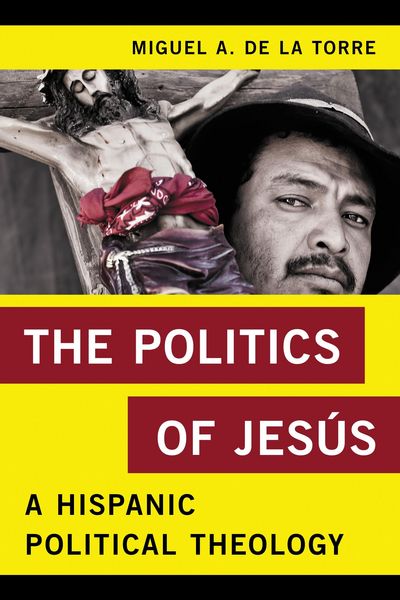
The Politics of Jesús A Hispanic Political Theology
-
- Hardcover
- Taschenbuch
- eBook ausgewählt
-
Form:Einzelkauf Download
-
Sprache:Englisch
-
eBook Format:ePUB
- PDF Fr. 31.90
- ePUB Fr. 31.90 ausgewählt
Fr. 31.90
inkl. gesetzl. MwSt.Beschreibung
Produktdetails
Format
ePUB
Kopierschutz
Ja
Family Sharing
Nein
Text-to-Speech
Ja
Altersempfehlung
18 - 22 Jahr(e)
Erscheinungsdatum
10.06.2015
Verlag
Bloomsbury eBooks USSeitenzahl
212 (Printausgabe)
Dateigröße
651 KB
Auflage
1. Auflage
Sprache
Englisch
EAN
9781442250376
The Politics of Jesús is a powerful new biography of Jesus told from the margins. Miguel A. De La Torre argues that we all create Jesus in our own image, reflecting and reinforcing the values of communities-sometimes for better, and often for worse. In light of the increasing economic and social inequality around the world, De La Torre asserts that what the world needs is a Jesus of solidarity who also comes from the underside of global power. The Politics of Jesús is a search for a Jesus that resonates specifically with the Latino/a community, as well as other marginalized groups. The book unabashedly rejects the Eurocentric Jesus for the Hispanic Jesús, whose mission is to give life abundantly, who resonates with the Latino/a experience of disenfranchisement, and who works for real social justice and political change.
While Jesus is an admirable figure for Christians, The Politics of Jesús highlights the way the Jesus of dominant culture is oppressive and describes a Jesús from the barrio who chose poverty and disrupted the status quo. Saying "no" to oppression and its symbols, even when one of those symbols is Jesus, is the first step to saying "yes" to the self, to liberation, and symbols of that liberation. For Jesus to connect with the Hispanic quest for liberation, Jesús must be unapologetically Hispanic and compel people to action. The Politics of Jesús provocatively moves the study of Jesús into the global present.
While Jesus is an admirable figure for Christians, The Politics of Jesús highlights the way the Jesus of dominant culture is oppressive and describes a Jesús from the barrio who chose poverty and disrupted the status quo. Saying "no" to oppression and its symbols, even when one of those symbols is Jesus, is the first step to saying "yes" to the self, to liberation, and symbols of that liberation. For Jesus to connect with the Hispanic quest for liberation, Jesús must be unapologetically Hispanic and compel people to action. The Politics of Jesús provocatively moves the study of Jesús into the global present.
Kundinnen und Kunden meinen
Verfassen Sie die erste Bewertung zu diesem Artikel
Helfen Sie anderen Kund*innen durch Ihre Meinung