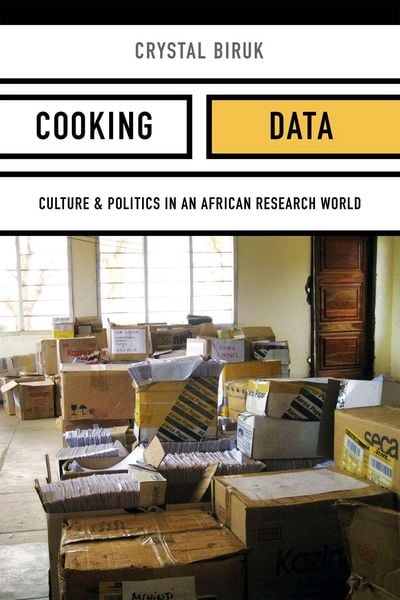
Produktbild: Cooking Data

Cooking Data Culture and Politics in an African Research World

Fr. 169.00

inkl. gesetzl. MwSt., Versandkostenfrei


Beschreibung

Produktdetails

Einband

Gebundene Ausgabe

Erscheinungsdatum

04.04.2018

Abbildungen

8 illustrations

Verlag

Duke University Press

Seitenzahl

296

Maße (L/B/H)

23.4/15.7/2 cm

Gewicht

567 g

Sprache

Englisch

ISBN

978-0-8223-7074-1

Beschreibung

Rezension

"A brilliant example of an ethnography of global health. Crystal Biruk offers a very insightful, convincingly argued and well-substantiated account of the effects of what has become the most common type of research not only in global health but the development industry more generally."

- Anna Wolkenhauer (LSE Review of Books) "Bookended by a thoughtful introduction and conclusion . . . I recommend this book to anyone who does survey work in Africa. . . . Its prose is scholarly but accessible and Biruk does a good job of marrying theoretical concepts to real world examples." - Kevin Fridy (Journal of Modern African Studies) "Cooking Data succeeds . . . by giving life to the trajectory of data from raw to cooked and troubling what we think we know about what happens in the field." - Monica Grant (Population and Development Review) "Impressive in its focus and scope, Cooking Data makes a clear and compelling case for the social thickness of numbers. . . . This is a substantive contribution to our understanding of the role of data in global health." - Damien Droney (Somatosphere) "Cooking Data is a powerful critique of the understanding that survey data are an objective and complete representation of reality. . . . I strongly recommend using this publication as a required reading in undergraduate and graduate courses in Anthropology, Demography, Sociology, and related social sciences that teach students to design and conduct qualitative as well as quantitative research. Further, those interested in African Studies, Global Health, and International Development will tremendously benefit from reading this publication as these disciplines are strongly influenced by survey research. The book is also a must-read for agencies, policy makers, and funding agencies. . . ." - Alexander Rödlach (Anthropos) "The continued relevance of Biruk's work is clear in the midst of the global COVID-19 pandemic.... At a time when trust in numbers is increasingly shaken, Biruk offers nuanced insights on the production of numbers that prompts discussion about the role of feminist science studies to both critically examine how numbers attain their authority and simultaneously build capacity for fact based decision making in a post-truth era where powerful leaders intentionally spread harmful misinformation." - Angela Okune (Catalyst)

Produktdetails

Einband

Gebundene Ausgabe

Erscheinungsdatum

04.04.2018

Abbildungen

8 illustrations

Verlag

Duke University Press

Seitenzahl

296

Maße (L/B/H)

23.4/15.7/2 cm

Gewicht

567 g

Sprache

Englisch

ISBN

978-0-8223-7074-1

Herstelleradresse

Libri GmbH
Europaallee 1
36244 Bad Hersfeld
DE

Email: gpsr@libri.de

Kundinnen und Kunden meinen

0 Bewertungen

Informationen zu Bewertungen

Zur Abgabe einer Bewertung ist eine Anmeldung im Konto notwendig. Die Authentizität der Bewertungen wird von uns nicht überprüft. Wir behalten uns vor, Bewertungstexte, die unseren Richtlinien widersprechen, entsprechend zu kürzen oder zu löschen.

Die Bewertungen sind nach Format, Anzahl Sterne und Datum sortiert.

Verfassen Sie die erste Bewertung zu diesem Artikel

Helfen Sie anderen Kund*innen durch Ihre Meinung

Kundinnen und Kunden meinen

0 Bewertungen filtern

  • Produktbild: Cooking Data
  • Acknowledgments  ix
    Introduction. An Anthropologist among the Demographers: Assembling Data in Survey Research Worlds  1
    1. The Office in the Field: Building Survey Infrastructures  31
    2. Living Project to Project: Brokering Local Knowledge in the Field  67
    3. Clean Data, Messy Gifts: Soap-for-Information Transactions in the Field  100
    4. Materializing Clean Data in the Field  129
    5. When Numbers Travel: The Politics of Making Evidence-Based Policy  166
    Conclusion. Anthropology in and of (Critical) Global Health  200
    Appendix. Sample Household Roster Questions  217
    Notes  223
    Bibliography  237
    Index  269