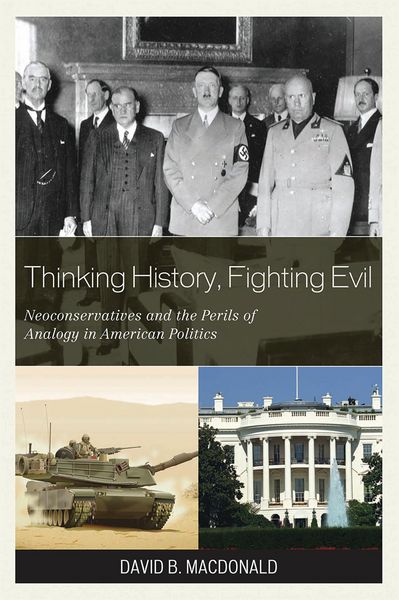
Thinking History, Fighting Evil Neoconservatives and the Perils of Analogy in American Politics
Aus der Reihe
Lexington Books
-
- Hardcover
- Taschenbuch
- eBook ausgewählt
-
Form:Einzelkauf Download
-
Sprache:Englisch
-
eBook Format:ePUB
- PDF Fr. 54.90
- ePUB Fr. 54.90 ausgewählt
Fr. 54.90
inkl. gesetzl. MwSt.Beschreibung
Produktdetails
Format
ePUB
Kopierschutz
Ja
Family Sharing
Nein
Text-to-Speech
Ja
Erscheinungsdatum
16.05.2009
Verlag
Bloomsbury eBooks USSeitenzahl
220 (Printausgabe)
Auflage
1. Auflage
Sprache
Englisch
EAN
9781461634515
Thinking History, Fighting Evil presents the most thorough exploration to date of how World War II analogies, particularly those focused on the Holocaust, have colored American foreign policy-making after 9/11. In particular, this book highlights how influential neoconservatives inside and outside the Bush administration used analogies of the "Good War" to reinterpret domestic and international events, often with disastrous consequences. On the surface, World War II promotes a simple but compelling range of images and symbols: valiant Roosevelts and Churchills, appeasing Chamberlains, evil Hitlers, Jewish victims, European bystanders, and American liberators. However, the simplistic use of analogies was precisely what doomed the neoconservative project to failure. This book explores the misuse of ten key analogies arising from World War II and charts their problematic deployment after the 9/11 attacks.
Divided into eight chapters, Thinking History, Fighting Evil engages with timely issues such as the moral legacies of the civil rights era, identity politics movements, the representation of the Holocaust in American life, the rise of victim politics on the neoconservative right, the instrumentalization of anti-American and anti-Semitic discourses, the trans-Atlantic rift between Europe and the United States, and the war on terror. While the book focuses on the post-9/11 security environment, it also explores the history of negative exceptionalism in U.S. history and politics, tracing back Manichean conceptions of good and evil to the foundation of the early colonies.
Divided into eight chapters, Thinking History, Fighting Evil engages with timely issues such as the moral legacies of the civil rights era, identity politics movements, the representation of the Holocaust in American life, the rise of victim politics on the neoconservative right, the instrumentalization of anti-American and anti-Semitic discourses, the trans-Atlantic rift between Europe and the United States, and the war on terror. While the book focuses on the post-9/11 security environment, it also explores the history of negative exceptionalism in U.S. history and politics, tracing back Manichean conceptions of good and evil to the foundation of the early colonies.
Kundinnen und Kunden meinen
Verfassen Sie die erste Bewertung zu diesem Artikel
Helfen Sie anderen Kund*innen durch Ihre Meinung