
KI-Beratung Beta

  • Produktbild: The Arab-Israeli Conflict, 1956-1975
  • Produktbild: The Arab-Israeli Conflict, 1956-1975

The Arab-Israeli Conflict, 1956-1975 From Violent Conflict to a Peace Process

Fr. 78.90

inkl. gesetzl. MwSt., Versandkostenfrei


Beschreibung

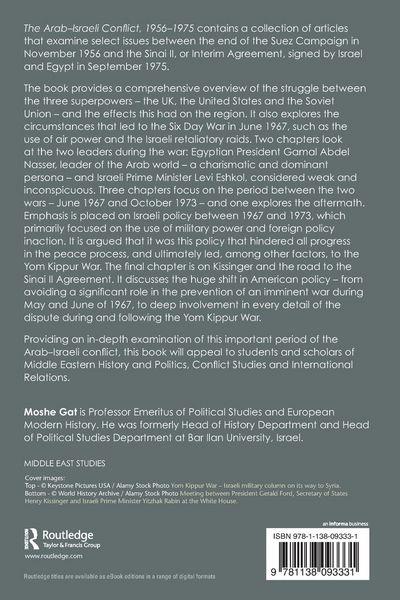
The Arab-Israeli Conflict, 1956-1975 contains a collection of articles that examine select issues between the end of the Suez Campaign in November 1956 and the Sinai II, or Interim Agreement, signed by Israel and Egypt in September 1975.

The book provides a comprehensive overview of the struggle between...

Beschreibung

The Arab-Israeli Conflict, 1956-1975 contains a collection of articles that examine select issues between the end of the Suez Campaign in November 1956 and the Sinai II, or Interim Agreement, signed by Israel and Egypt in September 1975.

The book provides a comprehensive overview of the struggle between the three superpowers - the UK, the United States and the Soviet Union - and the effects this had on the region. It also explores the circumstances that led to the Six Day War in June 1967, such as the use of air power and the Israeli retaliatory raids. Two chapters look at the two leaders during the war: Egyptian President Gamal Abdel Nasser, leader of the Arab world - a charismatic and dominant persona - and Israeli Prime Minister Levi Eshkol, considered weak and inconspicuous. Three chapters focus on the period between the two wars - June 1967 and October 1973 - and one explores the aftermath. Emphasis is placed on Israeli policy between 1967 and 1973, which primarily focused on the use of military power and foreign policy inaction. It is argued that it was this policy that hindered all progress in the peace process, and ultimately led, among other factors, to the Yom Kippur War. The final chapter is on Kissinger and the road to the Sinai II Agreement. It discusses the huge shift in American policy - from avoiding a significant role in the prevention of an imminent war during May and June of 1967, to deep involvement in every detail of the dispute during and following the Yom Kippur War.

Providing an in-depth examination of this important period of the Arab-Israeli conflict, this book will appeal to students and scholars of Middle Eastern History and Politics, Conflict Studies and International Relations.

Produktdetails

Einband

Taschenbuch

Erscheinungsdatum

20.11.2017

Verlag Taylor & Francis
Seitenzahl

270

Produktdetails

Einband

Taschenbuch

Erscheinungsdatum

20.11.2017

Verlag Taylor & Francis
Seitenzahl

270

Maße (L/B/H)

23.4/15.6/1.5 cm

Gewicht

415 g

Auflage

1st ed.

Sprache

Englisch

ISBN

978-1-138-09333-1

EU-Ansprechpartner

Taylor & Francis Verlag GmbH
Kaufingerstraße 24
80331 München
DE
GPSR@taylorandfrancis.com

Herstelleradresse

Taylor & Francis Group
5 Howick Place
SW1P 1WG London
UK
GPSR@taylorandfrancis.com

Noch keine Bewertungen vorhanden

Verfassen Sie die erste Bewertung zu diesem Artikel

Helfen Sie anderen Kundinnen und Kunden durch Ihre Meinung.

Kundinnen und Kunden meinen

Bewertungen (0)

Die Leseprobe wird geladen.
  • Produktbild: The Arab-Israeli Conflict, 1956-1975
  • Produktbild: The Arab-Israeli Conflict, 1956-1975
  • Introduction 1. Anatomy of decline: Anglo-Soviet competition in the Middle East, 1956-1967 2. On the use of air power and its effect on the outbreak of the Six Day War 3. Retaliatory raids as an accelerating factor leading to the Six Day War 4. Let someone else do the job: American policy on the Eve of the Six Day War  5. Levi Eshkol: an Israeli leader in the years leading to the Six Day War 6. Nasser and the Six Day War, 5 June 1967: a premediated strategy or an inexorable drift to war? 7. Britain and Israel before and after the Six Day War, June 1967: from support to hostility 8. Military Power and Foreign Policy Inaction: Israel, 1967-1973 9. Yitzhak Rabin, Ambassador to Washington, 1968-1973: a diplomat and policy-maker 10. Kissinger and the road to the Interim Agreement (Sinai II) between Israel and Egypt, September 1975