KI-Beratung Beta

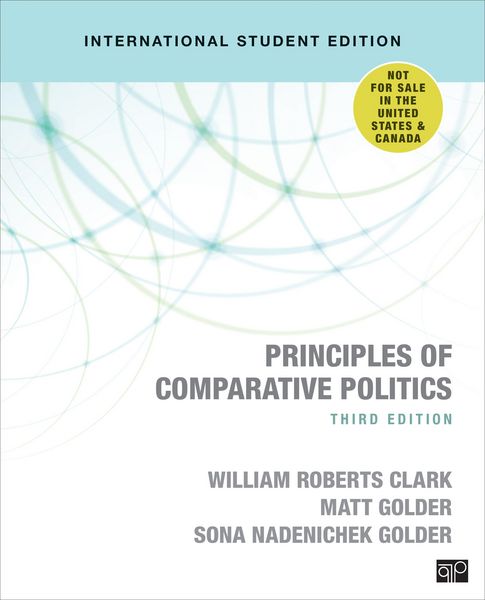
Produktbild: Golder, M: Principles of Comparative Politics (International

Golder, M: Principles of Comparative Politics (International

Fr. 135.00

inkl. gesetzl. MwSt., Versandkostenfrei


Beschreibung

Principles of Comparative Politics offers the most comprehensive and up-to-date introduction to comparative inquiry, research, and scholarship. In this thoroughly revised Third Edition, students now have an even better guide to cross-national comparison and why it matters. The new edition retains a focus...

Beschreibung

Principles of Comparative Politics offers the most comprehensive and up-to-date introduction to comparative inquiry, research, and scholarship. In this thoroughly revised Third Edition, students now have an even better guide to cross-national comparison and why it matters. The new edition retains a focus on the enduring questions with which scholars grapple, the issues about which consensus has started to emerge, and the tools comparativists use to get at the complex problems in the field.
Updates to this edition include a new intuitive take on statistical analyses and a clearer explanation of how to interpret regression results; a thoroughly-revised chapter on culture and democracy that includes a more extensive discussion of cultural modernization theory and a new overview of survey methods for addressing sensitive topics; and a revised chapter on dictatorships that incorporates a principal-agent framework for understanding authoritarian institutions. Examples from the gender and politics literature have been incorporated into various chapters, and empirical examples and data on various types of institutions have been updated. The authors have thoughtfully streamlined chapters to better focus attention on key topics.

Rezension

I am adjunct teaching this course and the main course leader used the book last year and recommended that I do the same. The book is very useful and we follow closely with narrative of the book and its themes. This provides the students who are faced with the subject for the first time with some degree of security. I am happy with the text and would use it again. Dr Guy Burton 20220218

Produktdetails

Einband

Taschenbuch

Erscheinungsdatum

26.06.2017

Verlag SAGE Publications
Seitenzahl

888

Produktdetails

Einband

Taschenbuch

Erscheinungsdatum

26.06.2017

Verlag SAGE Publications
Seitenzahl

888

Maße (L/B/H)

23.1/18.7/5 cm

Gewicht

1383 g

Farbe

Weiß

Auflage

3 Revised edition

Sprache

Englisch

ISBN

978-1-5063-8979-0

EU-Ansprechpartner

Kolibri 360 GmbH
Ettore-Bugatti-Straße 6-14
51149 Köln
DE
produktsicherheit@kolibri360.de

Herstelleradresse

SAGE Publications
1 Oliver's Yard 55 City Road
EC1Y 1SP London
GB
orders@sagepub.co.uk

Noch keine Bewertungen vorhanden

Verfassen Sie die erste Bewertung zu diesem Artikel

Helfen Sie anderen Kundinnen und Kunden durch Ihre Meinung.

Kundinnen und Kunden meinen

Bewertungen (0)

  • Produktbild: Golder, M: Principles of Comparative Politics (International
  • Part I. What Is Comparative Politics?
    Chapter 1. Introduction
    Overview of the Book
    The Approach Taken in This Book
    Key Concepts
    Chapter 2. What Is Science?
    Introduction
    What Is Science?
    The Scientific Method
    An Introduction to Logic
    Myths about Science
    Conclusion
    Key Concepts
    Problems
    Chapter 3. What Is Politics?
    The Exit, Voice, and Loyalty Game
    Solving the Exit, Voice, and Loyalty Game
    Evaluating the Exit, Voice, and Loyalty Game
    Conclusion
    Key Concepts
    Preparation for the Problems
    Problems
    Part II. The Modern State: Democracy or Dictatorship?
    Chapter 4. The Origins of the Modern State
    What Is a State?
    Somalia and Syria: Two Failed States
    The Contractarian View of the State
    The Predatory View of the State
    Conclusion
    Key Concepts
    Preparation for the Problems
    Problems
    Chapter 5. Democracy and Dictatorship: Conceptualization and Measurement
    Democracy and Dictatorship in Historical Perspective
    Classifying Democracies and Dictatorships
    Conclusion
    Key Concepts
    Problems
    Chapter 6. The Economic Determinants of Democracy and Dictatorship
    Classic Modernization Theory
    A Variant of Modernization Theory
    Some More Empirical Evidence
    Conclusion
    Key Concepts
    Appendix: An Intuitive Take on Statistical Analyses
    Problems
    Chapter 7. Cultural Determinants of Democracy and Dictatorship
    Classical Cultural Arguments: Mill and Montesquieu
    Does Democracy Require a Civic Culture?
    Religion and Democracy
    Experiments and Culture
    Conclusion
    Key Concepts
    Problems
    Chapter 8. Democratic Transitions
    Bottom-Up Transitions to Democracy
    Top-Down Transitions to Democracy
    Conclusion
    Key Concepts
    Problems
    Chapter 9. Democracy or Dictatorship: Does it Make a Difference?
    The Effect of Regime Type on Economic Growth
    The Effect of Regime Type on Government Performance
    Conclusion
    Key Concepts
    Problems
    Part III. Varieties of Democracy and Dictatorship
    Chapter 10. Varieties of Dictatorship
    A Common Typology of Authoritarian Regimes
    The Two Fundamental Problems of Authoritarian Rule
    Selectorate Theory
    Conclusion
    Key Concepts
    Problems
    Chapter 11. Problems with Group Decision Making
    Problems with Group Decision Making
    Arrow's Theorem
    Conclusion
    Key Concepts
    Problems
    APPENDIX: STABILITY IN TWO-DIMENSIONAL MAJORITY-RULE VOTING
    Chapter 12. Parliamentary, Presidential, and Semi-Presidential Democracies
    Classifying Democracies
    Making and Breaking Governments in Parliamentary Democracies
    Making and Breaking Governments in Presidential Democracies
    Making and Breaking Governments in Semi-Presidential Democracies
    A Unifying Framework: Principal-Agent and Delegation Problems
    Conclusion
    Key Concepts
    Problems
    Chapter 13. Elections and Electoral Systems
    Elections and Electoral Integrity
    Electoral Systems
    Conclusion
    Key Concepts
    Problems
    Chapter 14. Social Cleavages and Party Systems
    Political Parties: What Are They, and What Do They Do?
    Party Systems
    Where Do Parties Come From?
    Types of Parties: Social Cleavages and Political Identity Formation
    Number of Parties: Duverger's Theory
    Conclusion
    Key Concepts
    Problems
    Chapter 15. Institutional Veto Players
    Federalism
    Bicameralism
    Constitutionalism
    Veto Players
    Conclusion
    Key Concepts
    Problems
    Part IV. Varieties of Democracy and Political Outcomes
    Chapter 16. Consequences of Democratic Institutions
    Majoritarian or Consensus Democracy?
    The Effect of Political Institutions on Fiscal Policy
    Electoral Laws, Federalism, and Ethnic Conflict
    Presidentialism and Democratic Survival
    Conclusion
    Key Concepts
    Problems