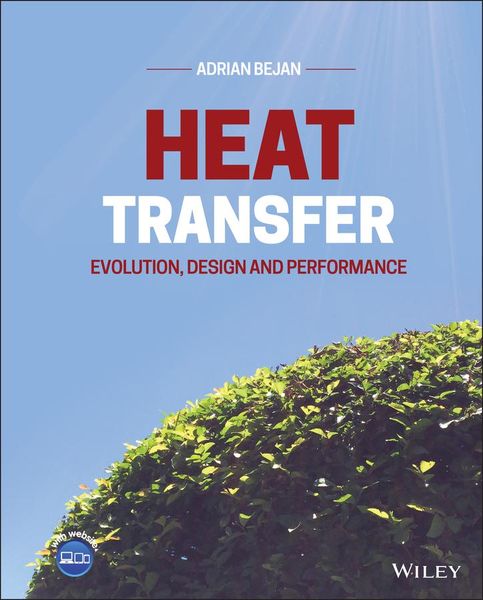
Heat Transfer Evolution, Design and Performance
-
- Hardcover ausgewählt
- Taschenbuch
- eBook
-
Sprache:Englisch
Fr. 173.00
inkl. gesetzl. MwSt.,
Beschreibung
Produktdetails
Einband
Gebundene Ausgabe
Erscheinungsdatum
05.04.2022
Verlag
John Wiley & Sons IncSeitenzahl
608
Maße (L/B/H)
26/21.2/3.9 cm
Gewicht
1569 g
Auflage
1. Auflage
Sprache
Englisch
ISBN
978-1-119-46740-3
HEAT TRANSFER
Provides authoritative coverage of the fundamentals of heat transfer, written by one of the most cited authors in all of Engineering
Heat Transfer presents the fundamentals of the generation, use, conversion, and exchange of heat between physical systems. A pioneer in establishing heat transfer as a pillar of the modern thermal sciences, Professor Adrian Bejan presents the fundamental concepts and problem-solving methods of the discipline, predicts the evolution of heat transfer configurations, the principles of thermodynamics, and more.
Building upon his classic 1993 book Heat Transfer, the author maintains his straightforward scientific approach to teaching essential developments such as Fourier conduction, fins, boundary layer theory, duct flow, scale analysis, and the structure of turbulence. In this new volume, Bejan explores topics and research developments that have emerged during the past decade, including the designing of convective flow and heat and mass transfer, the crucial relationship between configuration and performance, and new populations of configurations such as tapered ducts, plates with multi-scale features, and dendritic fins. Heat Transfer: Evolution, Design and Performance:
* Covers thermodynamics principles and establishes performance and evolution as fundamental concepts in thermal sciences
* Demonstrates how principles of physics predict a future with economies of scale, multi-scale design, vascularization, and hierarchical distribution of many small features
* Explores new work on conduction architecture, convection with nanofluids, boiling and condensation on designed surfaces, and resonance of natural circulation in enclosures
* Includes numerous examples, problems with solutions, and access to a companion website
Heat Transfer: Evolution, Design and Performance is essential reading for undergraduate and graduate students in mechanical and chemical engineering, and for all engineers, physicists, biologists, and earth scientists.
Provides authoritative coverage of the fundamentals of heat transfer, written by one of the most cited authors in all of Engineering
Heat Transfer presents the fundamentals of the generation, use, conversion, and exchange of heat between physical systems. A pioneer in establishing heat transfer as a pillar of the modern thermal sciences, Professor Adrian Bejan presents the fundamental concepts and problem-solving methods of the discipline, predicts the evolution of heat transfer configurations, the principles of thermodynamics, and more.
Building upon his classic 1993 book Heat Transfer, the author maintains his straightforward scientific approach to teaching essential developments such as Fourier conduction, fins, boundary layer theory, duct flow, scale analysis, and the structure of turbulence. In this new volume, Bejan explores topics and research developments that have emerged during the past decade, including the designing of convective flow and heat and mass transfer, the crucial relationship between configuration and performance, and new populations of configurations such as tapered ducts, plates with multi-scale features, and dendritic fins. Heat Transfer: Evolution, Design and Performance:
* Covers thermodynamics principles and establishes performance and evolution as fundamental concepts in thermal sciences
* Demonstrates how principles of physics predict a future with economies of scale, multi-scale design, vascularization, and hierarchical distribution of many small features
* Explores new work on conduction architecture, convection with nanofluids, boiling and condensation on designed surfaces, and resonance of natural circulation in enclosures
* Includes numerous examples, problems with solutions, and access to a companion website
Heat Transfer: Evolution, Design and Performance is essential reading for undergraduate and graduate students in mechanical and chemical engineering, and for all engineers, physicists, biologists, and earth scientists.
Noch keine Bewertungen vorhanden
Verfassen Sie die erste Bewertung zu diesem Artikel
Helfen Sie anderen Kundinnen und Kunden durch Ihre Meinung.