
Animal Models of Movement Disorders Volume I
-
- Hardcover
- Taschenbuch ausgewählt
-
Sprache:Englisch
-
Auflage:Softcover reprint of the original 1st ed. 2012
Fr. 149.00
inkl. gesetzl. MwSt.,
Beschreibung
Produktdetails
Einband
Taschenbuch
Erscheinungsdatum
23.08.2016
Abbildungen
XV, 447 p.
Herausgeber
Emma L. Lane + weitereVerlag
Humana PressSeitenzahl
447
Maße (L/B/H)
25.4/17.8/2.5 cm
Gewicht
866 g
Auflage
Softcover reprint of the original 1st ed. 2012
Sprache
Englisch
ISBN
978-1-4939-6240-2
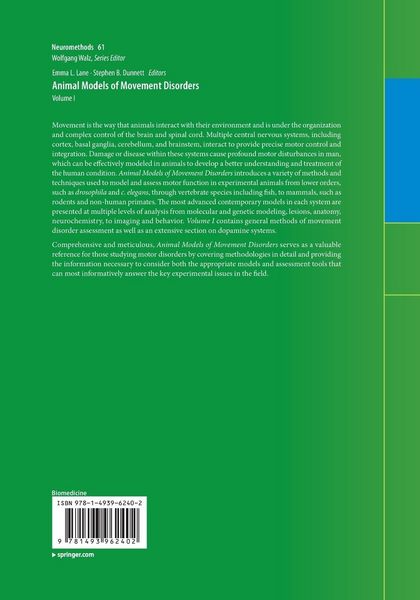
Movement is the way that animals interact with their environment and is under the organization and complex control of the brain and spinal cord. Multiple central nervous systems, including cortex, basal ganglia, cerebellum, and brainstem, interact to provide precise motor control and integration. Damage or disease within these systems cause profound motor disturbances in man, which can be effectively modeled in animals to develop a better understanding and treatment of the human condition. Animal Models of Movement Disorders introduces a variety of methods and techniques used to model and assess motor function in experimental animals from lower orders, such as drosophila and c. elegans , through vertebrate species including fish, to mammals, such as rodents and non-human primates. The most advanced contemporary models in each system are presented at multiple levels of analysis from molecular and genetic modeling, lesions, anatomy, neurochemistry, to imaging and behavior. Volume I contains general methods of movement disorder assessment as well as an extensive section on dopamine systems.
Comprehensive and meticulous, Animal Models of Movement Disorders serves as a valuable reference for those studying motor disorders by covering methodologies in detail and providing the information necessary to consider both the appropriate models and assessment tools that can most informatively answer the key experimental issues in the field.
Noch keine Bewertungen vorhanden
Verfassen Sie die erste Bewertung zu diesem Artikel
Helfen Sie anderen Kundinnen und Kunden durch Ihre Meinung.