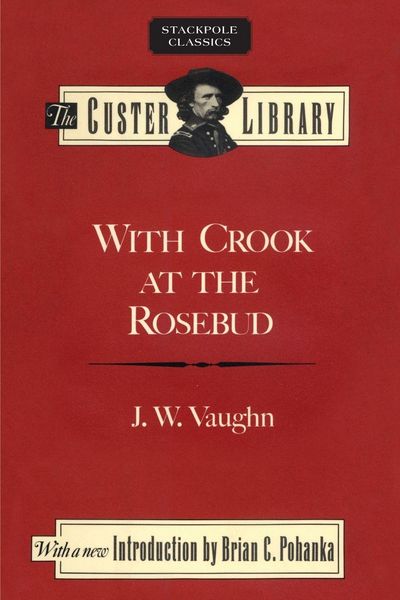
With Crook at the Rosebud
-
- Hardcover
- Taschenbuch ausgewählt
- eBook
-
Sprache:Englisch
Fr. 28.90
inkl. gesetzl. MwSt.,
-
Kostenlose Lieferung ab Fr. 30 Einkaufswert
Schweiz & Liechtenstein:
Versandkostenfrei ab Fr. 30.00
Versandkosten bis Fr. 30.00: Fr. 3.50Andere Lieferländer
Fr. 18.00 unabhängig vom Warenwert
Beschreibung
Produktdetails
Einband
Taschenbuch
Erscheinungsdatum
01.12.2017
Verlag
Globe Pequot Publishing Group IncSeitenzahl
284
Maße (L/B/H)
22.2/15.2/1.7 cm
Gewicht
389 g
Sprache
Englisch
ISBN
978-0-8117-3741-8
“Crook always maintained that, since his command occupied the field after the battle, he was not defeated at the Rosebud, and that if the battle had gone according to his orders, it would have resulted in a real triumph for his men. This view was also held by his superiors, although they called it a ‘barren victory.’ His part in the campaign was to form a junction with the other advancing columns, combining with them in returning the infractious Sioux to their reservations. His immediate purpose was to find and destroy the village of Crazy Horse. He accomplished none of these objectives. Instead he retired from the scene, permitting the forces of Crazy Horse to concentrate their strength against the troops to the north.” From With Crook at the Rosebud
The 1868 Treaty of Fort Laramie gave the Sioux and Cheyenne Indian tribes control over a wide region, covering Montana, Wyoming, Nebraska, and part of the Dakotas. But in the 1870s gold was discovered in the Black Hills, and white settlers invaded Indian territory in desperate search for the precious mineral. Clashes between miners and Indians erupted. After trying other means of settling the disputes, the U.S. government decreed that all Indians in the northwest should be living on reservations by January 1876. The Sioux and the Cheyenne refused to obey, so the Bureau of Indian Affairs called in the military to enforce the order.
Brigadier General George Crook led the Big Horn and Yellowstone Expeditionary forces into southern Montana against rebellious Sioux. But Crazy Horse, leading a party of Sioux and Cheyenne, defeated a portion of Crooks command at Powder River in March 1876. In his chagrin and determination for revenge, Crook led his troops to the Rosebud canyon to destroy Crazy Horse’s village.
The two powerful forces, each numbering more than one thousand men, met at the Rosebud River on June 17. At the end of the fierce, day-long battle, Crook returned to his base nearly forty miles away, convinced that he had won. Time would prove, however, that the battle resulted in a stalemate. Crook’s force was removed from the larger campaign and he was unable to come to Custer’s aid at the Little Big Horn eight days later.
Though the Battle of the Rosebud had a significant impact on the rest of the campaign against the Sioux, it has often been eclipsed by publicity surrounding the Battle of the Little Big Horn. It was not until 1956, when With Crook at the Rosebud was first published by Stackpole, that the first clear history of the battle emerged.
Noch keine Bewertungen vorhanden
Verfassen Sie die erste Bewertung zu diesem Artikel
Helfen Sie anderen Kundinnen und Kunden durch Ihre Meinung.