KI-Beratung Beta

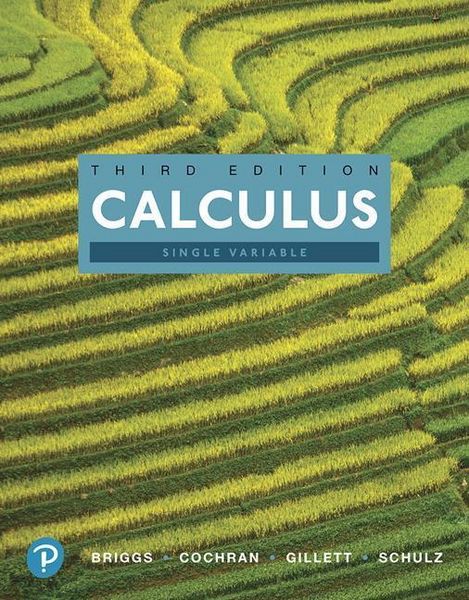
Produktbild: Single Variable Calculus

Single Variable Calculus

Fr. 179.00

inkl. gesetzl. MwSt., Versandkostenfrei


Beschreibung

Produktdetails

Einband

Taschenbuch

Erscheinungsdatum

28.09.2024

Verlag

Pearson

Seitenzahl

936

Maße (L/B/H)

27.6/21.7/3.8 cm

Gewicht

1628 g

Auflage

3. Auflage

Sprache

Englisch

ISBN

978-0-13-476978-3

Beschreibung

Produktdetails

Einband

Taschenbuch

Erscheinungsdatum

28.09.2024

Verlag

Pearson

Seitenzahl

936

Maße (L/B/H)

27.6/21.7/3.8 cm

Gewicht

1628 g

Auflage

3. Auflage

Sprache

Englisch

ISBN

978-0-13-476978-3

Noch keine Bewertungen vorhanden

Verfassen Sie die erste Bewertung zu diesem Artikel

Helfen Sie anderen Kundinnen und Kunden durch Ihre Meinung.

Kundinnen und Kunden meinen

Bewertungen (0)

  • Produktbild: Single Variable Calculus

  • 1. Functions

    • 1.1 Review of Functions

    • 1.2 Representing Functions

    • 1.3 Inverse, Exponential, and Logarithmic Functions

    • 1.4 Trigonometric Functions and Their Inverses

    • Review Exercises


    2. Limits

    • 2.1 The Idea of Limits

    • 2.2 Definitions of Limits

    • 2.3 Techniques for Computing Limits

    • 2.4 Infinite Limits

    • 2.5 Limits at Infinity

    • 2.6 Continuity

    • 2.7 Precise Definitions of Limits

    • Review Exercises


    3. Derivatives

    • 3.1 Introducing the Derivative

    • 3.2 The Derivative as a Function

    • 3.3 Rules of Differentiation

    • 3.4 The Product and Quotient Rules

    • 3.5 Derivatives of Trigonometric Functions

    • 3.6 Derivatives as Rates of Change

    • 3.7 The Chain Rule

    • 3.8 Implicit Differentiation

    • 3.9 Derivatives of Logarithmic and Exponential Functions

    • 3.10 Derivatives of Inverse Trigonometric Functions

    • 3.11 Related Rates

    • Review Exercises


    4. Applications of the Derivative

    • 4.1 Maxima and Minima

    • 4.2 Mean Value Theorem

    • 4.3 What Derivatives Tell Us

    • 4.4 Graphing Functions

    • 4.5 Optimization Problems

    • 4.6 Linear Approximation and Differentials

    • 4.7 L'Hôpital's Rule

    • 4.8 Newton's Method

    • 4.9 Antiderivatives

    • Review Exercises


    5. Integration

    • 5.1 Approximating Areas under Curves

    • 5.2 Definite Integrals

    • 5.3 Fundamental Theorem of Calculus

    • 5.4 Working with Integrals

    • 5.5 Substitution Rule

    • Review Exercises


    6. Applications of Integration

    • 6.1 Velocity and Net Change

    • 6.2 Regions Between Curves

    • 6.3 Volume by Slicing

    • 6.4 Volume by Shells

    • 6.5 Length of Curves

    • 6.6 Surface Area

    • 6.7 Physical Applications

    • Review Exercises


    7. Logarithmic, Exponential, and Hyperbolic Functions

    • 7.1 Logarithmic and Exponential Functions Revisited

    • 7.2 Exponential Models

    • 7.3 Hyperbolic Functions

    • Review Exercises


    8. Integration Techniques

    • 8.1 Basic Approaches

    • 8.2 Integration by Parts

    • 8.3 Trigonometric Integrals

    • 8.4 Trigonometric Substitutions

    • 8.5 Partial Fractions

    • 8.6 Integration Strategies

    • 8.7 Other Methods of Integration

    • 8.8 Numerical Integration

    • 8.9 Improper Integrals

    • Review Exercises


    9. Differential Equations

    • 9.1 Basic Ideas

    • 9.2 Direction Fields and Euler's Method

    • 9.3 Separable Differential Equations

    • 9.4 Special First-Order Linear Differential Equations

    • 9.5 Modeling with Differential Equations

    • Review Exercises


    10. Sequences and Infinite Series

    • 10.1 An Overview

    • 10.2 Sequences

    • 10.3 Infinite Series

    • 10.4 The Divergence and Integral Tests

    • 10.5 Comparison Tests

    • 10.6 Alternating Series

    • 10.7 The Ratio and Root Tests

    • 10.8 Choosing a Convergence Test

    • Review Exercises


    11. Power Series

    • 11.1 Approximating Functions with Polynomials

    • 11.2 Properties of Power Series

    • 11.3 Taylor Series

    • 11.4 Working with Taylor Series

    • Review Exercises


    12. Parametric and Polar Curves

    • 12.1 Parametric Equations

    • 12.2 Polar Coordinates

    • 12.3 Calculus in Polar Coordinates

    • 12.4 Conic Sections

    • Review Exercises


    13. Vectors and the Geometry of Space

    • 13.1 Vectors in the Plane

    • 13.2 Vectors in Three Dimensions

    • 13.3 Dot Products

    • 13.4 Cross Products

    • 13.5 Lines and Planes in Space

    • 13.6 Cylinders and Quadric Surfaces

    • Review Exercises


    14. Vector-Valued Functions

    • 14.1 Vector-Valued Functions

    • 14.2 Calculus of Vector-Valued Functions

    • 14.3 Motion in Space

    • 14.4 Length of Curves

    • 14.5 Curvature and Normal Vectors

    • Review Exercises


    15. Functions of Several Variables

    • 15.1 Graphs and Level Curves

    • 15.2 Limits and Continuity

    • 15.3 Partial Derivatives

    • 15.4 The Chain Rule

    • 15.5 Directional Derivatives and the Gradient

    • 15.6 Tangent Planes and Linear Approximation

    • 15.7 Maximum/Minimum Problems

    • 15.8 Lagrange Multipliers

    • Review Exercises


    16. Multiple Integration

    • 16.1 Double Integrals over Rectangular Regions

    • 16.2 Double Integrals over General Regions

    • 16.3 Double Integrals in Polar Coordinates

    • 16.4 Triple Integrals

    • 16.5 Triple Integrals in Cylindrical and Spherical Coordinates

    • 16.6 Integrals for Mass Calculations

    • 16.7 Change of Variables in Multiple Integrals

    • Review Exercises


    17. Vector Calculus

    • 17.1 Vector Fields

    • 17.2 Line Integrals

    • 17.3 Conservative Vector Fields

    • 17.4 Green's Theorem

    • 17.5 Divergence and Curl

    • 17.6 Surface Integrals

    • 17.7 Stokes' Theorem

    • 17.8 Divergence Theorem

    • Review Exercises


    D2 Second-Order Differential Equations ONLINE

    • D2.1 Basic Ideas

    • D2.2 Linear Homogeneous Equations

    • D2.3 Linear Nonhomogeneous Equations

    • D2.4 Applications

    • D2.5 Complex Forcing Functions

    • Review Exercises


    Appendices

    1. Proofs of Selected Theorems

    2. Algebra Review ONLINE

    3. Complex Numbers ONLINE


    Answers
    Index
    Table of Integrals