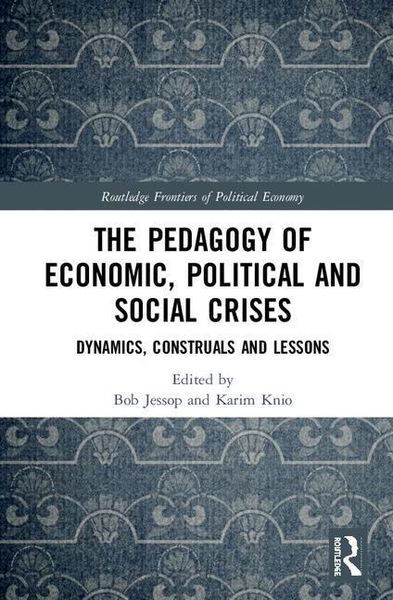
Produktbild: The Pedagogy of Economic, Political and Social Crises

The Pedagogy of Economic, Political and Social Crises Dynamics, Construals and Lessons

Fr. 213.00

inkl. gesetzl. MwSt., Versandkostenfrei


Beschreibung

Produktdetails

Einband

Gebundene Ausgabe

Erscheinungsdatum

07.11.2018

Abbildungen

8 Line drawings, black and white 6 Tables, black and white 8 Illustrations, black and white

Herausgeber

Jessop Bob + weitere

Verlag

Taylor and Francis

Seitenzahl

306

Maße (L/B/H)

18.3/24/2.8 cm

Gewicht

606 g

Sprache

Englisch

ISBN

978-1-138-06250-4

Beschreibung

Produktdetails

Einband

Gebundene Ausgabe

Erscheinungsdatum

07.11.2018

Abbildungen

8 Line drawings, black and white 6 Tables, black and white 8 Illustrations, black and white

Herausgeber

Verlag

Taylor and Francis

Seitenzahl

306

Maße (L/B/H)

18.3/24/2.8 cm

Gewicht

606 g

Sprache

Englisch

ISBN

978-1-138-06250-4

Kundinnen und Kunden meinen

0 Bewertungen

Informationen zu Bewertungen

Zur Abgabe einer Bewertung ist eine Anmeldung im Konto notwendig. Die Authentizität der Bewertungen wird von uns nicht überprüft. Wir behalten uns vor, Bewertungstexte, die unseren Richtlinien widersprechen, entsprechend zu kürzen oder zu löschen.

Die Bewertungen sind nach Format, Anzahl Sterne und Datum sortiert.

Verfassen Sie die erste Bewertung zu diesem Artikel

Helfen Sie anderen Kund*innen durch Ihre Meinung

Kundinnen und Kunden meinen

0 Bewertungen filtern

Die Leseprobe wird geladen.
  • Produktbild: The Pedagogy of Economic, Political and Social Crises
  • Preface. Part I Introducing Some Key Themes. 1. Introduction: Organizational Perspectives on Crisiology and Learning, Karim Knio and Bob Jessop. 2. The Diversity of Crisis Literatures and Learning Processes, Karim Knio. 3. Valid Construals and/or Correct Readings? On the Symptomatology of Crises, Bob Jessop. Part II Resilience in and through Crises. 4. The 2008 Crisis and the Resilience of the Neo-Liberal Order, Andrew Gamble. 5. Crises are the New Normal: Governing Through Resilience, David Chandler. Part III Non-Learning, Fantasy Learning, and Potential Learning. 6. Vision and Ideology in Economic Theory: The Post-Crisis Persistence of Mainstream General Equilibrium Macroeconomics, Matthew Watson. 7. The Crisis in Democracy and Authoritarian Neoliberalism After the Eurozone Crisis: Fantastic Debates and Power as Affording not to Learn from Mistakes, Magnus Ryner. 8. After the Crisis: Lessons on Economic and Political Paradigms and Policies, Robert Boyer. Part IV Fetishistic or Reflexive Learning? 9. The EU’s Competitiveness Fetish: Industrial Renaissance Through Internal Devaluation, Really?, Angela Wigger. 10. The Legitimacy Crisis Within International Criminal Justice and the Importance of Critical, Reflexive Learning, Jeff Handmaker. Part V Limits to Learning and the Scope for Overcoming Them. 11. Insouciance, Indifference and any Inspiration in the Face of Emergent Global Crises?, Des Gasper. 12. The Permanent Crisis of Development Aid, Wil Hout. 13. Crisis, Common Sense and the Limits to Learning in EU External Governance, Zuzana Novakova. Part VI Conclusion. 14. Critical realism, Symptomatology, and the Pedagogy of Crisis, Bob Jessop and Karim Knio