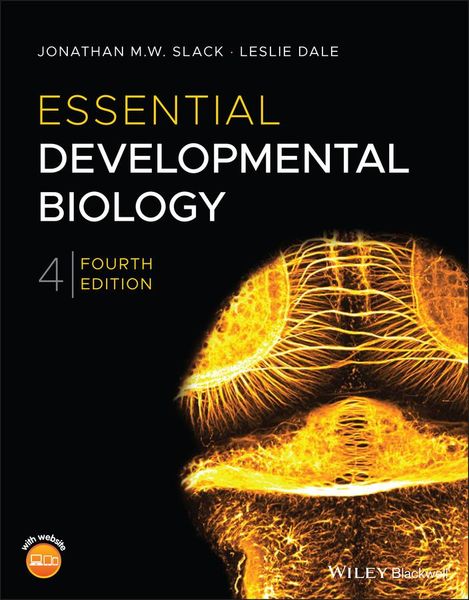
Essential Developmental Biology
-
- Hardcover
- Taschenbuch ausgewählt
- eBook
-
Sprache:Englisch
-
Verlag:John Wiley & Sons Inc
-
Auflage:4. Auflage
- 4. Auflage Fr. 173.00 ausgewählt
- 3. Auflage Fr. 138.00
Fr. 173.00
inkl. gesetzl. MwSt.,
Beschreibung
Produktdetails
Einband
Taschenbuch
Erscheinungsdatum
16.12.2021
Verlag
John Wiley & Sons IncSeitenzahl
544
Maße (L/B/H)
27.5/21.5/2.8 cm
Gewicht
1532 g
Auflage
4. Auflage
Sprache
Englisch
ISBN
978-1-119-51285-1
ESSENTIAL DEVELOPMENTAL BIOLOGY
Discover the foundations of developmental biology with this up to date and focused resource from two leading experts
The newly revised Fourth Edition of Essential Developmental Biology delivers the fundamentals of the developmental biology of animals. Designed as a core text for undergraduate students in their first to fourth years, as well as graduate students in their first year, the book is suited to both biologically based and medically oriented courses. The distinguished authors presume no prior knowledge of development, animal structure, or histology.
The new edition incorporates modern single cell transcriptome sequencing and CRISPR/Cas9, as well as other methods for targeted genetic manipulation. The existing material has also been reorganized to provide for easier reading and learning for students. The book avoids discussions of history and experimental priority and emphasizes instead the modern advances in developmental biology. The authors have kept the text short and focused on the areas truly central to developmental biology. Readers will benefit from the inclusion of such topics as:
* A thorough discussion of the groundwork of developmental biology, including developmental genetics, cell signaling and commitment, and cell and molecular biology techniques
* An exploration of major model organisms, including Xenopus, the zebrafish, the chick, the mouse, the human, Drosophila, and Caenorhabditis elegans
* A treatment of organogenesis, including postnatal development, and the development of the nervous system, mesodermal organs, endodermal organs, and imaginal discs in drosophila
* A final section on growth, stem cell biology, evolution, and regeneration
Perfect for undergraduate students, especially those preparing to enter teaching or graduate studies in developmental biology, Essential Developmental Biology will also earn a place in the libraries of those in the pharmaceutical industry expected to be able to evaluate assays based on developmental systems.
Discover the foundations of developmental biology with this up to date and focused resource from two leading experts
The newly revised Fourth Edition of Essential Developmental Biology delivers the fundamentals of the developmental biology of animals. Designed as a core text for undergraduate students in their first to fourth years, as well as graduate students in their first year, the book is suited to both biologically based and medically oriented courses. The distinguished authors presume no prior knowledge of development, animal structure, or histology.
The new edition incorporates modern single cell transcriptome sequencing and CRISPR/Cas9, as well as other methods for targeted genetic manipulation. The existing material has also been reorganized to provide for easier reading and learning for students. The book avoids discussions of history and experimental priority and emphasizes instead the modern advances in developmental biology. The authors have kept the text short and focused on the areas truly central to developmental biology. Readers will benefit from the inclusion of such topics as:
* A thorough discussion of the groundwork of developmental biology, including developmental genetics, cell signaling and commitment, and cell and molecular biology techniques
* An exploration of major model organisms, including Xenopus, the zebrafish, the chick, the mouse, the human, Drosophila, and Caenorhabditis elegans
* A treatment of organogenesis, including postnatal development, and the development of the nervous system, mesodermal organs, endodermal organs, and imaginal discs in drosophila
* A final section on growth, stem cell biology, evolution, and regeneration
Perfect for undergraduate students, especially those preparing to enter teaching or graduate studies in developmental biology, Essential Developmental Biology will also earn a place in the libraries of those in the pharmaceutical industry expected to be able to evaluate assays based on developmental systems.
Noch keine Bewertungen vorhanden
Verfassen Sie die erste Bewertung zu diesem Artikel
Helfen Sie anderen Kundinnen und Kunden durch Ihre Meinung.