• Produktbild: Phytotoxicity of Nanoparticles
  • Produktbild: Phytotoxicity of Nanoparticles

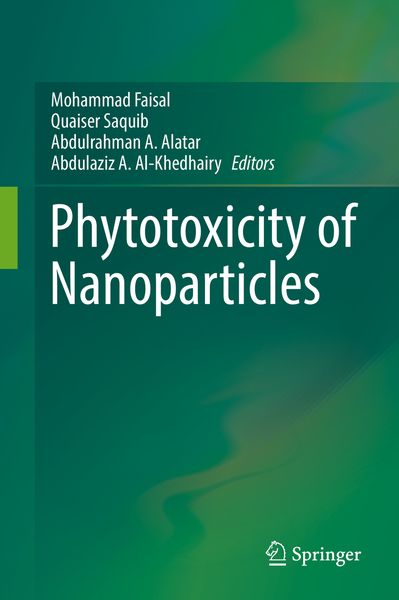
Phytotoxicity of Nanoparticles

Fr. 242.00

inkl. gesetzl. MwSt., Versandkostenfrei


Beschreibung

Produktdetails

Einband

Gebundene Ausgabe

Erscheinungsdatum

12.07.2018

Abbildungen

XV, 77 illus., 56 illus. in color., farbige Illustrationen, schwarz-weiss Illustrationen

Herausgeber

Mohammad Faisal + weitere

Verlag

Springer

Seitenzahl

407

Maße (L/B/H)

24.1/16/2.9 cm

Gewicht

784 g

Auflage

1st ed. 2018

Sprache

Englisch

ISBN

978-3-319-76707-9

Beschreibung

Portrait

  Dr. Mohammad Faisal has over 10 years of research experience in plant biotechnology, and is currently working as an associate professor at the Department of Botany & Microbiology, King Saud University, Riyadh, Saudi Arabia. He was the recipient of the 2017 SESR Plant Biotechnologist Award and the 2015 NESA Scientist of the Year Award, as well as several national and international fellowships. He is a member of numerous academic bodies/societies and fellow of the SESR. He has published over 64 research articles, 3 book chapters and 2 books and is on the editorial board of a number of journals.

Dr. Quaiser Saquib is currently working as an assistant professor and coordinator at the Al-Jeraisy Chair for DNA Research, Zoology Department, College of Science, King Saud University, Riyadh, Saudi Arabia. He received the NESA India Scientist of the Year Award in 2016, and the EMSI India Young Scientist Award in 2008. Dr. Saquib has published 46 research articles, 2 books and 2 book chapters.

Dr. Abdulrahman Alatar is Vice Dean of Graduate Studies, and a professor at the Department of Botany & Microbiology, King Saud University, Riyadh, Saudi Arabia. He has been the PI and Co-I of various projects and has published more than 65 scientific articles, 2 books. His work has been cited in various leading journals.

Professor Abdulaziz A. Al-Khedhairy is Director of the Twasol Research Excellence Program and Al-Jeraisy Chair for DNA Research at King Saud University, Riyadh, Saudi Arabia. He has published 160 research articles, 9 book chapters, 2 books and one US patient. As a PI and CO-I, he has supervised several successful projects funded by KACST, KSA.

Produktdetails

Einband

Gebundene Ausgabe

Erscheinungsdatum

12.07.2018

Abbildungen

XV, 77 illus., 56 illus. in color., farbige Illustrationen, schwarz-weiss Illustrationen

Herausgeber

Verlag

Springer

Seitenzahl

407

Maße (L/B/H)

24.1/16/2.9 cm

Gewicht

784 g

Auflage

1st ed. 2018

Sprache

Englisch

ISBN

978-3-319-76707-9

Herstelleradresse

Springer-Verlag KG
Sachsenplatz 4-6
1201 Wien
AT

Email: GPSR Kontakt

Noch keine Bewertungen vorhanden

Verfassen Sie die erste Bewertung zu diesem Artikel

Helfen Sie anderen Kundinnen und Kunden durch Ihre Meinung.

Kundinnen und Kunden meinen

Bewertungen (0)

  • Produktbild: Phytotoxicity of Nanoparticles
  • Produktbild: Phytotoxicity of Nanoparticles
  • Chapter 1: Nanoparticle Uptake by Plants – Beneficial or Detrimental?.- Chapter 2: Interplay Between Engineered Nanomaterials (ENMs) and Edible Plants: A Current Perspective.- Chapter 3: Penetration and accumulation of carbon-based nanoparticles in plants.- Chapter 4: Phytotoxicity of Rare Earth Nanomaterials.- Chapter 5: Interaction of Nano-sized Nutrients with Plant Biomass: A Review.- Chapter 6: Current Status of Nanoclays Phytotoxicity.- Chapter 7: Mechanism and Interaction of Nanoparticle-induced Programmed Cell Death in Plants.- Chapter 8: Metal-based nanomaterials and oxidative stress in plants – current aspects and overview.- Chapter 9: Biological and phytotoxic impacts of nanomaterial.- Chapter 10: Nanoparticle Associated Phytotoxicity and Abiotic Stress under Agroecosystems.- Chapter 11: Phytotoxic assessment of NiO Nanoparticles in Radish.- Chapter 12: Nano-silicon Particles Effects on Physiology and Growth of Woody Plants.- Chapter 13: Phytotoxicity of nanoscale zero valentiron (nZVI) in remediation strategies.- Chapter 14:    Alumina Nanoparticles and Plants: Environmental transformation, Bioaccumulation and Phytotoxicity.- Chapter 15: Lanatana aculeate L. Mediated Zin Oxide Nanoparticles Induced DNA Damage in Sesamumindicumand their cytotoxic activity against SiHa cell line.- Chapter 16: Uptake and distribution of 14C-labeled multi-walled carbon nanotubes by wheat (Triticum aestivum L.).- Chapter 17: Plant Response Strategies to Engineered Metal Oxide Nanoparticles-A Review.- Chapter 18: Nanobiotechnology in the Health Care: The Game and the Goal.