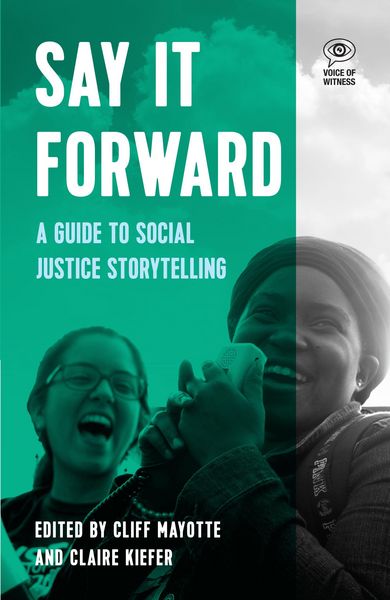
Say it Forward A Guide to Social Justice Storytelling
-
- Hardcover
- Taschenbuch ausgewählt
- eBook
-
Sprache:Englisch
Fr. 31.90
inkl. gesetzl. MwSt.,
Beschreibung
Produktdetails
Einband
Taschenbuch
Erscheinungsdatum
18.12.2018
Herausgeber
Mayotte Cliff + weitereVerlag
Haymarket BooksSeitenzahl
290
Maße (L/B/H)
21.6/14/1.5 cm
Gewicht
340 g
Sprache
Englisch
ISBN
978-1-60846-958-1
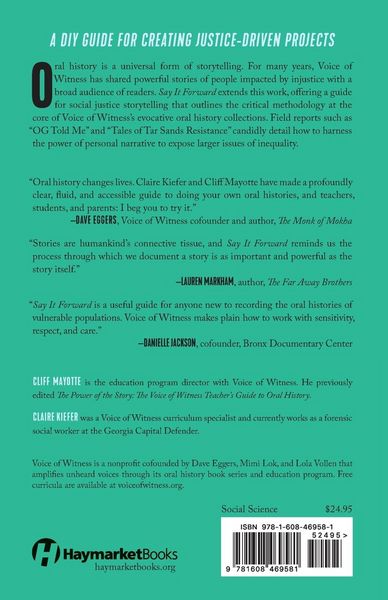
Oral history is a universal form of storytelling. For many years Voice of Witness, cofounded by Dave Eggers, has shared powerful stories of people impacted by in- justice with a broad audience of readers.
Say it Forward is an extension of this work: a guide for social justice storytelling that outlines Voice of Witness' critical methodolog y at the core of their evocative oral history collections. Expert editors and authors candidly outline how to harness the power of the personal narrative to expose larger issues of inequality.
An essential resource for empathetic oral historians, this guide addresses a lot of the ideas that many people aren't sure how to talk about, such as: How do I interview people who belong to a very different community than the one I'm from? How can power dynamics impact a narrator's comfort? How do I deal with secondary trauma when listening to difficult stories? Say It Forward will support readers with everything from the initial planning phases to the deeper, more essential questions that examine the ethics of the practice.
Cliff Mayotte is the Education Program Director with Voice of Witness. He previously edited The Power of the Story: The Voice of Witness Teachers Guide to Oral History published in 2013 by Voice of Witness and McSweeney's.
Claire Kiefer is the author of Bear Witness, forthcoming from Big Pencil Press in Fall 2018. She is a Voice of Witness Curriculum Specialist.
Noch keine Bewertungen vorhanden
Verfassen Sie die erste Bewertung zu diesem Artikel
Helfen Sie anderen Kundinnen und Kunden durch Ihre Meinung.