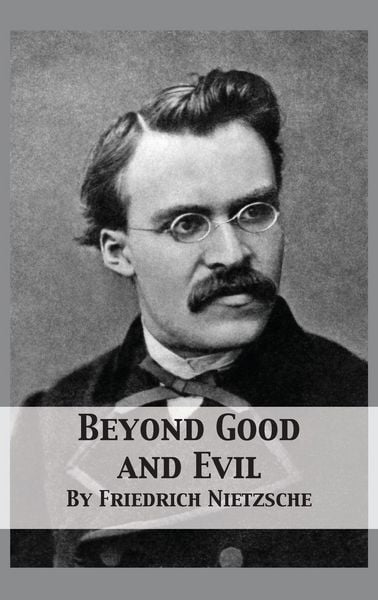
Beyond Good and Evil Prelude to a Philosophy of the Future
-
- Hardcover ausgewählt
- Taschenbuch
- eBook
- Hörbuch
-
Sprache:Englisch
- Deutsch Fr. 33.90
- Englisch Fr. 26.90 ausgewählt
-
Verlag:12th Media Services
- Arcturus Publishing Fr. 19.90
- Salmon Books Fr. 31.90
- Bibliotech Pr Fr. 38.90
- Akasha Publishing, LLC Fr. 39.90
- Ingram Publishers Services Fr. 28.90
- Iap Fr. 33.90
- Chiltern Publishing Fr. 38.90
- Arcturus Publishing Ltd Fr. 18.90
- 12th Media Services Fr. 26.90 ausgewählt
- Wilder Publications Fr. 38.90
- Prakash Books Fr. 23.90
- Start Publishing PD Fr. 36.90
- HarperCollins Fr. 31.90
- 1St World Library Fr. 39.90
- Benediction Classics Fr. 37.90
- Simon & Brown Fr. 33.90
- Chump Change Fr. 27.90
- Gröls Verlag Fr. 29.90
- Penguin Books Ltd Fr. 19.90
Fr. 26.90
inkl. gesetzl. MwSt.,
-
Kostenlose Lieferung ab Fr. 30 Einkaufswert
Schweiz & Liechtenstein:
Versandkostenfrei ab Fr. 30.00
Versandkosten bis Fr. 30.00: Fr. 3.50Andere Lieferländer
Fr. 18.00 unabhängig vom Warenwert
Beschreibung
Produktdetails
Einband
Gebundene Ausgabe
Erscheinungsdatum
01.01.1886
Verlag
12th Media ServicesSeitenzahl
102
Maße (L/B/H)
24/16.1/1 cm
Gewicht
326 g
Sprache
Englisch
ISBN
978-1-68092-190-8
Beyond Good and Evil: Prelude to a Philosophy of the Future (German: Jenseits von Gut und Böse: Vorspiel einer Philosophie der Zukunft) is a book by philosopher Friedrich Nietzsche that expands the ideas of his previous work, Thus Spoke Zarathustra, with a more critical and polemical approach. It was first published in 1886. In Beyond Good and Evil, Nietzsche accuses past philosophers of lacking critical sense and blindly accepting dogmatic premises in their consideration of morality. Specifically, he accuses them of founding grand metaphysical systems upon the faith that the good man is the opposite of the evil man, rather than just a different expression of the same basic impulses that find more direct expression in the evil man. The work moves into the realm "beyond good and evil" in the sense of leaving behind the traditional morality which Nietzsche subjects to a destructive critique in favour of what he regards as an affirmative approach that fearlessly confronts the perspectival nature of knowledge and the perilous condition of the modern individual. Source: Wikipedia
Noch keine Bewertungen vorhanden
Verfassen Sie die erste Bewertung zu diesem Artikel
Helfen Sie anderen Kundinnen und Kunden durch Ihre Meinung.