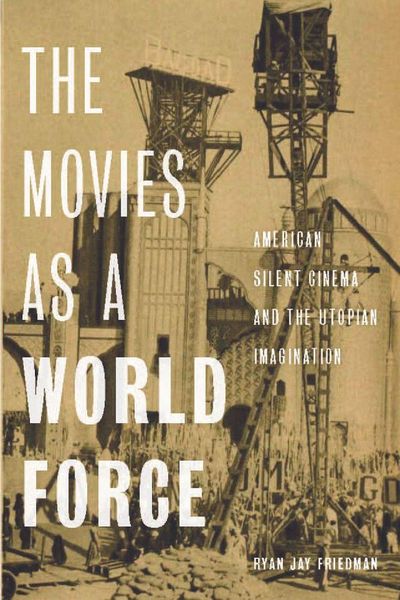
The Movies as a World Force American Silent Cinema and the Utopian Imagination
-
- Englisch ausgewählt
Fr. 52.90
inkl. gesetzl. MwSt.,
Beschreibung
Produktdetails
Einband
Taschenbuch
Erscheinungsdatum
04.02.2019
Verlag
Rutgers University PressSeitenzahl
264
Maße (L/B/H)
22.9/15.2/2 cm
Gewicht
363 g
Sprache
Englisch
ISBN
978-0-8135-9359-3
Throughout the silent-feature era, American artists and intellectuals routinely described cinema as a force of global communion, a universal language promoting mutual understanding and harmonious coexistence amongst disparate groups of people. In the early 1920s, film-industry leaders began to espouse this utopian view, in order to claim for motion pictures an essentially uplifting social function. The Movies as a World Force examines the body of writing in which this understanding of cinema emerged and explores how it shaped particular silent films and their marketing campaigns. The utopian and universalist view of cinema, the book shows, represents a synthesis of New Age spirituality and the new liberalism. It provided a framework for the first official, written histories of American cinema and persisted as an advertising trope, even after the transition to sound made movies reliant on specific national languages.
Noch keine Bewertungen vorhanden
Verfassen Sie die erste Bewertung zu diesem Artikel
Helfen Sie anderen Kundinnen und Kunden durch Ihre Meinung.