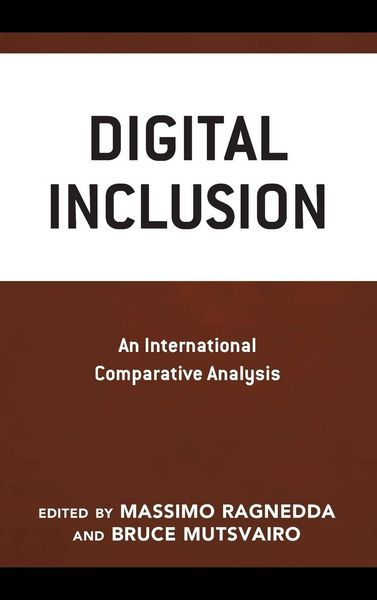
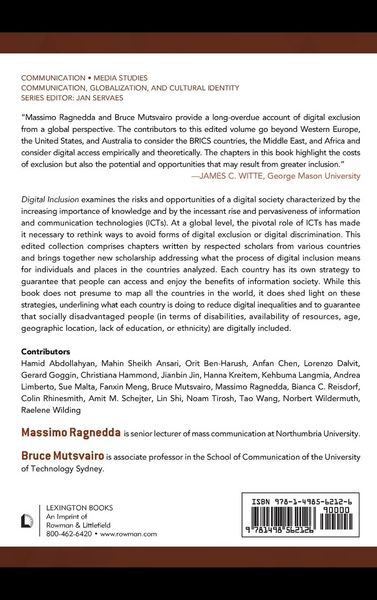
Introduction: Digital Inclusion: Empowering People through Information and Communication Technologies (ICTs), Massimo Ragnedda and Bruce Mutsvairo
Part I: Digital Inclusion in Advanced Countries
Chapter 1: Reducing and Preventing Digital Discrimination: Digital Inclusion Strategies in Europe, Massimo Ragnedda
Chapter 2: Not So Ubiquitous: Digital Inclusion and Older Adults in Australia, Sue Malta and Raelene Wilding
Chapter 3: Digital Inclusion in International Perspective: An Asset-Based Approach to Digital Inclusion Research in the US Context, Bianca C. Reisdorf and Colin Rhinesmith
Part II: Digital Inclusion in BRICS Countries
Chapter 4: From Access to Proficiency: Reconceptualising Digital Inclusion in a Rural Area in South Africa, Lorenzo Dalvit
Chapter 5: Mapping the Evolutive Trajectories of China's Digital Divide: A Longitudinal Observation, Jianbin Jin, Fanxin Meng, Anfan Chen, Lin Shi, and Tao Wang
Chapter 6: Changes in Knowledge Acquisition According to the Proximity with Digital Media Networks, Andrea Limberto
Part III: Digital Inclusion in the Middle East
Chapter 7: Digital Inclusion in Jordan: Opportunities and Hurdles, Hanna Kreitem
Chapter 8: An Explanatory Analysis of Facebook's Effect on Social Cohesion in Iran, Hamid Abdollahyan and Mahin Sheikh Ansari
Chapter 9: "Nothing Is Ever Truly New": The Persisting Digital Exclusion in Israel, 2002-2013, Amit M. Schejter, Orit Ben-Harush, and Noam Tirosh
Part IV: Digital Inclusion in Africa
Chapter 10: ICT and Development: Narrowing the Digital Divide and the Knowledge Gap of ICT Users in Cameroon and Ghana, Kehbuma Langmia and Christiana Hammond
Chapter 11: Kenya's Digital Divide: Challenged, Evolving, and Persistent, Norbert Wildermuth
Afterword, Why Digital Inclusion Now? Gerard Goggin