• Produktbild: Towards Extensible and Adaptable Methods in Computing
  • Produktbild: Towards Extensible and Adaptable Methods in Computing

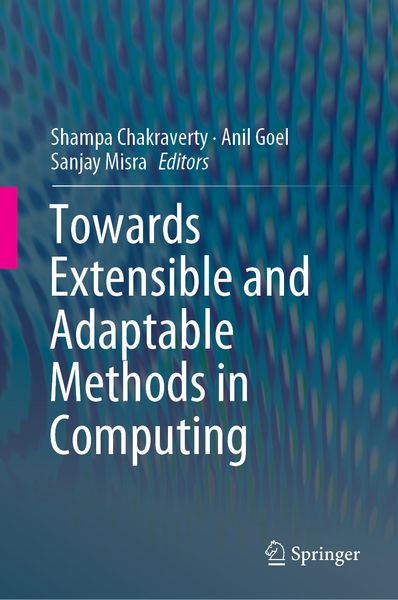
Towards Extensible and Adaptable Methods in Computing

Fr. 138.00

inkl. gesetzl. MwSt., Versandkostenfrei


Beschreibung

Produktdetails

Einband

Gebundene Ausgabe

Erscheinungsdatum

13.11.2018

Abbildungen

XIX, 407 p. 179 illus., 119 illus. in color.

Herausgeber

Shampa Chakraverty + weitere

Verlag

Springer Singapore

Seitenzahl

407

Maße (L/B/H)

24.1/16/2.9 cm

Gewicht

805 g

Auflage

1. Auflage

Sprache

Englisch

ISBN

978-981-13-2347-8

Beschreibung

Portrait

Dr. Shampa Chakraverty is a Professor at the Computer Engineering Division of Netaji Subhas Institute of Technology, New Delhi. She completed her B.E. in Electronics and Communication Engineering at Delhi University, her M.Tech. in Integrated Electronics and Circuits at the IIT Delhi, and her PhD at Delhi University.

Her research interests include sentiment, emotion and human language analysis, E-learning and engineering pedagogy, computer security – trust and digital watermarking, and design exploration of multiprocessor architectures.

Dr. Anil Goel is the Vice President of Engineering at SAP Canada, where he is also head of global development for a number of products and technologies related to SAP’s HANA Platform. He earned a Ph.D. (CS) from the University of Waterloo, Canada, and an M.Tech. (CS) from the IIT Delhi.

Dr. Sanjay Misra is a Professor of Computer (Software) Engineering at Covenant University (CU), Nigeria. He received hisM.E. in Software Engineering and his Ph.D. in Information Engineering from the University of Alcala, Spain.

His research interests are in information engineering, software engineering, web engineering, software quality assurance, software process improvement, cloud computing and cyber security.


Produktdetails

Einband

Gebundene Ausgabe

Erscheinungsdatum

13.11.2018

Abbildungen

XIX, 407 p. 179 illus., 119 illus. in color.

Herausgeber

Verlag

Springer Singapore

Seitenzahl

407

Maße (L/B/H)

24.1/16/2.9 cm

Gewicht

805 g

Auflage

1. Auflage

Sprache

Englisch

ISBN

978-981-13-2347-8

Herstelleradresse

Springer-Verlag KG
Sachsenplatz 4-6
1201 Wien
AT

Email: ProductSafety@springernature.com

Noch keine Bewertungen vorhanden

Verfassen Sie die erste Bewertung zu diesem Artikel

Helfen Sie anderen Kundinnen und Kunden durch Ihre Meinung.

Kundinnen und Kunden meinen

Bewertungen (0)

  • Produktbild: Towards Extensible and Adaptable Methods in Computing
  • Produktbild: Towards Extensible and Adaptable Methods in Computing
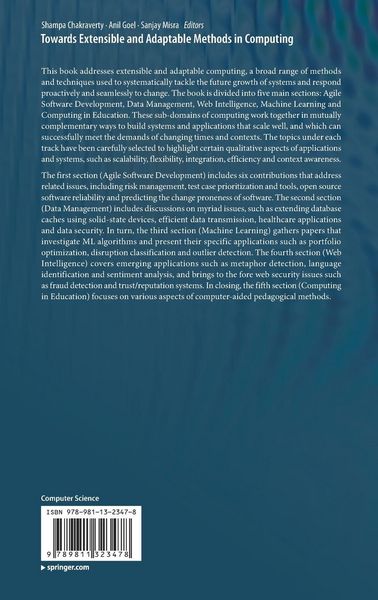
  • Chapter 1. Risk Assessment Framework: ADRIM Process model for Global Software Development.- Chapter 2. An Extended Test Case Prioritization Technique using Script and Linguistic Parameters in a Distributed Agile Environment.- Chapter 3. AutoJet: Web Application Automation Tool.- Chapter 4. Prioritisation of User Story Acceptance Tests in Agile Software Development using Meta Heuristic Techniques in Comparative Analysis.- Chapter 5. Software Reliability assessment using Deep Learning Technique.- Chapter 6 . Empirical Validation of OO metrics and machine learning algorithms for software change proneness.- Chapter 7. Extending database cache using SSDs.- Chapter 8. Cloud Based Healthcare Monitoring System Using STORM And KAFKA.- Chapter 9. Honeynet Data Analysis and Distributed SSH Brute-Force Attacks.- Chapter 10. Efficient Data Transmission in WSN: Techniques & Future Challenges.- Chapter 11. A Study of Epidemic Spreading and Rumor Spreading over Complex Networks.- Chapter 12. Medical Alert System using Social Data.- Chapter 13. A novel framework for portfolio optimization based on modified Simulated Annealing algorithm using ANN, RBFN and ABC Algorithm.- Chapter 14. A Proposed Method for Disruption Classification in Tokamak using Convolutional Neural Network.- Chapter 15. Comparative Evaluation of Machine Learning Algorithms for Network Intrusion Detection Using Weka.- Chapter 16. Super-Intelligent Machine Operations in 21st Century  Manufacturing Industries: A Boost or Doom to Political and Human Development?.- Chapter 17. Exploring Ensembles for Unsupervised Outlier  Detection: An Empirical Analysis.- Chapter 18. A Review of Type-III Metaphors.- Chapter 19. Multi-Class Classification of Sentiments in Hindi Sentences Based on Intensities.- Chapter 20. Language identification for Hindi language transliterated text in Roman Script using Generative Adversarial Networks.- Chapter 21. An improved Similarity Measure to alleviate sparsity problem in Context Aware Recommender Systems.- Chapter 22. Trust and Reputation-Based Model to Prevent Denial of Service Attacks in Mobile Agent System.- Chapter 23. Fraud Detection in Online Transactions Using Supervised Learning Techniques.- Chapter 24. Real-time Printed Text Reader for Visually Impaired.- Chapter 25. Knowledge and Belief Based Task Assignment in Crowdsourcing Platform.- Chapter 26. Teaching Algorithms Using an Android App.- Chapter 27. Keyword Extraction using Graph Centrality and WordNet.- Chapter 28. Hybrid Mobile Learning Architecture for Higher Education.- Chapter 29. Using Collaborative Robotics as a Way to Engage Students.- Chapter 30. Assessing Scratch Programmers’ Development of Computational Thinking with Transaction-Level Data.