KI-Beratung Beta

  • Produktbild: Treatment of Sex Offenders
  • Produktbild: Treatment of Sex Offenders

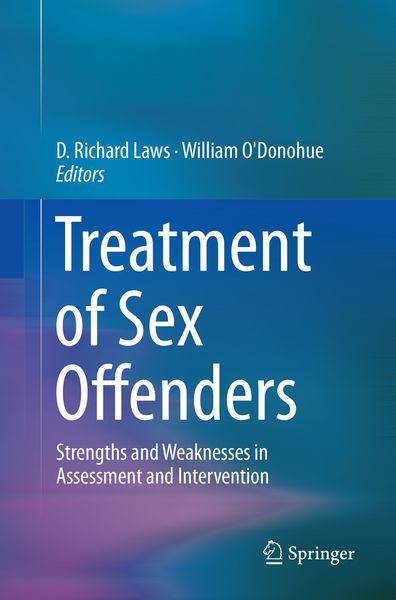
Treatment of Sex Offenders Strengths and Weaknesses in Assessment and Intervention

Fr. 112.00

inkl. gesetzl. MwSt., Versandkostenfrei


Beschreibung

This rigorous survey offers a comprehensive rethinking of the assessment and treatment of sexual offenders for a bold challenge to practitioners. It critiques what we understand about offenders and the mechanisms of offending behaviors, and examines how this knowledge can best be used to reduce offending...

Beschreibung

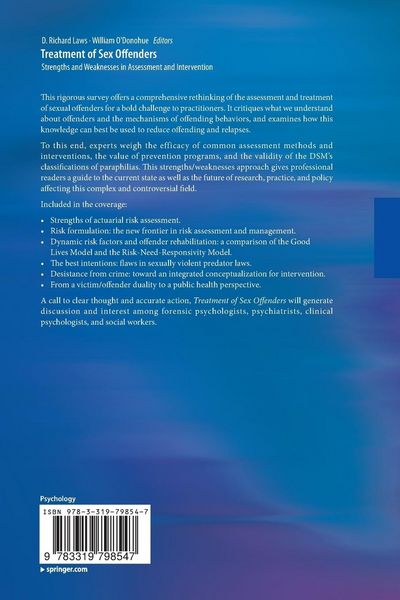
This rigorous survey offers a comprehensive rethinking of the assessment and treatment of sexual offenders for a bold challenge to practitioners. It critiques what we understand about offenders and the mechanisms of offending behaviors, and examines how this knowledge can best be used to reduce offending and relapses.   To this end, experts weigh the efficacy of common assessment methods and interventions, the value of prevention programs, and the validity of the DSM’s classifications of paraphilias. This strengths/weaknesses approach gives professional readers a guide to the current state as well as the future of research, practice, and policy affecting this complex and controversial field.   Included in the coverage:   Strengths of actuarial risk assessment. Risk formulation: the new frontier in risk assessment and management.  Dynamic risk factors and offender rehabilitation: a comparisonof the Good Lives Model and the Risk-Need-Responsivity Model. The best intentions: flaws in sexually violent predator laws. Desistance from crime: toward an integrated conceptualization for intervention.From a victim/offender duality to a public health perspective.   A call to clear thought and accurate action, Treatment of Sex Offenders will generate discussion and interest among forensic psychologists, psychiatrists, clinical psychologists, and social workers.  

Rezension

“High-profile authors have written 14 chapters covering a wide range of topics, including risk assessment, assessment of disordered sexual arousal, strengths and weaknesses of treatment, and community control. ... Treatment of Sex Offenders is a well-written book … edited by two well-respected figures in the field. ... this appears to be an important contribution to the field and will prove to be quite useful for documenting the current state-of-the-art in assessment and treatment of sexual offenders.” (Anita Schlank, PsycCRITIQUES, Vol. 61 (36), September, 2016)

“The intended audience is forensic psychologists, psychiatrists, clinical psychologists, and social workers. The book is written by an international collection of authors from the U.S., the U.K., Canada, Germany, and New Zealand. … This book does a good job of discussing both theoretical and clinical issues. The strengths/weaknesses approach helps clinicians to better understand what works and what does not. It should be in the libraries of professionals and researchers who work with sexual offenders.” (Gary B. Kaniuk, Doody's Book Reviews, August, 2016)

Portrait

D.Richard Laws, Ph.D., was the director of the Sexual Behavior Laboratory at Atascadero State Hospital in California from 1970-1985; project director at the Florida Mental Health Institute from 1985-1989; manager of forensic psychology at Alberta Hospital, Edmonton, Alberta from 1989-1994; and most recently a psychologist with Adult Forensic Psychiatric Services in Victoria, British Columbia from 1994 until his retirement in 1999. Dr. Laws is known in the field of sexual deviation as a developer of assessment procedures and in program development and evaluation. He is the author of numerous articles and book chapters in this area and serves on the editorial board of several journals. He is past president of the Association for the Treatment of Sexual Abusers. He is adjunct faculty at the University of Victoria and Simon Fraser University in British Columbia and is Honorary Professor at the University of Birmingham (UK) and Cardiff University (UK). William O’Donohue, Ph.D. is a licensed psychologist and chairman and professor of psychology at the University of Nevada, Reno, and an adjunct professor in the department of philosophy and a faculty member of the National Judicial College. He has published over 70 books and 150 journal articles and book chapters. He holds advanced degrees both in philosophy and psychology. For the past 14 years, he has been director of a free clinic that treats children who have been sexually abused and adults who have been sexually assaulted.

Produktdetails

Einband

Taschenbuch

Erscheinungsdatum

24.04.2018

Abbildungen

X, 348 p. 4 illus., 3 illus. in color.

Herausgeber D. Richard Laws + weitere

Produktdetails

Einband

Taschenbuch

Erscheinungsdatum

24.04.2018

Abbildungen

X, 348 p. 4 illus., 3 illus. in color.

Herausgeber
Verlag Springer
Seitenzahl

348

Maße (L/B/H)

23.5/15.5/2 cm

Gewicht

546 g

Auflage

Softcover reprint of the original 1st ed. 2016

Sprache

Englisch

ISBN

978-3-319-79854-7

Herstelleradresse

Springer-Verlag KG
Sachsenplatz 4-6
1201 Wien
AT

Email: ProductSafety@springernature.com

Noch keine Bewertungen vorhanden

Verfassen Sie die erste Bewertung zu diesem Artikel

Helfen Sie anderen Kundinnen und Kunden durch Ihre Meinung.

Kundinnen und Kunden meinen

Bewertungen (0)

  • Produktbild: Treatment of Sex Offenders
  • Produktbild: Treatment of Sex Offenders
  • Problems in diagnosis.- Problems in classification: major vs. minor paraphilias.- A brief history of risk assessment.- Strengths of risk assessment.- Weaknesses of risk assessment.- Community control of sex offenders.- Phallometry vs. viewing time.- Polygrtaphy in the treatment of sex offenders.- Shortcomings of sex offender treatment.- Two models: Risk-Need-Responsibility (RNR) vs. Good Lives Model (GLM).- Desistance-focused rehabilitation of sex offenders.- The strengths of sex offender treatment.- Civil commitment of "sexual predators".- Prevention of sex offending: the public health approach.- Early detection: the case for juvenile sex offender treatment.- Summary and conclusions