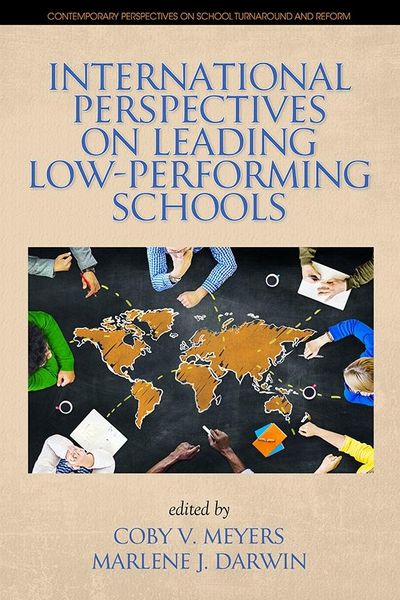
International Perspectives on Leading Low-Performing Schools
-
- Hardcover
- Taschenbuch
- eBook ausgewählt
-
Form:Einzelkauf Download
-
Sprache:Englisch
Fr. 62.90
inkl. gesetzl. MwSt.Beschreibung
Produktdetails
Format
ePUB
Kopierschutz
Ja
Family Sharing
Ja
Text-to-Speech
Ja
Erscheinungsdatum
08.01.2018
Herausgeber
Coby V. MeyersVerlag
Information Age PublishingSeitenzahl
341 (Printausgabe)
Dateigröße
13503 KB
Sprache
Englisch
EAN
9781641133456
Research is clear: School leadership quality matters. However, our knowledge of effective school leadership remains limited in at least three substantial ways. First, our understanding of school leadership effectiveness generally and school principal effectiveness specifically is limited to Western contexts, primarily North America and western European ones. Second, even in the confines of Western research and context, there has been relatively little specific focus on effectively leading low-performing schools. Third, even the conceptualization of leadership-do we mean the school principal, an administrative team, or a broader school leadership team-is a key factor in how we define and respond to the challenge of leading in low-performing schools. This book advances discussion and disseminates knowledge and global perspectives on what school leadership looks like, how it is enacted and under what circumstances, and when or where lessons might be portable.
We anticipate this book having wide appeal for researchers, policymakers, and practitioners considering school leadership and how to support it effectively. The chapters suggest a noticeable level of convergence globally on how to lead low-performing schools effectively. Yet, there are clear political and culture differences that add significant gradation to how school leaders might enact best practice locally or inform policymakers and systems leaders about how to set up school leaders for success and subsequently support them. This book is one of the first that prioritizes the universality and nuance of leading low-performing schools globally.
We anticipate this book having wide appeal for researchers, policymakers, and practitioners considering school leadership and how to support it effectively. The chapters suggest a noticeable level of convergence globally on how to lead low-performing schools effectively. Yet, there are clear political and culture differences that add significant gradation to how school leaders might enact best practice locally or inform policymakers and systems leaders about how to set up school leaders for success and subsequently support them. This book is one of the first that prioritizes the universality and nuance of leading low-performing schools globally.
Kundinnen und Kunden meinen
Verfassen Sie die erste Bewertung zu diesem Artikel
Helfen Sie anderen Kund*innen durch Ihre Meinung