• Produktbild: Caatinga
  • Produktbild: Caatinga

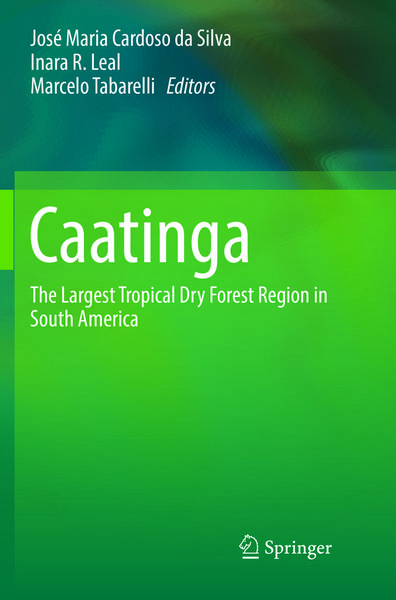
Caatinga The Largest Tropical Dry Forest Region in South America

Fr. 242.00

inkl. gesetzl. MwSt., Versandkostenfrei


Beschreibung

Produktdetails

Einband

Taschenbuch

Erscheinungsdatum

04.06.2019

Abbildungen

XXI, 74 illus., 37 illus. in color., farbige Illustrationen, schwarz-weiss Illustrationen

Herausgeber

José Maria Cardoso da Silva + weitere

Verlag

Springer

Seitenzahl

482

Maße (L/B/H)

23.5/15.5/2.8 cm

Gewicht

780 g

Auflage

Softcover reprint of the original 1st ed. 2017

Sprache

Englisch

ISBN

978-3-319-88583-4

Beschreibung

Portrait

José Maria Cardoso da Silva  has a BSc. from Universidade Federal do Pará, MSc. from Universidade de Brasília and a PhD from the University of Copenhagen. He is currently Professor of the Department of Geography at the University of Miami. He has more than 15 years managing conservation programs and developing research on sustainable development around the world. Dr. Silva has published more than 100 papers and book chapters. He received several awards for his scientific accomplishments.

Inara R. Leal  has the BSc from Universidade Federal de Santa Catarina and a PhD from Universidade Estadual de Campinas. She is Adjunct Professor at the Universidade Federal de Pernambuco. Her research is focused on how anthropogenic disturbances influence plant-animal interactions in Caatinga and Atlantic Forest. Dr. Leal has published more than a 100 papers and book chapters, and 6 books. 

Marcelo Tabarelli  has a BSc in Agronomic Engineering fromUniversidade Federal de Santa Maria and a PhD from Universidade de São Paulo. Currently, he is Associate Professor at Universidade Federal de Pernambuco with research activities devoted to plant ecology and conservation, particularly tropical forests. Dr. Tabarelli has published over 100 papers and dozens of book chapters.

Produktdetails

Einband

Taschenbuch

Erscheinungsdatum

04.06.2019

Abbildungen

XXI, 74 illus., 37 illus. in color., farbige Illustrationen, schwarz-weiss Illustrationen

Herausgeber

Verlag

Springer

Seitenzahl

482

Maße (L/B/H)

23.5/15.5/2.8 cm

Gewicht

780 g

Auflage

Softcover reprint of the original 1st ed. 2017

Sprache

Englisch

ISBN

978-3-319-88583-4

Herstelleradresse

Springer-Verlag KG
Sachsenplatz 4-6
1201 Wien
AT

Email: GPSR Kontakt

Noch keine Bewertungen vorhanden

Verfassen Sie die erste Bewertung zu diesem Artikel

Helfen Sie anderen Kundinnen und Kunden durch Ihre Meinung.

Kundinnen und Kunden meinen

Bewertungen (0)

Weitere Artikel finden Sie in

  • Produktbild: Caatinga
  • Produktbild: Caatinga
  • Part I Introduction: Chapter 1: The Caatinga: understanding the challenges.- Part II Biodiversity: Chapter 2: Diversity and evolution of the flowering plants of the Caatinga Domain.- Chapter 3: Ants of the Caatinga: diversity, biogeography and functional responses to anthropogenic disturbance and climate change.- Chapter 4: Diversity, distribution and conservation of the Caatinga fishes: advances and challenges.- Chapter 5: Ecology, biogeography and conservation of amphibians of the Caatinga.- Chapter 6: Species composition, biogeography and conservation of the Caatinga Lizards.- Chapter 7: The avifauna of the Caatinga: biogeography, ecology, and conservation.- Chapter 8: Mammals of the Caatinga: diversity, ecology, biogeography and conservation.- Chapter 9: Plant-animal interactions in the Caatinga: overview and perspectives.- Part III Ecosystem Services: Chapter 10: Water as capital and its uses in the Caatinga.- Chapter 11: People and natural resources in the Caatinga.-Chapter 12: Cultural Services in the Caatinga.- Part IV Threats: Chapter 13: Human impacts on the Caatinga.- Chapter 14: The socioecology of the Caatinga: understanding how natural resource use shapes an ecosystem.- Chapter 15: Future climate change in the Caatinga.- Part V Solutions: Chapter 16: Sustainable agricultural uses in the Caatinga.- Chapter 17: Conservation opportunities in the Caatinga.- Chapter 18: Sustainable development in the Caatinga.- Part VI Conclusions: Chapter 19: The future of the Caatinga.-