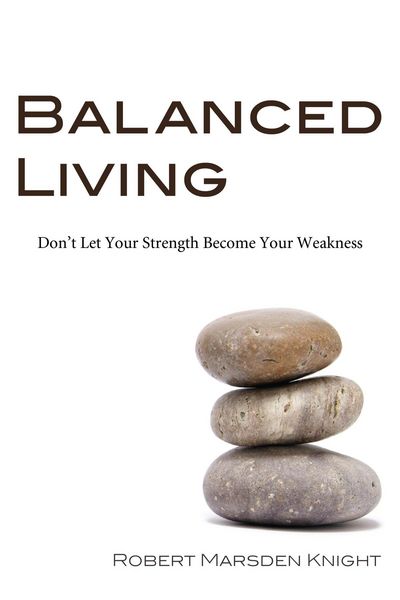
Balanced Living Don't Let Your Strength Become Your Weakness
-
- Hardcover
- Taschenbuch
- eBook ausgewählt
-
Form:Einzelkauf Download
-
Sprache:Englisch
Fr. 28.90
inkl. gesetzl. MwSt.Beschreibung
Produktdetails
Format
ePUB
Kopierschutz
Nein
Family Sharing
Nein
Text-to-Speech
Ja
Erscheinungsdatum
01.01.2009
Verlag
Wipf and Stock PublishersSeitenzahl
212 (Printausgabe)
Dateigröße
328 KB
Sprache
Englisch
EAN
9781621892182
In Balanced Living: Don't Let Your Strength Become Your Weakness, Robert Knight develops the theme of balance as central to good mental health, to moral and spiritual health, to emotional well-being, and to social functioning. This theme emerges from his more than thirty years of experience as a Christian minister, as a counselor, as a teacher and clinical supervisor of counselors, as well as from experience as a management and human-relations consultant. According to Knight, when we are failing or falling, it isn't always because of some inadequacy or limitation; it is rather because we have taken a strength (or it has taken us) too far--a strength that has become a weakness.
The signature chapter, "Balanced Living," addresses such common tensions as success and failure. It asks: How seriously do you take yourself? What time is it in your life?
Following chapters cover balanced families, balance and personality type (using the Myers-Briggs Type Indicator), and balanced religion (achieving healthy moral and spiritual balance). Based on common questions, the chapter on "Counseling and Psychotherapy" guides consumers of professional counseling services. Topics include the various types of mental health service providers and theoretical approaches to counseling. The final chapter discusses human developmental models (in particular that of Erik Erikson), addresses certain values implicit in the counseling process, and treats certain theological assumptions from a Hebrew-Christian perspective.
Mental health professionals, pastors, and others involved in helping people (as well as students preparing for such vocations) will find this book informative and challenging, perhaps even confirming. The book also engages laypersons--consumers of professional counseling and related mental, emotional, moral, spiritual, and relational health services. Of particular value are the case studies, examples, and illustrations presented in Balanced Living: Don't Let Your Strength Become Your Weakness.
The signature chapter, "Balanced Living," addresses such common tensions as success and failure. It asks: How seriously do you take yourself? What time is it in your life?
Following chapters cover balanced families, balance and personality type (using the Myers-Briggs Type Indicator), and balanced religion (achieving healthy moral and spiritual balance). Based on common questions, the chapter on "Counseling and Psychotherapy" guides consumers of professional counseling services. Topics include the various types of mental health service providers and theoretical approaches to counseling. The final chapter discusses human developmental models (in particular that of Erik Erikson), addresses certain values implicit in the counseling process, and treats certain theological assumptions from a Hebrew-Christian perspective.
Mental health professionals, pastors, and others involved in helping people (as well as students preparing for such vocations) will find this book informative and challenging, perhaps even confirming. The book also engages laypersons--consumers of professional counseling and related mental, emotional, moral, spiritual, and relational health services. Of particular value are the case studies, examples, and illustrations presented in Balanced Living: Don't Let Your Strength Become Your Weakness.
Kundinnen und Kunden meinen
Verfassen Sie die erste Bewertung zu diesem Artikel
Helfen Sie anderen Kund*innen durch Ihre Meinung