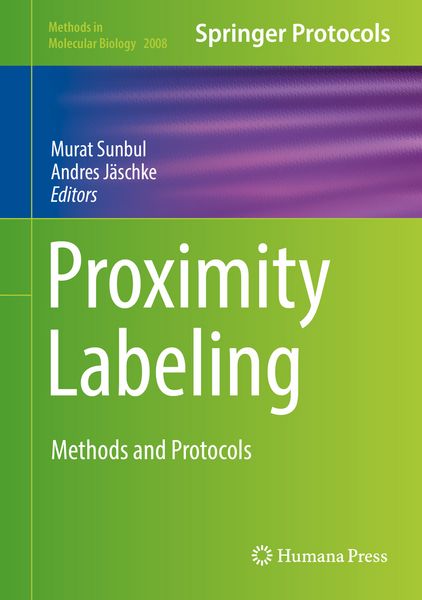
Produktbild: Proximity Labeling
Band 2008

Proximity Labeling Methods and Protocols

Fr. 242.00

inkl. gesetzl. MwSt., Versandkostenfrei


Beschreibung

Produktdetails

Einband

Gebundene Ausgabe

Erscheinungsdatum

25.05.2019

Abbildungen

X, 74 illus., 46 illus. in color., schwarz-weiss Illustrationen, farbige Illustrationen

Herausgeber

Murat Sunbul + weitere

Verlag

Springer Us

Seitenzahl

231

Maße (L/B/H)

26/18.3/1.9 cm

Gewicht

634 g

Auflage

1st ed. 2019

Sprache

Englisch

ISBN

978-1-4939-9536-3

Beschreibung

Produktdetails

Einband

Gebundene Ausgabe

Erscheinungsdatum

25.05.2019

Abbildungen

X, 74 illus., 46 illus. in color., schwarz-weiss Illustrationen, farbige Illustrationen

Herausgeber

Verlag

Springer Us

Seitenzahl

231

Maße (L/B/H)

26/18.3/1.9 cm

Gewicht

634 g

Auflage

1st ed. 2019

Sprache

Englisch

ISBN

978-1-4939-9536-3

Herstelleradresse

Libri GmbH
Europaallee 1
36244 Bad Hersfeld
DE

Email: GPSR Kontakt

Noch keine Bewertungen vorhanden

Verfassen Sie die erste Bewertung zu diesem Artikel

Helfen Sie anderen Kundinnen und Kunden durch Ihre Meinung.

Kundinnen und Kunden meinen

Bewertungen (0)

  • Produktbild: Proximity Labeling
  • Part 1: Template-directed reactions on nucleic acids


    1.          Eric Kool, “Efficient Nucleic Acid Detection by Templated Reaction Cascades” Department of Chemistry, Stanford University

    2.          Kurt W. Gothelf, “Template-directed covalent conjugation of DNA to native antibodies, transferrin and othermetal-binding proteins” Department of Chemistry, Aarhus University

    3.          Zhuo Tang, “Template-directed Chemical Ligation to Obtain 3′-3′ and 5′-5′ Phosphodiester DNA Linkages”, The College of Life Science, Sichuan University

    4.          Yossi Weizmann, “Synthesizing topological structures containing RNA” Department of Chemistry, The University of Chicago

    5.          Richard Wombacher, “DNA-templated Chemistry”, Institute of Pharmacy and Molecular Biotechnology, Heidelberg University


    Part 2: Proximity driven covalent labeling of proteins and nucleic acids


    6.          Itaru Hamachi, “Ligand-Directed Chemistry for Selective Native Protein Labeling”, Department of Synthetic Chemistry and Biological Chemistry, Kyoto University

    7.          Itaru Hamachi, “Non-enzymatic Covalent Protein Labeling Using a Reactive Tag”, Department of Synthetic Chemistry and Biological Chemistry, Kyoto University

    8.          Virginia Cornish, “An In Vivo Covalent TMP-tag Based on Proximity-Induced Reactivity”, Department of Chemistry, Columbia University

    9.          Andres Jäschke, “Proximity Induced Protein labeling with a TexasRed fluorette”, Institute of Pharmacy and Molecular Biotechnology, Heidelberg University

    10.      Zachary T Ball, “Site-Specific Protein Modification with a Dirhodium Metallopeptide Catalyst” Department of Chemistry, Rice University

    11.      Yao-Wen Wu, “A Rapid and Fluorogenic TMP-AcBOPDIPY Probe for Covalent Labeling of Proteins in Live Cells” Chemical Genomics Centre of the Max Planck Society, Dortmund

    12.      Annette G. Beck-Sickinger (and Oliver Seitz) “Rapid Covalent Fluorescence Labeling of Membrane Proteins on Live Cells via Coiled-Coil Templated Acyl Transfer” Institute of Biochemistry, Leipzig University

    13.      Carolyn R. Bertozzi, “Live-Cell Labeling of Specific Protein Glycoforms by Proximity-Enhanced Bioorthogonal Ligation”

    14.      Andrew Tsorkas, “Proximity-Based Sortase-Mediated Ligation”, Department of Bioengineering, University of Pennsylvania

    15.      Andres Jäschke, “Proximity induced covalent labeling of RNAs with fluorophore binding aptamers”, Institute of Pharmacy and Molecular Biotechnology, Heidelberg University


    Part 3: Proximity labeling to reveal interactions between biomolecules


    16.      Alice Ting, “Proximity biotinylation (via APEX2) as a method for mapping proteins associated with mitochondrial DNA in living cells”, Department of Chemistry, Massachusetts Institute of Technology

    17.      Dr. Kyle J Roux, “An improved smaller biotin ligase for BioID proximity labeling”, Department of Pediatrics, Sanford School of Medicine, University of South Dakota

    18.      Roberto Bonasio, “In Vivo Proximity Labeling for the Detection of Protein–Protein and Protein–RNA Interactions” Perelman School of Medicine, University of Pennsylvania

    19.      Koichi Honke, “Biochemical visualization of cell surface molecular clustering in living cells” Department of Biochemistry, Kochi University

    20.      Alexander Mazo, “Detection of RNA-DNA association by a proximity ligation-based method”

    21.      Andrea Rentmeister, “New AdoMet Analogues as Tools for Enzymatic Transfer of Photo-Cross-Linkers and Capturing RNA–Protein Interactions”, Institute of Biochemistry, Münster University

    22.      Ulf Landegren, “In vitro analysis of DNA–protein interactions by proximity ligation”, Department of Genetics and Pathology, Uppsala University

    23.      Chuan He, “Utilization of proximity affect to manipulate the epigenetics of mRNAs”, Department of Chemistry, University of Chicago

    24.      Jay Schendure, “High-throughput determination of RNA structure by proximity ligation”, Department of Genome Sciences, University of Washington