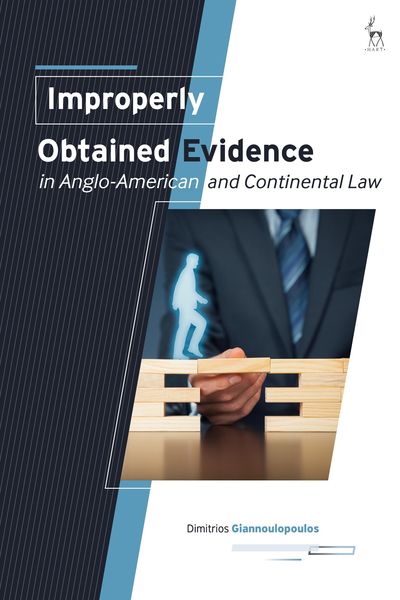
Improperly Obtained Evidence in Anglo-American and Continental Law
-
- Hardcover
- Taschenbuch
- eBook ausgewählt
-
Form:Einzelkauf Download
-
Sprache:Englisch
-
eBook Format:PDF
- PDF Fr. 45.90 ausgewählt
- ePUB Fr. 45.90
Fr. 45.90
inkl. gesetzl. MwSt.Beschreibung
Produktdetails
Format
Kopierschutz
Ja
Family Sharing
Nein
Text-to-Speech
Nein
Erscheinungsdatum
21.02.2019
Verlag
Bloomsbury eBooks UKSeitenzahl
256 (Printausgabe)
Dateigröße
6706 KB
Auflage
1. Auflage
Sprache
Englisch
EAN
9781509923243
This is the first book to offer an extensive cosmopolitan, cross-cultural insight into the perennial controversy over the use of improperly obtained evidence in criminal trials. It challenges the conventional view that exclusionary rules are idiosyncratic of Anglo-American law, and highlights the 'constitutionalisation' and 'internationalisation' of criminal evidence and procedure as a cause of rapprochement (or divergence) beyond the Anglo-American and Continental law divide.
Analysis focuses on confessional evidence and evidence obtained by search and seizure, telephone interceptions and other means of electronic surveillance. The laws of England and Wales, France, Greece and the United States are systematically compared and contrasted throughout this study, but, where appropriate, analysis extends to other Anglo-American and Continental legal systems. The book reviews exclusionary rules vis-à-vis the operation of judicial discretion, and explores the normative justifications that underpin them. It attempts to reinvigorate the idea of excluding evidence to protect constitutional or human rights (the rights thesis), arguing that there is significant scope for Anglo-American and Continental legal systems to place a renewed emphasis on it, particularly in relation to confessional evidence obtained in violation of custodial interrogation rights; we can locate an emerging rapprochement, and unique potential for European Court of Human Rights jurisprudence to build consensus in this respect. In marked contrast, remaining divergence with regard to evidence obtained by privacy violations means there is little momentum to adopt a reinvigorated rights thesis more widely.
Longlisted for the Inner Temple Book Prize 2022.
Analysis focuses on confessional evidence and evidence obtained by search and seizure, telephone interceptions and other means of electronic surveillance. The laws of England and Wales, France, Greece and the United States are systematically compared and contrasted throughout this study, but, where appropriate, analysis extends to other Anglo-American and Continental legal systems. The book reviews exclusionary rules vis-à-vis the operation of judicial discretion, and explores the normative justifications that underpin them. It attempts to reinvigorate the idea of excluding evidence to protect constitutional or human rights (the rights thesis), arguing that there is significant scope for Anglo-American and Continental legal systems to place a renewed emphasis on it, particularly in relation to confessional evidence obtained in violation of custodial interrogation rights; we can locate an emerging rapprochement, and unique potential for European Court of Human Rights jurisprudence to build consensus in this respect. In marked contrast, remaining divergence with regard to evidence obtained by privacy violations means there is little momentum to adopt a reinvigorated rights thesis more widely.
Longlisted for the Inner Temple Book Prize 2022.
Kundinnen und Kunden meinen
Verfassen Sie die erste Bewertung zu diesem Artikel
Helfen Sie anderen Kund*innen durch Ihre Meinung