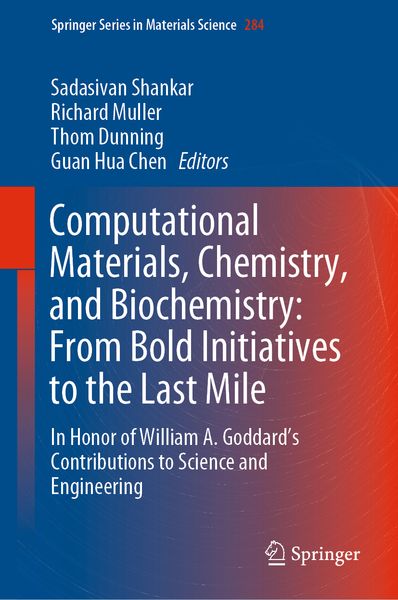
Computational Materials, Chemistry, and Biochemistry: From Bold Initiatives to the Last Mile In Honor of William A. Goddard’s Contributions to Science and Engineering
-
- eBook
- ausgewählt
-
Sprache:Englisch
-
Auflage:1st ed. 2021
- 1st ed. 2021 Fr. 264.00
- 1st ed. 2021 Fr. 264.00 ausgewählt
Fr. 264.00
inkl. gesetzl. MwSt.,
Beschreibung
Produktdetails
Einband
Set mit diversen Artikeln
Erscheinungsdatum
26.01.2021
Abbildungen
LV, 1333 p. 678 illus., 485 illus. in color. In 2 volumes, not available separately.
Herausgeber
Sadasivan Shankar + weitereVerlag
SpringerSeitenzahl
1333
Maße (L/B/H)
24.1/16/8.3 cm
Gewicht
2637 g
Auflage
1st ed. 2021
Sprache
Englisch
ISBN
978-3-030-18777-4
This book provides a broad and nuanced overview of the achievements and legacy of Professor William (“Bill”) Goddard in the field of computational materials and molecular science. Leading researchers from around the globe discuss Goddard’s work and its lasting impacts, which can be seen in today’s cutting-edge chemistry, materials science, and biology techniques. Each section of the book closes with an outline of the prospects for future developments.
In the course of a career spanning more than 50 years, Goddard’s seminal work has led to dramatic advances in a diverse range of science and engineering fields. Presenting scientific essays and reflections by students, postdoctoral associates, collaborators and colleagues, the book describes the contributions of one of the world’s greatest materials and molecular scientists in the context of theory, experimentation, and applications, and examines his legacy in each area, from conceptualization (the first mile)to developments and extensions aimed at applications, and lastly to de novo design (the last mile). Goddard’s passion for science, his insights, and his ability to actively engage with his collaborators in bold initiatives is a model for us all. As he enters his second half-century of scientific research and education, this book inspires future generations of students and researchers to employ and extend these powerful techniques and insights to tackle today’s critical problems in biology, chemistry, and materials.
Examples highlighted in the book include new materials for photocatalysts to convert water and CO2 into fuels, novel catalysts for the highly selective and active catalysis of alkanes to valuable organics, simulating the chemistry in film growth to develop two-dimensional functional films, and predicting ligand–protein binding and activation to enable the design of targeted drugs with minimal side effects.
Noch keine Bewertungen vorhanden
Verfassen Sie die erste Bewertung zu diesem Artikel
Helfen Sie anderen Kundinnen und Kunden durch Ihre Meinung.