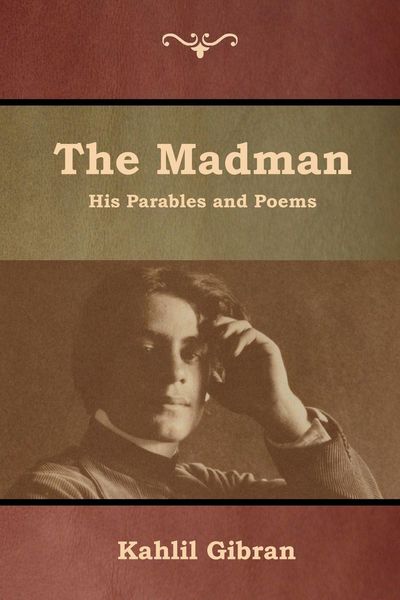
The Madman His Parables and Poems
-
- Hardcover
- Taschenbuch ausgewählt
- eBook
- Hörbuch
-
Sprache:Englisch
- Deutsch Fr. 6.90
- Englisch Fr. 21.90 ausgewählt
-
Verlag:Indoeuropeanpublishing.Com
- Outlook Fr. 23.90
- Ragged Hand - Read & Co. Fr. 21.90
- Editorium Fr. 15.90
- Delhi Open Books Fr. 14.90
- Sanage Publishing Fr. 16.90
- Sharp Ink Fr. 14.90
- External catalogues UK Fr. 17.90
- Watchmaker Publishing Fr. 13.90
- Book Jungle Fr. 19.90
- Culturea Fr. 18.90
- Martino Fine Books Fr. 14.90
- Digireads.com Fr. 13.90
- Creative Media Partners, LLC Fr. 24.90
- FV éditions Fr. 18.90
- Stonewell Press Fr. 16.90
- Dover Publications Fr. 9.90
- BoD - Books on Demand Fr. 15.90
- Aziloth Books Fr. 14.90
- Indoeuropeanpublishing.Com Fr. 21.90 ausgewählt
Fr. 21.90
inkl. gesetzl. MwSt.,
-
Kostenlose Lieferung ab Fr. 30 Einkaufswert
Schweiz & Liechtenstein:
Versandkostenfrei ab Fr. 30.00
Versandkosten bis Fr. 30.00: Fr. 3.50Andere Lieferländer
Fr. 18.00 unabhängig vom Warenwert
Beschreibung
Produktdetails
Einband
Taschenbuch
Erscheinungsdatum
27.05.2019
Verlag
Indoeuropeanpublishing.ComSeitenzahl
58
Maße (L/B/H)
22.9/15.2/0.4 cm
Gewicht
100 g
Sprache
Englisch
ISBN
978-1-64439-178-5
Khalil Gibran (January 6, 1883 – April 10, 1931) was a Lebanese-American writer, poet, visual artist and Lebanese nationalist. Though born a Maronite, Gibran was influenced not only by his own religion but also by Islam, and especially by the mysticism of the Sufis. His knowledge of Lebanon's bloody history, with its destructive factional struggles, strengthened his belief in the fundamental unity of religions, which his parents exemplified by welcoming people of various religions in their home. Connections and parallels have also been made to William Blake's work, as well as the theological ideas of Walt Whitman and in Ralph Waldo Emerson such as reincarnation and the Over-soul. Themes of influence in his work were Islamic/Arabic art, European Classicism (particularly Leonardo Da Vinci) and Romanticism (Blake and Auguste Rodin), the pre-Raphelite Brotherhood, and more modern symbolism and surrealism. Gibran had a number of strong connections to the Bahá'í Faith starting around 1912. One of Gibran's acquaintances, Juliet Thompson, reported several anecdotes relating to Gibran. She recalled Gibran had met 'Abdu'l-Bahá, the leader of the religion at the time of his journeys to the West Gibran was unable to sleep the night before meeting him in person to draw his portrait in April 1912 on the island of Manhattan. Gibran later told Thompson that in 'Abdu'l-Bahá he had "seen the Unseen, and been filled".
Noch keine Bewertungen vorhanden
Verfassen Sie die erste Bewertung zu diesem Artikel
Helfen Sie anderen Kundinnen und Kunden durch Ihre Meinung.