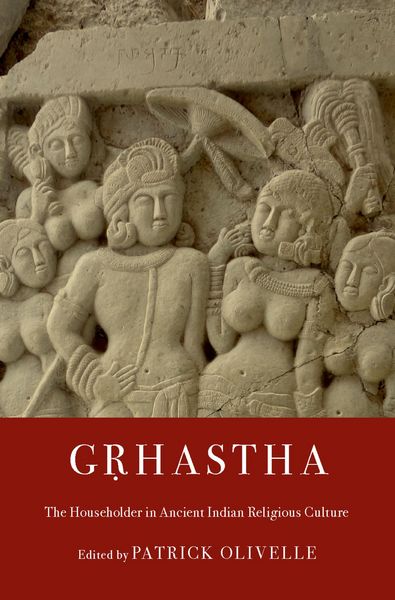
Grhastha The Householder in Ancient Indian Religious Culture
-
Form:Einzelkauf Download
-
Sprache:Englisch
-
eBook Format:ePUB
- PDF Fr. 68.90
- ePUB Fr. 53.90 ausgewählt
Fr. 53.90
inkl. gesetzl. MwSt.Beschreibung
Produktdetails
Format
ePUB
Kopierschutz
Ja
Family Sharing
Nein
Text-to-Speech
Ja
Erscheinungsdatum
11.07.2019
Herausgeber
Patrick OlivelleVerlag
OUP eBookSeitenzahl
416 (Printausgabe)
Dateigröße
1313 KB
Sprache
Englisch
EAN
9780190696177
For scholars of ancient Indian religions, the wandering mendicants who left home and family for a celibate life and the search for liberation represent an enigma. The Vedic religion, centered on the married household, had no place for such a figure. Much has been written about the Indian ascetic but hardly any scholarly attention has been paid to the married householder with wife and children, generally referred to in Sanskrit as grhastha: "the stay-at-home." The institution of the householder is viewed implicitly as posing little historical problems with regard to its origin or meaning. This volume problematizes the figure of the householder within ancient Indian culture and religion. It shows that the term grhastha is a neologism and is understandable only in its opposition to the ascetic who goes away from home (pravrajita). Through a thorough and comprehensive analysis of a wide range of inscriptions and texts, ranging from the Vedas, Dharmasastras, Epics, and belle lettres to Buddhist and Jain texts and texts on governance and erotics, this volume analyses the meanings, functions, and roles of the householder from the earliest times unti about the fifth century CE. The central finding of these studies is that the householder bearing the name grhastha is not simply a married man with a family but someone dedicated to the same or similar goals as an ascetic while remaining at home and performing the economic and ritual duties incumbent on him. The grhastha is thus not a generic householder, for whom there are many other Sanskrit terms, but a religiously charged concept that is intended as a full-fledged and even superior alternative to the concept of a religious renouncer.
Kundinnen und Kunden meinen
Verfassen Sie die erste Bewertung zu diesem Artikel
Helfen Sie anderen Kund*innen durch Ihre Meinung