KI-Beratung Beta

Produktbild: Advances in Effective Flow Separation Control for Aircraft Drag Reduction
Band 52

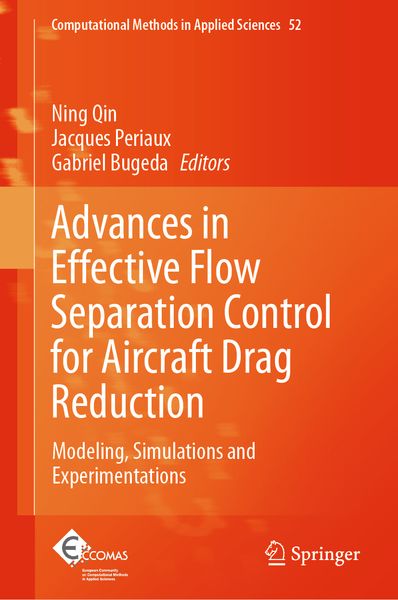
Advances in Effective Flow Separation Control for Aircraft Drag Reduction Modeling, Simulations and Experimentations

Fr. 191.00

inkl. gesetzl. MwSt., Versandkostenfrei


Beschreibung

This book presents the results of a European-Chinese collaborative research project, Manipulation of Reynolds Stress for Separation Control and Drag Reduction (MARS), including an analysis and discussion of the effects of a number of active flow control devices on the discrete dynamic components of the...

Beschreibung

This book presents the results of a European-Chinese collaborative research project, Manipulation of Reynolds Stress for Separation Control and Drag Reduction (MARS), including an analysis and discussion of the effects of a number of active flow control devices on the discrete dynamic components of the turbulent shear layers and Reynolds stress. From an application point of view, it provides a positive and necessary step to control individual structures that are larger in scale and lower in frequency compared to the richness of the temporal and spatial scales in turbulent separated flows.

Produktdetails

Einband

Gebundene Ausgabe

Erscheinungsdatum

15.11.2019

Abbildungen

X, 341 p. 285 illus., 218 illus. in color.

Herausgeber Ning Qin + weitere

Produktdetails

Einband

Gebundene Ausgabe

Erscheinungsdatum

15.11.2019

Abbildungen

X, 341 p. 285 illus., 218 illus. in color.

Herausgeber
Verlag Springer
Seitenzahl

341

Maße (L/B/H)

24.1/16/2.5 cm

Gewicht

642 g

Auflage

19001 Auflage 1st edition 2020

Sprache

Englisch

ISBN

978-3-030-29687-2

Herstelleradresse

Springer-Verlag GmbH
Europaplatz 3
69115 Heidelberg
DE

Email: ProductSafety@springernature.com

Noch keine Bewertungen vorhanden

Verfassen Sie die erste Bewertung zu diesem Artikel

Helfen Sie anderen Kundinnen und Kunden durch Ihre Meinung.

Kundinnen und Kunden meinen

Bewertungen (0)

  • Produktbild: Advances in Effective Flow Separation Control for Aircraft Drag Reduction
  • 1.     Preface ( 2)

    2.     Foreword 1  (Norman Wood, Airbus) (2)

    3.     Foreword 2 (Dietrich Knoerzer ,EC Brussels and LI Benjian, MIIT Beijing ) (2)

    4.     Introduction.

    4.1 Flow Control Active devices : experimental state of the art  ( J.P. Bonnet, Poitiers , France) (15)

    4.2 Flow Control Active devices: numerical state of the art (FU Song, Tsinghua University, Beijing (15)

    5.  Overview of the MARS project : overview and outcomes ( Ning Qin , Univ. Sheffield , UK and Dong Jun, ARI, China) (15)

    6.  MARS Evaluation : The Database Workshop ( Jacques Periaux , Gabriel Bugeda and Jordi Pons, , CIMNE, Spain)

    6.1 Motivation, objectives , experimental and computational data ( Ning Qin, University of Sheffield, Spain ) (5) 

    6.2 The MARS Database: structure , access and regulations (Jordi Pons, CIMNE, Spain) (5) 

    6.3   The MARS Database content : BSF and NACA 0015 test cases definition , experimentation simulation and optimization (5)

    6.4 .BFS : definition of test cases for simulation and experimentation

    6.4.1      Oscillating surfaces( UNIMAN, UK) (2)

    6.4.2      Plasma ( UNIMAN , UK ,Univ Poitiers, France and DLR-Gottingen, Germany) (2)

                                  6.4.3      Synthetic jets ( x NPU, China and y NUAA) (2)

    6.4.4      Micro blowing/suction ( Ming Xiao, NUAA, China) (2)

    6.4.5      Spanwise vortex generators ( Ming Xiao, NUAA, China) (2)

    6.5 NACA0015 : definition of test cases for simulation and experimentation

    6.5.1      Plasma ( x, AVIC-ARI, China ) (2)

    6.5.2      Synthetic Jets ( x, AVIC-ARI, China) (2)

    6.5.3      Moving surfaces (x, AVIC-ARI, China) (2)

    6.5.4      Micro blowing/suction ( x BUAA , China) (2)

    6.5.5      Pulsed jets (x Univ. Poitiers, France) (2)

    5.6  BFS:  definition of active device test case optimization

    5.6.1  Plasma ( Ning Qin, Univ. Sheffield, UK ) (2) 5.6.2  Synthetic Jets (NUAA , China) (2)5.7 NACA0015: definition of active device test case optimization5.7.1 Pulsed Jets ( Univ. Poitiers ) (2)5.8: Experimentations and simulations of BSF test cases: contributions5.8.1  Contributed experimentations (7x 12= 84)5.8.2  Contributed simulations (9)5.9  :  experimentations and simulations of NACA0015 test cases : contributions 5.9.1:   Contributed experimentations (5x12= 60) 5.9.2 Contributed simulations ( 10x12= 120) 5.10: Optimization of the active devices on BSF test cases: contributions (4x12=48) 5.11: Optimization of the active devices on NACA0015 test cases: contributions (5x12=        60)

    6.    Analysis and synthesis of the achieved experimental, computational and active devices optimization contributions on BSF and NACA0012

    6 .1 Academic point of view ( Adel Abbas , UPM & Airbus, Ning Qin , Univ. Sheffield, UK and Dong Jun, ARI, China, Jean Paul Bonnet , Univ. Poitiers , FU Song , Tsinghua University, Beijing, China , Ming Xiao, NUAA, China, Gao Zhenghong , NPU, China, Peng Shi-Hua , FOA, Sweden) (8x3=24)

    6.2 Industrial point of view ( Norman Wood, Airbus; Jean Claude Courty Dassault Aviation , France ; Nicola Ceresola , Alenia ,Italy; DENG Yiju, FAI, China, Meihong Zhong, COMAC, China, Charles Hirsch, NUMECA, Belgium) (6x3= 18)


    7.  Assessment of results obtained in the MARS project (Herman Deconinck, VKI, Belgium, Yao Zheng , Zhejiang University , China ) ( 2x2=4)

    8.  Conclusion and future ( Ning Qin , Sheffield University, UK and Dong Jun , ARI, China) (2)

    9.  Acknowledgements  (1)

    10.  References (2)

    11.  Index of authors