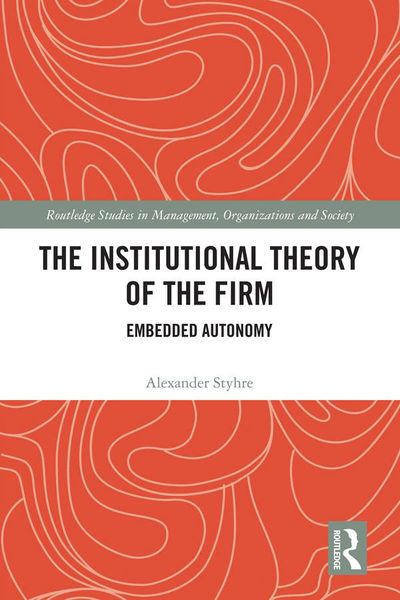
The Institutional Theory of the Firm Embedded Autonomy
-
- Hardcover
- Taschenbuch
- eBook ausgewählt
-
Form:Einzelkauf Download
-
Sprache:Englisch
-
eBook Format:ePUB 3
- ePUB 3 Fr. 68.90 ausgewählt
- PDF Fr. 68.90
Fr. 68.90
inkl. gesetzl. MwSt.Beschreibung
Produktdetails
Format
ePUB 3
Kopierschutz
Ja
Family Sharing
Nein
Text-to-Speech
Ja
Erscheinungsdatum
25.07.2019
Verlag
Taylor & Francis eBooksSeitenzahl
196 (Printausgabe)
Auflage
1. Auflage
Sprache
Englisch
EAN
9780429632280
The Institutional Theory of the Firm examines recent and previous organization theory literature to advocate what Evans (1995) refers to as the "embedded autonomy" of the firm, as well as its role in being simultaneously anchored in, for example, corporate legislation and regulatory practices on the national, regional (i.e., within the European Union) and transnational levels, while at the same time being granted the right to operate with significant degrees of freedom within this legal-regulatory model. Seen in this view, the embedded autonomy of the corporation represents a theoretical view of the corporation that complements the market-based image of the corporation in economic theory.
When advocating the institutional theory model, three forms of embedded autonomy are examined. First, the corporation is enacted as a legal entity sui juris-as a freestanding "legal person" in corporate law and within the regulatory framework that serves to enforce legislation in everyday life settings. Second, the corporation is embedded within what social theorists refer to as moral economies, the norms and values that regulate what are the socially acceptable and legitimate means for conducting business. Third and finally, the corporation is embedded in governance, a relatively complex economic concept that denotes legal and regulatory control on the societal and economic system levels, and on the level of the individual corporation. By combining the three forms of embeddedness, sanctioned by law, norms, and governance, the embedded autonomy of the firm is secured on the basis of a variety of social practices and resources.
This book brings together a diverse literature including management studies, economic sociology, legal theory, finance theory, and mainstream economic theory to advance the argument that the corporation is best understood as what is embedded in a social and economic context, yet best serving its defined and stipulated ends by assuming considerable degrees of freedom to operate in isolation from various stakeholders. It will be of relevance for a variety of readers, including graduate students, management scholars, policy-makers, and management consultants interested in organization theory and management studies.
Kundinnen und Kunden meinen
Verfassen Sie die erste Bewertung zu diesem Artikel
Helfen Sie anderen Kund*innen durch Ihre Meinung