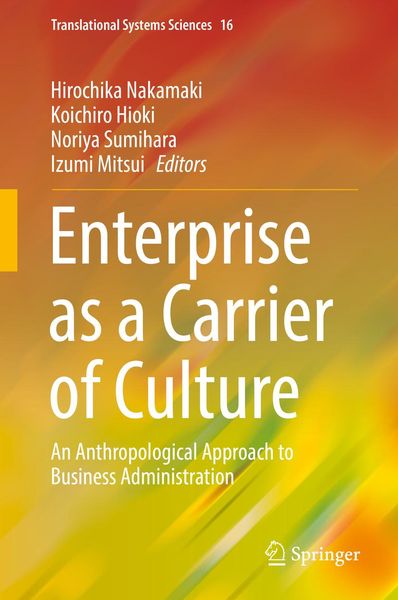
Enterprise as a Carrier of Culture An Anthropological Approach to Business Administration
Fr. 150.90
inkl. gesetzl. MwSt.Beschreibung
Produktdetails
Format
ePUB
Kopierschutz
Nein
Family Sharing
Nein
Text-to-Speech
Ja
Erscheinungsdatum
08.05.2019
Herausgeber
Hirochika Nakamaki + weitereVerlag
SpringerSeitenzahl
191 (Printausgabe)
Dateigröße
4957 KB
Auflage
1st ed. 2019
Sprache
Englisch
EAN
9789811371936
This book expands anthropological studies of business enterprise to include comparative and interdisciplinary perspectives. A number of books on business anthropology have been published, but most of them are written by anthropologists alone. By contrast, this book engages interdisciplinary studies, e.g., not only by anthropologists but also management scholars and other social scientists. It is the second volume of studies forwarding anthropological approaches to business administration, Keiei Jinruigaku.
This volume focusses on the cultural dimensions of enterprise. Here enterprise is viewed as a medium carrying culture, rather than solely an entity of production and management, as is typical in mainstream studies. The approach is based on Tadao Umesao's definition of culture as a projection of instruments/devices and institutions into the mental/spiritual dimensions of life. Therefore, in our view production and management are among the projections of the cultural aspects of enterprise. This perspective, we believe, constitutes a new frontier in the study of business administration.
This book consists of three parts, the first being "religiosity and spirituality", the second "exhibitions, performance and inducement," and the third "history and story." In Part I, Quaker Codes, ex-votos, and spiritual leadership are discussed in relation to management and behavior, and miracles and pilgrimage. Part II describes exhibitions justifying nuclear power industry within power plants in both Japan and England, the exhibition by English families of their porcelain collections, and the performance skills of orchestral maestros. All of these examples indicate that, through the use of narratives and myths, exhibits and performances overtly and covertly induce visitors or audiences to certain viewpoints and emotions. Part III offers examples of histories and stories of enterprise articulated through the branding and consumption of industrial products, and their display in enterprise museums where the essence of culture and heritage is cherished and emphasized, by and for the wider community and the enterprise itself.
Conjoined as an interdisciplinary team of Western and Japanese researchers, we apply an anthropological approach to the cultural history of enterprise in both Britain and Japan.
Noch keine Bewertungen vorhanden
Verfassen Sie die erste Bewertung zu diesem Artikel
Helfen Sie anderen Kundinnen und Kunden durch Ihre Meinung.