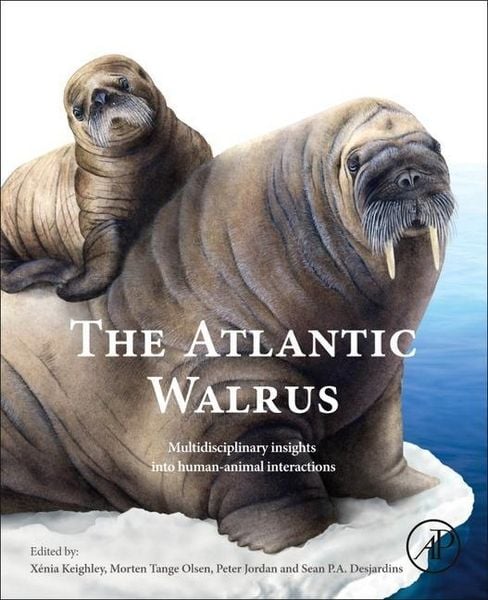
Produktbild: The Atlantic Walrus

The Atlantic Walrus Multidisciplinary Insights Into Human-Animal Interactions

Fr. 151.00

inkl. gesetzl. MwSt., Versandkostenfrei


Beschreibung

Produktdetails

Einband

Taschenbuch

Erscheinungsdatum

18.06.2021

Herausgeber

Xénia Keighley + weitere

Verlag

Elsevier Science & Technology

Seitenzahl

344

Maße (L/B/H)

23.4/19.1/1.8 cm

Gewicht

726 g

Sprache

Englisch

ISBN

978-0-12-817430-2

Beschreibung

Portrait

Xénia Keighley completed her PhD as part of the Marie Curie Horizon 2020 ArchSci2020 network, investigating ancient genomics of the Atlantic walrus. She has been based at the University of Copenhagen (Denmark) and the University of Groningen (the Netherlands) and defended her PhD thesis in January 2021. Xénia's academic background is in Biology, with a Bachelor of Philosophy (Science)
(Honours) awarded by the Australian National University. Her undergraduate studies focused on taxonomy, phylogeography, botany and environmental sciences.
Morten Tange Olsen is an associate professor at the Globe Institute, University of Copenhagen, Denmark. His research seeks to document and understand the effects of environmental change, pathogens and human activities on marine mammals and ecosystems, using ancient, environmental and modern DNA analyses, museum collections and observations in the wild. He is a member of multiple marine mammal expert groups, including the Helsinki Commission (HELCOM) and the North Atlantic Marine Mammal Commission (NAMMCO), as well as the Danish Ministry of Environment and Environmental Protection Agency.
Peter Jordan is currently a professor of Archaeology at the Department of Archaeology and Ancient History, Lund University, Sweden. His research examines long-term human animal environment interactions in the circumpolar regions, including northern Europe and Northeast Asia. He was previously Directorof the Arctic Centre at the University of Groningen and the Netherlands Scientistin-Charge in the ArchSci2020 Network. He also served as the Netherlands representative in the Council of the International Arctic Science Committee (IASC) andwas also Chair of IASC's Polar Archaeology Network (PAN).
Sean Desjardins is a postdoctoral researcher at the Arctic Centre and the Groningen Institute of Archaeology, University of Groningen (the Netherlands)and a research associate at the Canadian Museum of Nature (Canada). An anthropological archaeologist with more than a decade of experience investigating human walrus interactions in Inuit Nunangat (the traditional Inuit territories of Arctic Canada), his research interests include Indigenous knowledge systems, food security/food safety among hunting gathering fishing populations and
long-term human responses to climate change in the Arctic. He represents the Netherlands in the Sustainable Development Working Group (SDWG) of the Arctic Council.

Produktdetails

Einband

Taschenbuch

Erscheinungsdatum

18.06.2021

Herausgeber

Verlag

Elsevier Science & Technology

Seitenzahl

344

Maße (L/B/H)

23.4/19.1/1.8 cm

Gewicht

726 g

Sprache

Englisch

ISBN

978-0-12-817430-2

Herstelleradresse

Libri GmbH
Europaallee 1
36244 Bad Hersfeld
DE

Email: GPSR Kontakt

Noch keine Bewertungen vorhanden

Verfassen Sie die erste Bewertung zu diesem Artikel

Helfen Sie anderen Kundinnen und Kunden durch Ihre Meinung.

Kundinnen und Kunden meinen

Bewertungen (0)

Die Leseprobe wird geladen.
  • Produktbild: The Atlantic Walrus
  • 1 Introduction

    Section I Atlantic walrus evolution, ecology, and behavior
    2 The surprising evolutionary heritage of the Atlantic walrus as chronicled by the fossil record
    3 Ecology and behavior of Atlantic walruses
    4 Stocks, distribution and abundance

    Section II Walruses and Indigenous peoples
    5 Pre-Inuit walrus use in Arctic Canada and Greenland, c.2500 BCE to 1250 CE
    6 Subsistence walrus hunting in Inuit Nunangat (Arctic Canada) and Kalaallit Nunaat (Greenland) from the 13th century CE to present

    Section III European walrus use from the Norse to present
    7 Early European and Greenlandic walrus hunting: Motivations, techniques and practices
    8 The exploitation of walrus ivory in medieval Europe
    9 Modern European commercial walrus exploitation, 1700 to 1960 CE

    Section IV Future directions and innovations in Atlantic walrus research
    10 Molecular advances in archaeological and biological research on Atlantic walrus
    11 Atlantic walrus management, regulation and conservation
    12 Anthropogenic impacts on the Atlantic walrus
    13 The future of Atlantic walrus in a rapidly warming Arctic