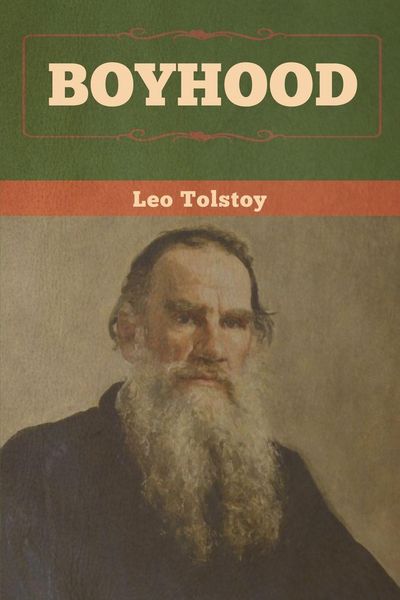
Boyhood
1-
- Hardcover
- Taschenbuch ausgewählt
- eBook
- Hörbuch
-
Sprache:Englisch
-
Verlag:Bibliotech Pr
- Important Books Fr. 17.90
- Arcturus Publishing Ltd Fr. 16.90
- Tingle Books Fr. 22.90
- Tredition Fr. 15.90
- Houghton Mifflin Company Fr. 19.90
- Bod Fr. 15.90
- Oxford University Press Fr. 17.90
- Bibliotech Pr Fr. 25.90 ausgewählt
- HarperCollins Fr. 5.90
- Pki Fr. 16.90
- Copycat Fr. 9.90
- Ingram Publishers Services Fr. 11.90
- Alma Books Ltd. Fr. 16.90
- Flame Tree Fr. 16.90
- Kessinger Publishing, LLC Fr. 21.90
- Penguin Books Ltd Fr. 19.90
Fr. 25.90
inkl. gesetzl. MwSt.,
-
Kostenlose Lieferung ab Fr. 30 Einkaufswert
Schweiz & Liechtenstein:
Versandkostenfrei ab Fr. 30.00
Versandkosten bis Fr. 30.00: Fr. 3.50Andere Lieferländer
Fr. 18.00 unabhängig vom Warenwert
Beschreibung
Produktdetails
Einband
Taschenbuch
Erscheinungsdatum
22.02.2020
Verlag
Bibliotech PrSeitenzahl
124
Maße (L/B/H)
22.9/15.2/0.8 cm
Gewicht
214 g
Sprache
Englisch
ISBN
978-1-64799-045-9
Leo Tolstoy, Tolstoy also spelled Tolstoi, Russian in full Lev Nikolayevich, Graf (count) Tolstoy, (born August 28 [September 9, New Style], 1828, Yasnaya Polyana, Tula province, Russian Empire—died November 7 [November 20], 1910, Astapovo, Ryazan province), Russian author, a master of realistic fiction and one of the world’s greatest novelists. Tolstoy is best known for his two longest works, War and Peace (1865–69) and Anna Karenina (1875–77), which are commonly regarded as among the finest novels ever written. War and Peace in particular seems virtually to define this form for many readers and critics. Among Tolstoy’s shorter works, The Death of Ivan Ilyich (1886) is usually classed among the best examples of the novella. Especially during his last three decades Tolstoy also achieved world renown as a moral and religious teacher. His doctrine of nonresistance to evil had an important influence on Gandhi. Although Tolstoy’s religious ideas no longer command the respect they once did, interest in his life and personality has, if anything, increased over the years. Most readers will agree with the assessment of the 19th-century British poet and critic Matthew Arnold that a novel by Tolstoy is not a work of art but a piece of life; the Russian author Isaak Babel commented that, if the world could write by itself, it would write like Tolstoy. Critics of diverse schools have agreed that somehow Tolstoy’s works seem to elude all artifice. Most have stressed his ability to observe the smallest changes of consciousness and to record the slightest movements of the body. What another novelist would describe as a single act of consciousness, Tolstoy convincingly breaks down into a series of infinitesimally small steps. According to the English writer Virginia Woolf, who took for granted that Tolstoy was "the greatest of all novelists," these observational powers elicited a kind of fear in readers, who "wish to escape from the gaze which Tolstoy fixes on us." Those who visited Tolstoy as an old man also reported feelings of great discomfort when he appeared to understand their unspoken thoughts. It was commonplace to describe him as godlike in his powers and titanic in his struggles to escape the limitations of the human condition.