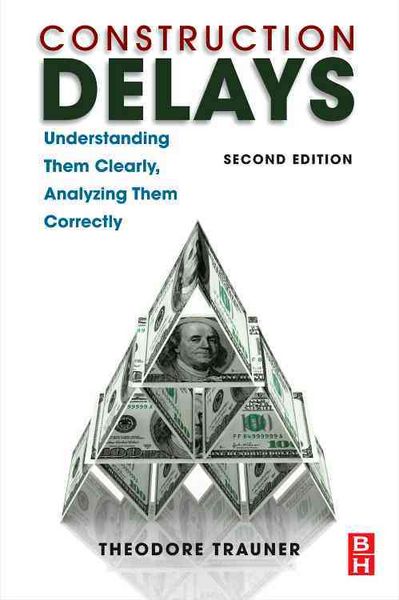
Construction Delays 2/e Understanding Them Clearly, Analyzing Them Correctly
-
- Hardcover ausgewählt
- Taschenbuch
- eBook
-
Sprache:Englisch
Fr. 122.00
inkl. gesetzl. MwSt.,
Beschreibung
Produktdetails
Einband
Gebundene Ausgabe
Erscheinungsdatum
01.05.2009
Verlag
Elsevier LTD, OxfordSeitenzahl
288
Maße (L/B/H)
22.9/15.5/2.3 cm
Gewicht
600 g
Auflage
2. Auflage
Sprache
Englisch
ISBN
978-1-85617-677-4
Delays in construction projects are frequently expensive, since there is usually a construction loan involved which charges interest, management staff dedicated to the project whose costs are time dependent, and ongoing inflation in wage and material prices. Many techniques are used to analyze delays. Some of these methods have inherent weaknesses and should be avoided. This book points out the shortcomings of these faulty methods and explains how a delay analysis should be performed. It then describes specifically how the analysis is done with CPM schedules. A explanation of delays and delay damages, presented in a straightforward, accessible manner, should be useful to public and private owners, construction managers, general contractors, subcontractors, designers, suppliers, and attorneys whose work involves them in the construction industry. The discussion will include subtleties of the process, such as shifts in the critical path, and non-critical delays. The subject of damages is covered in detail, including the major categories of extended field overhead and unabsorbed home office overhead. Likewise, the damages suffered by the owner, either actual or liquidated, are also explained. Finally, a chapter is devoted to managing the risk of delays and time extensions from the viewpoints of the various parties to a construction project. A discussion of early completion schedules and constructive acceleration is also included. In this new ediion, all chapters are updated to reflect the changes in the construction field since the first edition published over l6 years ago. The Second Edition includes over 40% more information such as new methods for analyzing delays with examples of the proper approach. The author also includes a new chapter on risk managment which focuses on the delay-related risks of the various parties in a construction project.
Noch keine Bewertungen vorhanden
Verfassen Sie die erste Bewertung zu diesem Artikel
Helfen Sie anderen Kundinnen und Kunden durch Ihre Meinung.