Gutscheinbedingungen

*Gültig bis 18.08.2026 auf (fast) alles. Ausgeschlossen sind Smartboxen, Zeitschriften, Tickets, Lebensmittel, Gaming-Elektroartikel, Tinte/Toner, Gutscheine, Geschenkkarten, Blumen und Abos | Einlösbar in allen Buchhandlungen von Orell Füssli, Barth Bücher, Buchladen Rapunzel, Schuler Orell Füssli, Stauffacher und ZAP unter Vorweisung des Gutscheins, auf www.orellfüssli.ch durch Eingabe des Gutscheincodes. Beim Service „eBooks verschenken“ und bei eBook-Käufen via eReader nicht einlösbar | Mindesteinkaufswert: Fr. 100.- | Nicht mit anderen Rabatten kumulierbar.

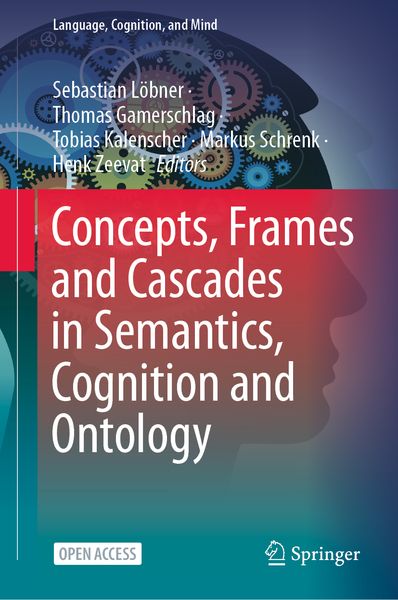
  • Produktbild: Concepts, Frames and Cascades in Semantics, Cognition and Ontology
  • Produktbild: Concepts, Frames and Cascades in Semantics, Cognition and Ontology
Band 7

Concepts, Frames and Cascades in Semantics, Cognition and Ontology

Fr. 72.90

inkl. gesetzl. MwSt., Versandkostenfrei


Beschreibung

Produktdetails

Einband

Gebundene Ausgabe

Erscheinungsdatum

29.05.2021

Abbildungen

IX, 486 p. 263 illus., 33 illus. in color.

Herausgeber

Sebastian Löbner + weitere

Verlag

Springer

Seitenzahl

486

Maße (L/B/H)

24.1/16/3.3 cm

Gewicht

904 g

Auflage

1st ed. 2021

Sprache

Englisch

ISBN

978-3-030-50199-0

Beschreibung

Produktdetails

Einband

Gebundene Ausgabe

Erscheinungsdatum

29.05.2021

Abbildungen

IX, 486 p. 263 illus., 33 illus. in color.

Herausgeber

Verlag

Springer

Seitenzahl

486

Maße (L/B/H)

24.1/16/3.3 cm

Gewicht

904 g

Auflage

1st ed. 2021

Sprache

Englisch

ISBN

978-3-030-50199-0

Herstelleradresse

Springer-Verlag KG
Sachsenplatz 4-6
1201 Wien
AT

Email: GPSR Kontakt

Noch keine Bewertungen vorhanden

Verfassen Sie die erste Bewertung zu diesem Artikel

Helfen Sie anderen Kundinnen und Kunden durch Ihre Meinung.

Kundinnen und Kunden meinen

Bewertungen (0)

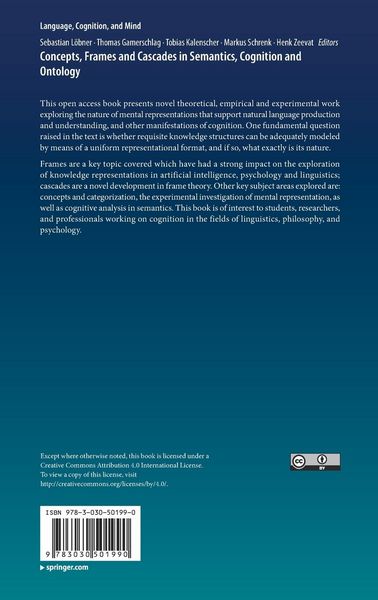
  • Produktbild: Concepts, Frames and Cascades in Semantics, Cognition and Ontology
  • Produktbild: Concepts, Frames and Cascades in Semantics, Cognition and Ontology
  • Introduction (Sebastian Löbner).- Part I: Pushing the boundaries of formal semantics.- Chapter 2. A compositional pluralist semantics for extensional and attitude Verbs (Kristina Liefke).- Chapter 3. Counting possible configurations (Manfred Krifka).- Chapter 4. Structure and ontology in nonlocal readings of adjectives (Marcin Morzycki).- Part II: Concept theory.- Chapter 5. How can semantics avoid the troubles with the analytic/synthetic distinction? (Roberto G. de Almeida).- Chapter 6. Linguistic relativity and flexibility of mental representations: Color terms in a frame based analysis (Leda Berio).- Chapter 7. Implicatures and naturalness (Igor Douven).- Chapter 8. Perception, types and frames (Robin Cooper).- Part III: Conceptualizing eventualities.- Chapter 9. An XMG account of multiplicity of meaning in derivation (Marios Andreou).- Chapter 10. Operationalizing the role of context in language variation: The role of perspective alignment in the Spanish imperfective domain (MartínFuchs).- Chapter 11. A frame-based analysis of verbal particles in Hungarian (Katalin Balogh).- Chapter 12. On the fictive reading of German steigen 'climb, rise' – A frame account (Thomas Gamerschlag).- Chapter 13. Cascades. Goldman’s level-generation, multilevel categorization of action, and multilevel verb semantics (Sebastian Löbner).- Part IV: Prototypes and probabilities.- Chapter 14. Modification and default inheritance (Corina Strößner).- Chapter 15. A frame-theoretic model of Bayesian category learning (Samuel Taylor).- Chapter 16. Extremes are typical – A game theoretical derivation (Robert van Rooij).- Chapter 17. Grading similarity (Carla Umbach).- Part V:  Cognition and psychology.- Chapter 18. Escitalopram restores reversal learning impairments in rats with lesions of orbital frontal cortex (David S. Tait).- Chapter 19. Rat ultrasonic vocalizations as social reinforcers – implications for a multilevel model of the cognitive representation of action and rats' socialworld (Tobias Kalenscher).- Chapter 20. Influence of manner adverbs on action verb processing (Jan Sieksmeyer).- Chapter 21. When do computations explain better (Silvano Zipoli Caiani).