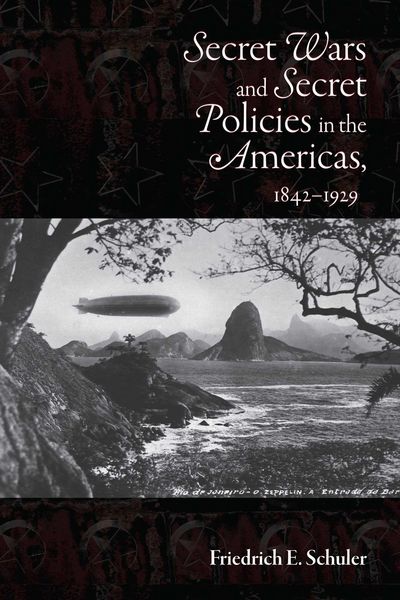
Secret Wars and Secret Policies in the Americas, 1842-1929
-
- Hardcover
- Taschenbuch
- eBook ausgewählt
-
Form:Einzelkauf Download
-
Sprache:Englisch
Fr. 29.95
inkl. gesetzl. MwSt.Beschreibung
Produktdetails
Format
ePUB
Kopierschutz
Ja
Family Sharing
Ja
Text-to-Speech
Ja
Erscheinungsdatum
16.04.2011
Verlag
Simon + Schuster LLCSeitenzahl
576 (Printausgabe)
Sprache
Englisch
EAN
9780826344915
The conflicts that culminated in the First and Second World Wars had their origins in the rise of imperial powers in North America, Europe, and Asia in the late nineteenth century and the imperialist quests for the resources of colonies and former colonies. American expansionists, encouraged by a growing U.S. Navy, nurtured U.S. policies with illusions of easy access to South America. Policy makers in the fledgling empires of Germany, Japan, Spain, and Italy relied on clandestine means to rival U.S. ambitions. In this original and thoroughly researched book, based on new sources from previously unused collections in Germany and Spain, Friedrich E. Schuler details their attempts to suborn ethnic groups within Latin America but also the United States to establish ethnic beachheads that would serve to undermine U.S. interests. These deeply disturbing lessons became central historical reference points for U.S. policy makers during World War II.
Not surprisingly, though rarely covered in Latin American historiography, Latin American nations, but also Spain, developed their own plans to exploit these imperialist rivalries after World War I. The resulting intrigue and subterfuge revealed in this revisionist study add a fascinating new dimension to our understanding of transpacific and transatlantic politics during this critical period of world history.
Not surprisingly, though rarely covered in Latin American historiography, Latin American nations, but also Spain, developed their own plans to exploit these imperialist rivalries after World War I. The resulting intrigue and subterfuge revealed in this revisionist study add a fascinating new dimension to our understanding of transpacific and transatlantic politics during this critical period of world history.
Kundinnen und Kunden meinen
Verfassen Sie die erste Bewertung zu diesem Artikel
Helfen Sie anderen Kund*innen durch Ihre Meinung