KI-Beratung Beta

  • Produktbild: South Asia in Global Power Rivalry
  • Produktbild: South Asia in Global Power Rivalry

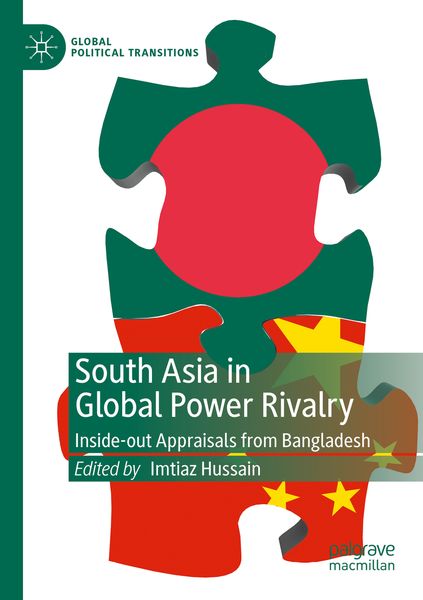
South Asia in Global Power Rivalry Inside-out Appraisals from Bangladesh

Fr. 112.00

inkl. gesetzl. MwSt., Versandkostenfrei


Beschreibung

This edited volume examines global power-rivalry in and around South Asia through Bangladeshi lenses using imperfect and overlapping interest concentric-circles as a template. Dynamics from three transitions —the United States exiting the Cold War, China emerging as a global-level power, and India’s...

Beschreibung

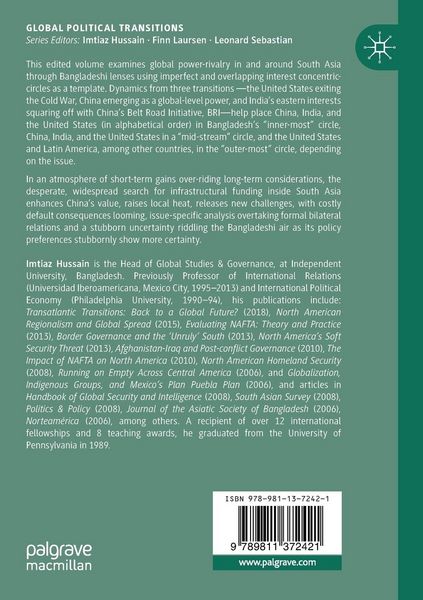
This edited volume examines global power-rivalry in and around South Asia through Bangladeshi lenses using imperfect and overlapping interest concentric-circles as a template. Dynamics from three transitions —the United States exiting the Cold War, China emerging as a global-level power, and India’s eastern interests squaring off with China’s Belt Road Initiative, BRI—help place China, India, and the United States (in alphabetical order) in Bangladesh’s “inner-most” circle, China, India, and the United States in a “mid-stream” circle, and the United States and Latin America, among other countries, in the “outer-most” circle, depending on the issue.
In an atmosphere of short-term gains over-riding long-term considerations, the desperate, widespread search for infrastructural funding inside South Asia enhances China’s value, raises local heat, releases new challenges, with costly default consequences looming, issue-specific analysis overtaking formal bilateral relations and a stubborn uncertainty riddling the Bangladeshi air as its policy preferences stubbornly show more certainty.

Portrait

Imtiaz Hussain is the Head of Global Studies & Governance, at Independent University, Bangladesh. Previously Professor of International Relations (Universidad Iberoamericana, Mexico City, 1995-2013) and International Political Economy (Philadelphia University, 1990-94), his publications include: Transatlantic Transitions: Back to a Global Future? (2018), North American Regionalism and Global Spread (2015); Evaluating NAFTA: Theory and Practice (2013); Border Governance and the ‘Unruly’ South (2013), North America’s Soft Security Threat (2013), Afghanistan-Iraq and Post-conflict Governance (2010), The Impact of NAFTA on North America (2010), North American Homeland Security (2008); Running on Empty Across Central America (2006), and Globalization, Indigenous Groups, and Mexico’s Plan Puebla Plan (2006); and articles in Handbook of Global Security and Intelligence (2008), South Asian Survey (2008), Politics & Policy (2008), Journal of the Asiatic Society of Bangladesh (2006),   Norteamérica (2006), among others. A recipient of over 12 international fellowships and 8 teaching awards, he graduated from the University of Pennsylvania in 1989.

Produktdetails

Einband

Taschenbuch

Erscheinungsdatum

14.08.2020

Herausgeber Imtiaz Hussain
Verlag Springer Singapore

Produktdetails

Einband

Taschenbuch

Erscheinungsdatum

14.08.2020

Herausgeber Imtiaz Hussain
Verlag Springer Singapore
Seitenzahl

320

Maße (L/B/H)

21/14.8/1.9 cm

Gewicht

436 g

Auflage

1st ed. 2019

Sprache

Englisch

ISBN

978-981-13-7242-1

Herstelleradresse

Springer-Verlag GmbH
Tiergartenstr. 17
69121 Heidelberg
DE

Email: ProductSafety@springernature.com

Noch keine Bewertungen vorhanden

Verfassen Sie die erste Bewertung zu diesem Artikel

Helfen Sie anderen Kundinnen und Kunden durch Ihre Meinung.

Kundinnen und Kunden meinen

Bewertungen (0)

  • Produktbild: South Asia in Global Power Rivalry
  • Produktbild: South Asia in Global Power Rivalry
  • 1. Introduction: Bangladesh & the Changing Global Rivalry: An Inside-out Appraisal of Bangladesh.- 2. Bangladesh-India Relations: Transitions at the Core.- 3. "Shining”or “Suffering” South Asia: China’s South Asian Footprints.- 4. China, India, Myanmar: Playing Rohingya Roulette.- 5. Encircling India: China Tightens Soth Asian Noose.- 6. Gender-benders in off-shore Production: Bangladesh-China Comparisons.- 7. Trading with China, India, and the United States: Bangladesh’s Track-record.- 8. China’s and India’s Latin Entry: Old-model Revival?.- 9. Asia, Latin America, & Globalization: Close Encounters of a Third Kind.- 10. South Asia in Strategic Competition: Tracing Chinese, Indian, & U.S. Footprints.- 11. Conclusions: Global Leadership of a Glocal Kind?