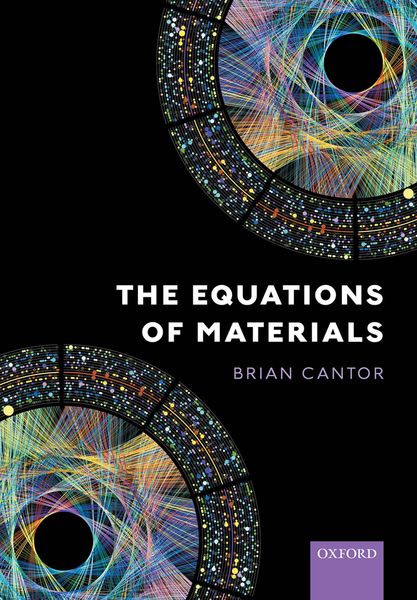
The Equations of Materials
-
- Hardcover
- Taschenbuch
- eBook ausgewählt
-
Form:Einzelkauf Download
-
Sprache:Englisch
Fr. 41.90
inkl. gesetzl. MwSt.Beschreibung
Produktdetails
Format
Kopierschutz
Ja
Family Sharing
Nein
Text-to-Speech
Nein
Erscheinungsdatum
24.07.2020
Verlag
OUP eBookSeitenzahl
288 (Printausgabe)
Dateigröße
21533 KB
Sprache
Englisch
EAN
9780192592910
This primer describes important equations of materials and the scientists who derived them. It provides an excellent introduction to the subject by making the material accessible and enjoyable. The book is dedicated to a number of propositions:
1. The most important equations are often simple and easily explained;
2. The most important equations are often experimental, confirmed time and again;
3. The most important equations have been derived by remarkable scientists who lived interesting lives.
Each chapter covers a single equation and materials subject, and is structured in three sections: first, a description of the equation itself; second, a short biography of the scientist after whom it is named; and third, a discussion of some of the ramifications and applications of the equation. The biographical sections intertwine the personal and professional life of the scientist with contemporary political and scientific developments.
Topics included are: Bravais lattices and crystals; Bragg's law and diffraction; the Gibbs phase rule and phases; Boltzmann's equation and thermodynamics; the Arrhenius equation and reactions; the Gibbs-Thomson equation and surfaces; Fick's laws and diffusion; the Scheil equation and solidification; the Avrami equation and phase transformations; Hooke's law and elasticity; the Burgers vector and plasticity; Griffith's equation and fracture; and the Fermi level and electrical properties.
The book is written for students interested in the manufacture, structure, properties and engineering application of materials such as metals, polymers, ceramics, semiconductors and composites. It requires only a working knowledge of school maths, mainly algebra and simple calculus.
1. The most important equations are often simple and easily explained;
2. The most important equations are often experimental, confirmed time and again;
3. The most important equations have been derived by remarkable scientists who lived interesting lives.
Each chapter covers a single equation and materials subject, and is structured in three sections: first, a description of the equation itself; second, a short biography of the scientist after whom it is named; and third, a discussion of some of the ramifications and applications of the equation. The biographical sections intertwine the personal and professional life of the scientist with contemporary political and scientific developments.
Topics included are: Bravais lattices and crystals; Bragg's law and diffraction; the Gibbs phase rule and phases; Boltzmann's equation and thermodynamics; the Arrhenius equation and reactions; the Gibbs-Thomson equation and surfaces; Fick's laws and diffusion; the Scheil equation and solidification; the Avrami equation and phase transformations; Hooke's law and elasticity; the Burgers vector and plasticity; Griffith's equation and fracture; and the Fermi level and electrical properties.
The book is written for students interested in the manufacture, structure, properties and engineering application of materials such as metals, polymers, ceramics, semiconductors and composites. It requires only a working knowledge of school maths, mainly algebra and simple calculus.
Kundinnen und Kunden meinen
Verfassen Sie die erste Bewertung zu diesem Artikel
Helfen Sie anderen Kund*innen durch Ihre Meinung