• Produktbild: Bioinformatics Research and Applications
  • Produktbild: Bioinformatics Research and Applications
Band 12304

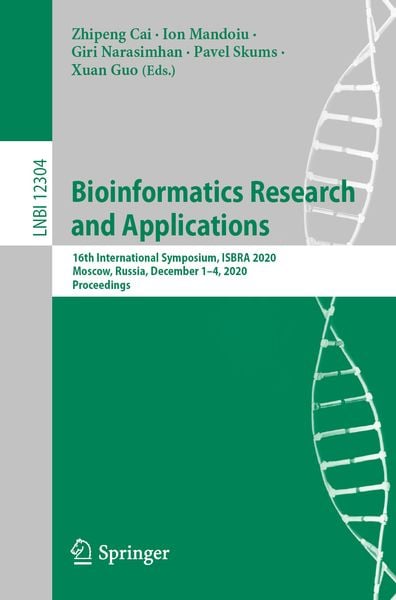
Bioinformatics Research and Applications 16th International Symposium, ISBRA 2020, Moscow, Russia, December 1–4, 2020, Proceedings

Fr. 72.90

inkl. gesetzl. MwSt., Versandkostenfrei


Beschreibung

Produktdetails

Einband

Taschenbuch

Erscheinungsdatum

18.08.2020

Herausgeber

Zhipeng Cai + weitere

Verlag

Springer

Seitenzahl

418

Maße (L/B/H)

23.5/15.5/2.4 cm

Gewicht

651 g

Auflage

1st ed. 2020

Sprache

Englisch

ISBN

978-3-030-57820-6

Beschreibung

Produktdetails

Einband

Taschenbuch

Erscheinungsdatum

18.08.2020

Herausgeber

Verlag

Springer

Seitenzahl

418

Maße (L/B/H)

23.5/15.5/2.4 cm

Gewicht

651 g

Auflage

1st ed. 2020

Sprache

Englisch

ISBN

978-3-030-57820-6

Herstelleradresse

Springer-Verlag KG
Sachsenplatz 4-6
1201 Wien
AT

Email: ProductSafety@springernature.com

Kundinnen und Kunden meinen

0 Bewertungen

Informationen zu Bewertungen

Zur Abgabe einer Bewertung ist eine Anmeldung im Konto notwendig. Die Authentizität der Bewertungen wird von uns nicht überprüft. Wir behalten uns vor, Bewertungstexte, die unseren Richtlinien widersprechen, entsprechend zu kürzen oder zu löschen.

Die Bewertungen sind nach Format, Anzahl Sterne und Datum sortiert.

Verfassen Sie die erste Bewertung zu diesem Artikel

Helfen Sie anderen Kund*innen durch Ihre Meinung

Kundinnen und Kunden meinen

0 Bewertungen filtern

  • Produktbild: Bioinformatics Research and Applications
  • Produktbild: Bioinformatics Research and Applications
  • Mitochondrial Haplogroup Assignment for High-Throughput Sequencing Data from Single Individual and Mixed DNA Samples.- Signet Ring Cell Detection with Classi cation Reinforcement Detection Network.- SPOC: Identification of Drug Targets in Biological Networks via Set Preference Output Control.- Identification of a novel compound heterozygous variant in NBAS causing bone fragility by the type of osteogenesis imperfecta.- Isoform-disease association prediction by data fusion.- EpIntMC: Detecting Epistatic Interactions using Multiple Clusterings.- Improving Metagenomic Classi cation using discriminative k-mers from sequencing data.- Dilated-DenseNet For Macromolecule Classifi cation In Cryo-electron Tomography.- Ess-NEXG: Predict Essential Proteins by Constructing a Weighted.- Protein Interaction Network based on Node Embedding and XGBoost.- mapAlign: an efficient approach for mapping and aligning long reads to reference genomes.- Functional Evolutionary Modeling Exposes Overlooked Protein-Coding Genes Involved in Cancer.- Testing the Agreement of Trees with Internal Labels.- SVLR: Genome Structure Variant Detection Using Long Read Sequencing Data.- De novo prediction of drug-target interaction via Laplacian regularized Schatten-p norm minimization.- Diagnosis of ASD from rs-fMRIs based on brain dynamic networks.- miRNA-Disease Associations Prediction Based on Negative Sample Selection and Multi-layer Perceptron.- Checking Phylogenetic Decisiveness in Theory and in Practice.- TNet: Phylogeny-Based Inference of Disease Transmission Networks Using Within-Host Strain Diversity.- Cancer breakpoint hotspots versus individual breakpoints prediction by machine learning models.- Integer Linear Programming Formulation for the Uni ed DuplicationLoss-Coalescence Model.- In silico-guided discovery of potential HIV-1 entry inhibitors mimicking bNAb N6: virtual screening, docking, molecular dynamics, and post-molecular modeling analysis.- Learning Structural Genetic Information via Graph Neural Embedding.- A New Network-based Tool to Analyse Competing Endogenous RNAs.- Deep Ensemble models for 16S Ribosomal Gene Classification.- Search for tandem repeats in the rst chromosome from the rice genome.- Deep Learning approach with rotate-shift invariant input to predict protein homodimer structure.- Development of a Neural Network-Based Approach for Prediction of Potential HIV-1 Entry Inhibitors Using Deep Learning and Molecular Modeling Methods.- In Silico Design and Evaluation of Novel Triazole-Based Compounds as Promising Drug Candidates Against Breast Cancer.- Identification of essential genes with NemoPro le and various machine learning models.- NemoLib: Network Motif Libraries for network motif detection and analysis.- Estimating enzyme participation in metabolic pathways for microbial communities from RNA-seq data.- Identication of Virus-Receptor Interactions based on Network Enhancement and Similarity.- Enhanced functional pathway annotations for differentiallyexpressed gene clusters.- Automated Detection of Sleep Apnea from Abdominal Respiratory Signal using Hilbert-Huang Transform.- Na/K-ATPase glutathionylation: in silico modeling of reaction mechanisms.- HiChew: a tool for TAD clustering in embryogenesis.- Generation of Hi-C maps from DNA sequence data using Deep Learning.- SC1: A Tool for Interactive Web-Based Single Cell RNA-Seq Data Analysis.- Quantitative analysis of the dynamics of maternal gradients in the early Drosophila embryo.- Atom Tracking Using Cayley Graphs.- SPOC: Identification of Drug Targets in Biological Networks via Set Preference Output Control.- Identification of a novel compound heterozygous variant in NBAS causing bone fragility by the type of osteogenesis imperfecta.