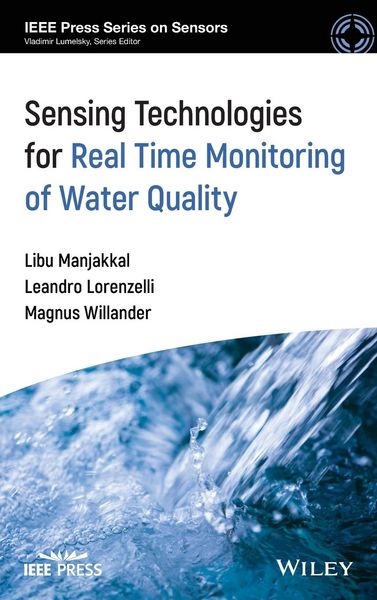
Sensing Technologies for Real Time Monitoring of Water Quality
Aus der Reihe
IEEE Press Series on Sensors
-
- Englisch ausgewählt
Fr. 173.00
inkl. gesetzl. MwSt.,
Beschreibung
Produktdetails
Einband
Gebundene Ausgabe
Erscheinungsdatum
07.08.2023
Herausgeber
Libu Manjakkal + weitereVerlag
John Wiley & SonsSeitenzahl
384
Maße (L/B/H)
23.5/15.7/2.5 cm
Gewicht
708 g
Auflage
1. Auflage
Sprache
Englisch
ISBN
978-1-119-77581-2
Sensing Technologies for Real Time Monitoring of Water Quality
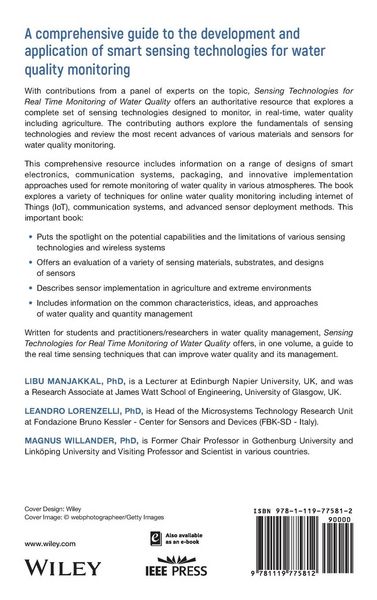
A comprehensive guide to the development and application of smart sensing technologies for water quality monitoring
With contributions from a panel of experts on the topic, Sensing Technologies for Real Time Monitoring of Water Quality offers an authoritative resource that explores a complete set of sensing technologies designed to monitor, in real-time, water quality including agriculture. The contributing authors explore the fundamentals of sensing technologies and review the most recent advances of various materials and sensors for water quality??monitoring.
This comprehensive resource includes information on a range of designs of smart electronics, communication systems, packaging, and innovative implementation approaches used for remote monitoring of water quality in various atmospheres. The book explores a variety of techniques for online water quality monitoring including internet of Things (IoT), communication systems, and advanced sensor deployment methods. This important book:
* Puts the spotlight on the potential capabilities and the limitations of various sensing technologies and wireless systems
* Offers an evaluation of a variety of sensing materials, substrates, and designs of sensors
* Describes sensor implementation in agriculture and extreme environments
* Includes information on the common characteristics, ideas, and approaches of water quality and quantity management
Written for students and practitioners/researchers in water quality management, Sensing Technologies for Real Time Monitoring of Water Quality offers, in one volume, a guide to the real time sensing techniques that can improve water quality and its management.
A comprehensive guide to the development and application of smart sensing technologies for water quality monitoring
With contributions from a panel of experts on the topic, Sensing Technologies for Real Time Monitoring of Water Quality offers an authoritative resource that explores a complete set of sensing technologies designed to monitor, in real-time, water quality including agriculture. The contributing authors explore the fundamentals of sensing technologies and review the most recent advances of various materials and sensors for water quality??monitoring.
This comprehensive resource includes information on a range of designs of smart electronics, communication systems, packaging, and innovative implementation approaches used for remote monitoring of water quality in various atmospheres. The book explores a variety of techniques for online water quality monitoring including internet of Things (IoT), communication systems, and advanced sensor deployment methods. This important book:
* Puts the spotlight on the potential capabilities and the limitations of various sensing technologies and wireless systems
* Offers an evaluation of a variety of sensing materials, substrates, and designs of sensors
* Describes sensor implementation in agriculture and extreme environments
* Includes information on the common characteristics, ideas, and approaches of water quality and quantity management
Written for students and practitioners/researchers in water quality management, Sensing Technologies for Real Time Monitoring of Water Quality offers, in one volume, a guide to the real time sensing techniques that can improve water quality and its management.
Noch keine Bewertungen vorhanden
Verfassen Sie die erste Bewertung zu diesem Artikel
Helfen Sie anderen Kundinnen und Kunden durch Ihre Meinung.